OCR · A-Level · Chemistry
Course version: H432 · Version from Sept 2017
Amount of substance: (iii) solution volume and concentration
This sub-topic links the volume of a solution to its concentration and the amount of solute in moles.
- Point 14 of 21
- 4 key terms
Study notes
From the teaching notes for this specification point.
The idea
This sub-topic links the volume of a solution to its concentration and the amount of solute in moles. Concentration is the amount of solute per unit volume of solution, commonly expressed in mol dm⁻³, so a solution of concentration c and volume V contains n = c × V moles of solute, provided V is converted to dm³. Because 1 dm³ = 1000 cm³, a volume in cm³ is divided by 1000 before use, so 250 cm³ becomes 0.250 dm³. A 0.100 mol dm⁻³ solution in 250 cm³ therefore contains 0.100 × 0.250 = 0.0250 mol. Rearranging gives c = n ÷ V and V = n ÷ c. When a solution is diluted by adding solvent, the amount of solute stays the same, so c₁V₁ = c₂V₂. Questions test unit conversion, rearrangement and the distinction between amount in moles and concentration.
What earns the marks
- Converts a volume in cm³ to dm³ by dividing by 1000 before substituting into n = c × V.
- Calculates the amount of solute in moles as concentration multiplied by volume in dm³.
- Rearranges the relationship to find concentration as moles divided by volume, or volume as moles divided by concentration.
- Applies c₁V₁ = c₂V₂ to a dilution, recognising that the amount of solute is unchanged when solvent is added.
- Distinguishes concentration in mol dm⁻³ from amount in moles and reports each with a correct unit.
Common mistakes and how to put them right
Substitutes a volume in cm³ directly into n = c × V without converting to dm³.
Put it right: Divide the volume by 1000 first.
Confuses concentration with amount in moles and reports moles where mol dm⁻³ is required.
Put it right: Check which quantity the question asks for.
Adds volumes incorrectly during a dilution and assumes the moles change.
Put it right: Keep the moles constant and use c₁V₁ = c₂V₂.
Exam tips
- Write the unit conversion as an explicit step so the marker can see the volume in dm³ before substitution.
- State the rearranged equation before substituting numbers to reduce arithmetic slips.
- Check the final unit against the quantity requested, mol dm⁻³ for concentration and mol for amount.
Try the lesson
The start of the Amount of substance: (iii) solution volume and concentration lesson, made from teaching notes for this specification point.
Listen
This sub-topic links the volume of a solution to its concentration and the amount of solute in moles. Concentration is the amount of solute per unit volume of solution, commonly expressed in mol dm⁻³, so a solution of concentration c and volume V contains n = c × V moles of solute, provided V is converted to dm³. Because 1 dm³ = 1000 cm³, a volume in cm³ is divided by 1000 before use, so 250 cm³ becomes 0.250 dm³. A 0.100 mol dm⁻³ solution in 250 cm³ therefore contains 0.100 × 0.250 = 0.0250 mol. Rearranging gives c = n ÷ V and V = n ÷ c. When a solution is diluted by adding solvent, the amount of solute stays the same, so c₁V₁ = c₂V₂. Questions test unit conversion, rearrangement and the distinction between amount in moles and concentration. A strong answer earns marks for these points. Converts a volume in cm³ to dm³ by dividing by 1000 before substituting into n = c × V. Calculates the amount of solute in moles as concentration multiplied by volume in dm³. Rearranges the relationship to find concentration as moles divided by volume, or volume as moles divided by concentration. Applies c₁V₁ = c₂V₂ to a dilution, recognising that the amount of solute is unchanged when solvent is added. Exam tip: Write the unit conversion as an explicit step so the marker can see the volume in dm³ before substitution.
See it
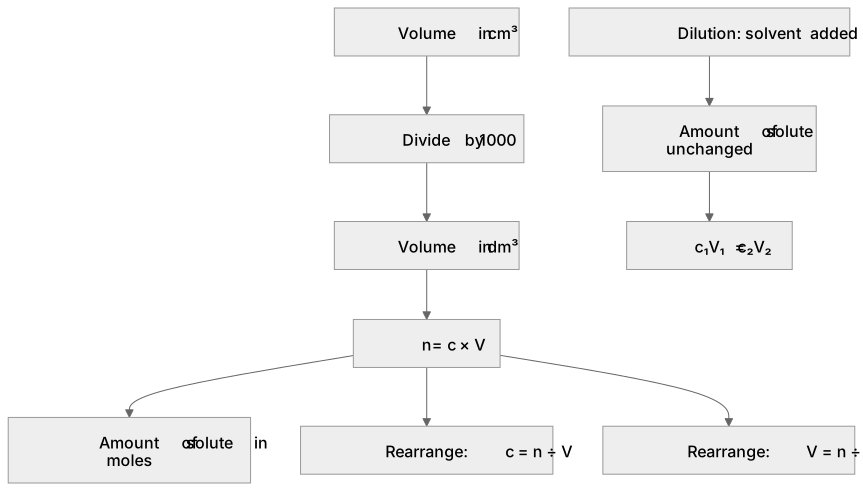
Key words
Say what each word means before you turn the card.
Relationship between amount, concentration and volume
Try answering aloud or in your head before turning the card.
Unit conversion between cm³ and dm³
Try answering aloud or in your head before turning the card.
Rearranging equations
Try answering aloud or in your head before turning the card.
Dilution and conservation of solute amount
Try answering aloud or in your head before turning the card.
See every definition
- Relationship between amount, concentration and volume
- A solution of concentration c and volume V contains n = c × V moles of solute, provided V is converted to dm³.
- Unit conversion between cm³ and dm³
- Because 1 dm³ = 1000 cm³, a volume in cm³ is divided by 1000 before use, so 250 cm³ becomes 0.250 dm³.
- Rearranging equations
- Rearranging gives c = n ÷ V and V = n ÷ c.
- Dilution and conservation of solute amount
- When a solution is diluted by adding solvent, the amount of solute stays the same, so c₁V₁ = c₂V₂.
Label the diagram
Some boxes have lost their names. Pick the right name for each number.
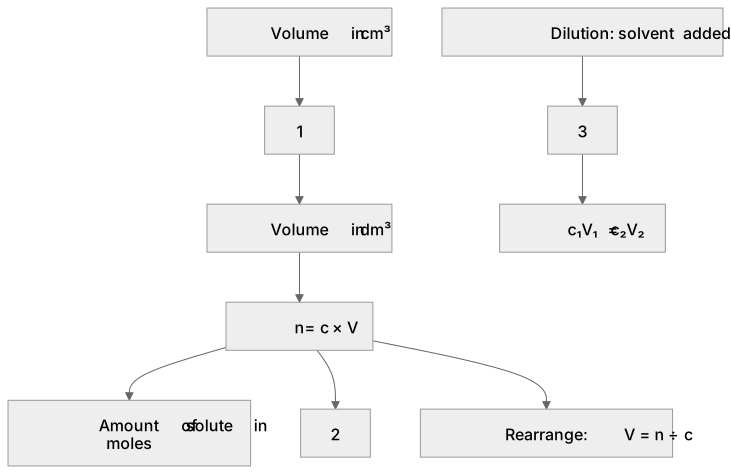
1Box 1
2Box 2
3Box 3
There is more to this lesson
The full lesson goes on to check your understanding and help you earn the marks. Create a free account to carry on, with your progress saved.
A week of Premium from your first lesson · Then the free plan continues · No card, no charge
Test your understanding of Amount of substance: (iii) solution volume and concentration
Active recall beats re-reading. Take an instant quiz now to test what you’ve learned and lock it into long-term memory.
A week of Premium from your first lesson · Then the free plan continues · No card, no charge