OCR · A-Level · Chemistry
Course version: H432 · Version from Sept 2017
(b) use of appropriate mathematical skills for analysis of quantitative data
Full specification wording
Analysis: (b) use of appropriate mathematical skills for analysis of quantitative data
Quantitative analysis in chemistry depends on selecting and applying the right mathematical tool.
- Point 1 of 4
- 4 key terms
Study notes
From the teaching notes for this specification point.
The idea
Quantitative analysis in chemistry depends on selecting and applying the right mathematical tool. Learners must choose appropriate skills such as calculating moles from mass and molar mass (n = m ÷ M), using concentration and volume (n = c × V, with V in dm³), applying the ideal gas equation (pV = nRT with consistent units), handling percentage yield and atom economy, and processing titration data. They must also work with significant figures, standard form, ratios and unit conversions, for example converting 25.0 cm³ to 0.0250 dm³ before using n = c × V. Choosing the correct relationship, substituting values with matching units, and rounding the final answer to an appropriate number of significant figures are all part of the skill.
What earns the marks
- Selects the relationship that matches the quantities given, such as n = c × V for a solution of known concentration and volume.
- Converts units consistently before substitution, for example changing cm³ to dm³ so that concentration in mol dm⁻³ is compatible.
- Substitutes values correctly into the chosen equation and evaluates the result accurately.
- Rounds the final answer to an appropriate number of significant figures consistent with the data.
- Uses standard form and correct powers of ten when handling very large or very small quantities.
Common mistakes and how to put them right
Uses volume in cm³ directly in n = c × V.
Put it right: Convert to dm³ first so the units match the concentration.
Rounds intermediate values too early and carries the error forward.
Put it right: Keep full precision until the final answer.
Selects an equation that does not match the quantities given.
Put it right: Check which variables are known before choosing a relationship.
Ignores significant figures and reports an over-precise answer.
Put it right: Round to match the precision of the input data.
Exam tips
- Write down the known quantities with units before choosing an equation.
- Convert all units to a consistent set before substituting into the formula.
- Check the final answer against the expected order of magnitude to catch unit slips.
Try the lesson
The start of the Analysis: (b) use of appropriate mathematical skills for analysis of quantitative data lesson, made from teaching notes for this specification point.
Listen
Quantitative analysis in chemistry depends on selecting and applying the right mathematical tool. Learners must choose appropriate skills such as calculating moles from mass and molar mass (n = m ÷ M), using concentration and volume (n = c × V, with V in dm³), applying the ideal gas equation (pV = nRT with consistent units), handling percentage yield and atom economy, and processing titration data. They must also work with significant figures, standard form, ratios and unit conversions, for example converting 25.0 cm³ to 0.0250 dm³ before using n = c × V. Choosing the correct relationship, substituting values with matching units, and rounding the final answer to an appropriate number of significant figures are all part of the skill. A strong answer earns marks for these points. Selects the relationship that matches the quantities given, such as n = c × V for a solution of known concentration and volume. Converts units consistently before substitution, for example changing cm³ to dm³ so that concentration in mol dm⁻³ is compatible. Substitutes values correctly into the chosen equation and evaluates the result accurately. Rounds the final answer to an appropriate number of significant figures consistent with the data. Exam tip: Write down the known quantities with units before choosing an equation.
See it
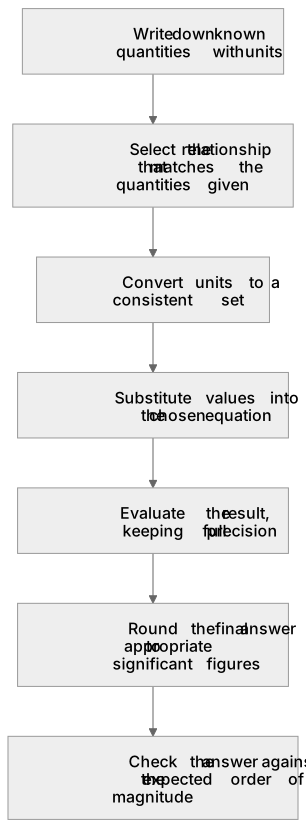
Put it in order
Put these steps in the order they happen.
- 1. Check the answer against the expected order of magnitude
- 2. Round the final answer to appropriate significant figures
- 3. Convert units to a consistent set
- 4. Evaluate the result, keeping full precision
- 5. Write down known quantities with units
- 6. Select the relationship that matches the quantities given
- 7. Substitute values into the chosen equation
Key words
Say what each word means before you turn the card.
Selecting the correct mathematical relationship
Try answering aloud or in your head before turning the card.
Consistent unit conversion
Try answering aloud or in your head before turning the card.
Accurate substitution and evaluation
Try answering aloud or in your head before turning the card.
Significant figures and standard form
Try answering aloud or in your head before turning the card.
See every definition
- Selecting the correct mathematical relationship
- Choosing the relationship that matches the quantities given, such as n = c × V for a solution of known concentration and volume.
- Consistent unit conversion
- Converting units consistently before substitution, for example changing cm³ to dm³ so that concentration in mol dm⁻³ is compatible.
- Accurate substitution and evaluation
- Substituting values correctly into the chosen equation and evaluating the result accurately.
- Significant figures and standard form
- Rounding the final answer to an appropriate number of significant figures consistent with the data, and using standard form and correct powers of ten for very large or very small quantities.
Label the diagram
Some boxes have lost their names. Pick the right name for each number.
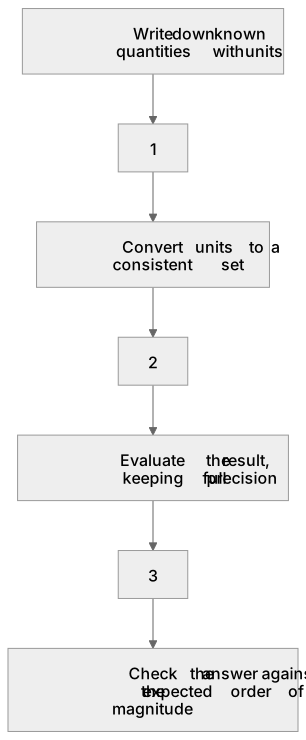
1Box 1
2Box 2
3Box 3
There is more to this lesson
The full lesson goes on to check your understanding and help you earn the marks. Create a free account to carry on, with your progress saved.
A week of Premium from your first lesson · Then the free plan continues · No card, no charge
Test your understanding of Analysis: (b) use of appropriate mathematical skills for analysis of quantitative data
Active recall beats re-reading. Take an instant quiz now to test what you’ve learned and lock it into long-term memory.
A week of Premium from your first lesson · Then the free plan continues · No card, no charge