OCR · A-Level · Chemistry
Course version: H432 · Version from Sept 2017
(iii) a carboxylic acid from an absorption peak of the C=O bond and a…
Full specification wording
Analytical techniques: (iii) a carboxylic acid from an absorption peak of the C=O bond and a broad absorption peak of the O–H bond
A carboxylic acid shows two diagnostic infrared features together.
- Point 6 of 13
- 4 key terms
Study notes
From the teaching notes for this specification point.
The idea
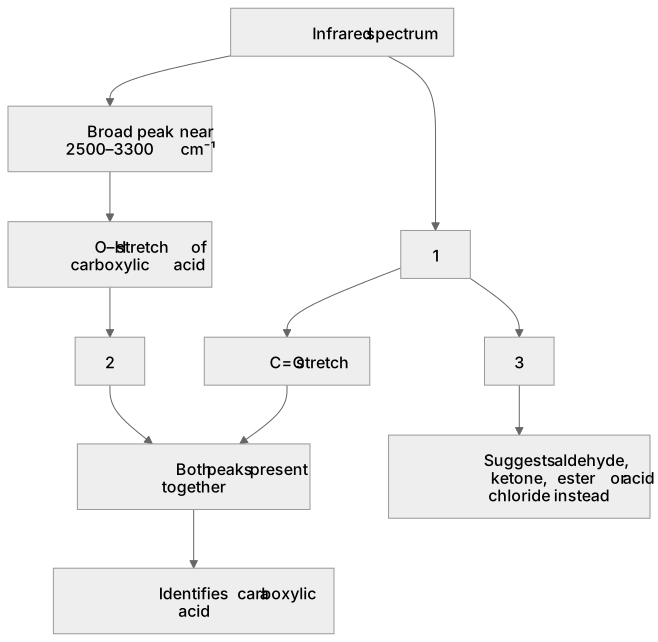
A carboxylic acid shows two diagnostic infrared features together. The C=O bond absorbs strongly and sharply around 1680–1750 cm⁻¹, and the O–H bond of the carboxyl group absorbs broadly around 2500–3300 cm⁻¹ because of hydrogen bonding. The breadth of that O–H absorption is the key clue: it is much wider than the sharper O–H stretch of an alcohol, which appears around 3230–3550 cm⁻¹. To identify a carboxylic acid, confirm both peaks are present and note the broad shape of the O–H signal. A spectrum showing only a C=O peak suggests an aldehyde, ketone, ester or acid chloride instead, so the pair of absorptions together is what supports the identification.
What earns the marks
- Identifies a strong sharp absorption near 1680–1750 cm⁻¹ as the C=O stretch.
- Identifies a broad absorption near 2500–3300 cm⁻¹ as the O–H stretch of a carboxylic acid.
- Explains that the breadth of the O–H peak results from hydrogen bonding in the carboxyl group.
- States that both the C=O and the broad O–H peaks must be present together to identify a carboxylic acid.
Common mistakes and how to put them right
Treats a single C=O peak as proof of a carboxylic acid.
Put it right: Require the broad O–H absorption as well before concluding.
Confuses the broad carboxylic acid O–H absorption with the sharper alcohol O–H absorption.
Put it right: Compare the width and wavenumber range of each peak.
Describes the O–H peak as sharp.
Put it right: Recognise that hydrogen bonding makes this absorption broad.
Exam tips
- Give both wavenumber ranges, one for C=O and one for the broad O–H, to show full identification.
- Comment on the breadth of the O–H peak, since shape distinguishes a carboxylic acid from an alcohol.
- Explain that hydrogen bonding causes the broadening rather than merely stating that the peak is broad.
Try the lesson
The start of the Analytical techniques: (iii) a carboxylic acid from an absorption peak of the C=O bond and a broad absorption peak of the O–H bond lesson, made from teaching notes for this specification point.
Listen
A carboxylic acid shows two diagnostic infrared features together. The C=O bond absorbs strongly and sharply around 1680–1750 cm⁻¹, and the O–H bond of the carboxyl group absorbs broadly around 2500–3300 cm⁻¹ because of hydrogen bonding. The breadth of that O–H absorption is the key clue: it is much wider than the sharper O–H stretch of an alcohol, which appears around 3230–3550 cm⁻¹. To identify a carboxylic acid, confirm both peaks are present and note the broad shape of the O–H signal. A spectrum showing only a C=O peak suggests an aldehyde, ketone, ester or acid chloride instead, so the pair of absorptions together is what supports the identification. A strong answer earns marks for these points. Identifies a strong sharp absorption near 1680–1750 cm⁻¹ as the C=O stretch. Identifies a broad absorption near 2500–3300 cm⁻¹ as the O–H stretch of a carboxylic acid. Explains that the breadth of the O–H peak results from hydrogen bonding in the carboxyl group. States that both the C=O and the broad O–H peaks must be present together to identify a carboxylic acid. Exam tip: Give both wavenumber ranges, one for C=O and one for the broad O–H, to show full identification.
See it
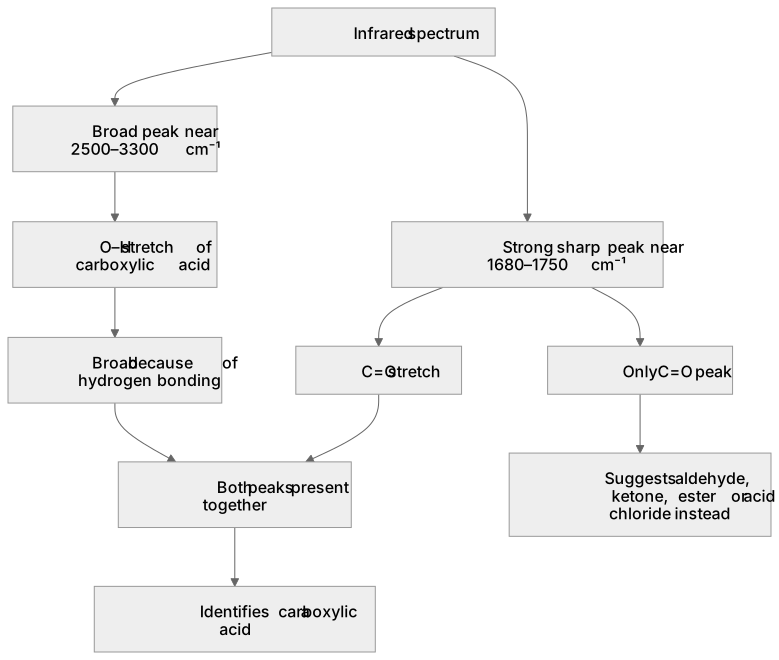
Key words
Say what each word means before you turn the card.
C=O absorption peak
Try answering aloud or in your head before turning the card.
Broad O–H absorption peak
Try answering aloud or in your head before turning the card.
Effect of hydrogen bonding on peak shape
Try answering aloud or in your head before turning the card.
Combined C=O and O–H evidence
Try answering aloud or in your head before turning the card.
See every definition
- C=O absorption peak
- A strong sharp absorption near 1680–1750 cm⁻¹ that is one of the two diagnostic infrared features of a carboxylic acid.
- Broad O–H absorption peak
- A broad absorption near 2500–3300 cm⁻¹ from the O–H bond of the carboxyl group, broadened because of hydrogen bonding.
- Effect of hydrogen bonding on peak shape
- Hydrogen bonding in the carboxyl group makes the O–H absorption broad, much wider than the sharper O–H stretch of an alcohol.
- Combined C=O and O–H evidence
- Both the C=O peak and the broad O–H peak must be present together to identify a carboxylic acid, since a single C=O peak suggests an aldehyde, ketone, ester or acid chloride instead.
Label the diagram
Some boxes have lost their names. Pick the right name for each number.
1Box 1
2Box 2
3Box 3
There is more to this lesson
The full lesson goes on to check your understanding and help you earn the marks. Create a free account to carry on, with your progress saved.
A week of Premium from your first lesson · Then the free plan continues · No card, no charge
Test your understanding of Analytical techniques: (iii) a carboxylic acid from an absorption peak of the C=O bond and a broad absorption peak of the O–H bond
Active recall beats re-reading. Take an instant quiz now to test what you’ve learned and lock it into long-term memory.
A week of Premium from your first lesson · Then the free plan continues · No card, no charge