OCR · A-Level · Chemistry
Course version: H432 · Version from Sept 2017
(d) interpretations and predictions of an infrared spectrum of familiar or…
Full specification wording
Analytical techniques: (d) interpretations and predictions of an infrared spectrum of familiar or unfamiliar substances using supplied data
Infrared spectroscopy identifies bonds by the wavenumber at which they absorb.
- Point 7 of 13
- 4 key terms
Study notes
From the teaching notes for this specification point.
The idea
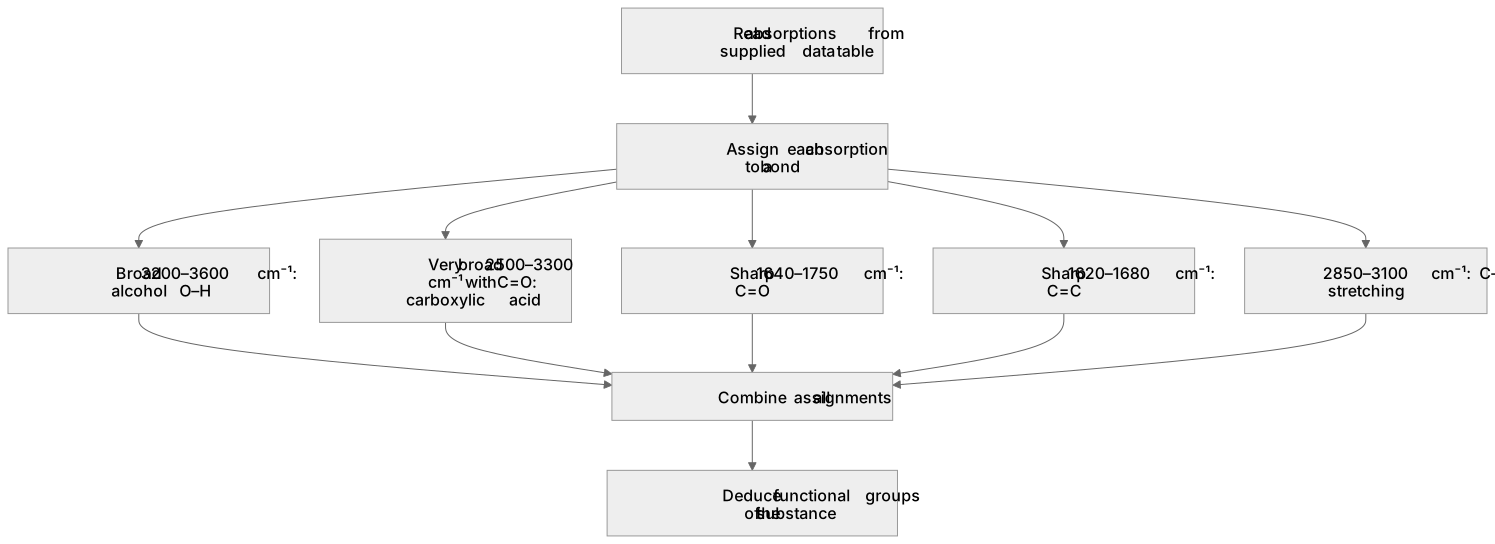
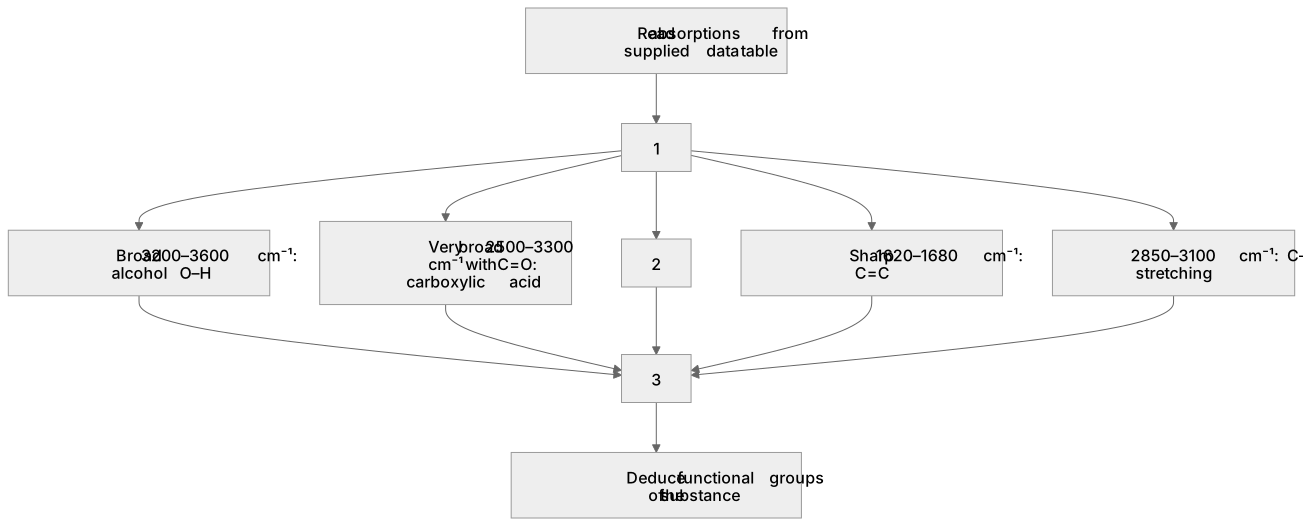
Infrared spectroscopy identifies bonds by the wavenumber at which they absorb. Use the supplied data table rather than memory. A broad absorption around 3200–3600 cm⁻¹ indicates an alcohol O–H bond; a very broad absorption around 2500–3300 cm⁻¹ indicates the O–H of a carboxylic acid, often with a C=O near 1680–1750 cm⁻¹. A sharp absorption near 1640–1750 cm⁻¹ indicates C=O, and a sharp absorption near 1620–1680 cm⁻¹ indicates C=C. Absorptions around 2850–3100 cm⁻¹ indicate C–H stretching. To interpret, list the absorptions present, assign each using the table, then combine the assignments into a structure. To predict, work from a proposed structure and state which absorptions it must show and which it must lack. An unfamiliar substance is handled the same way: read the supplied data, assign peaks, and deduce functional groups.
What earns the marks
- Reads absorptions from the supplied infrared data table and assigns each to a bond or functional group.
- Uses a broad absorption around 3200–3600 cm⁻¹ to identify an alcohol O–H group.
- Uses a very broad absorption around 2500–3300 cm⁻¹ together with a C=O absorption to identify a carboxylic acid.
- Combines several peak assignments to deduce the functional groups present in an unfamiliar substance.
- Predicts the absorptions a proposed structure would show and checks them against the spectrum.
Common mistakes and how to put them right
Assigns a broad absorption around 2500–3300 cm⁻¹ to an alcohol O–H group.
Put it right by assigning alcohol O–H to about 3200–3600 cm⁻¹ and carboxylic acid O–H to about 2500–3300 cm⁻¹.
Identifies a substance from a single absorption without checking the rest of the spectrum.
Put it right by combining all assignments before deducing the structure.
Ignores the supplied data table and relies on memorised values.
Put it right by reading the wavenumber ranges from the data provided.
Exam tips
- Quote the wavenumber range from the supplied table for each absorption you assign.
- State both the bond and the functional group, for example a broad O–H absorption indicating an alcohol.
- Check that your deduced structure accounts for every significant absorption and for the absence of expected ones.
Try the lesson
The start of the Analytical techniques: (d) interpretations and predictions of an infrared spectrum of familiar or unfamiliar substances using supplied data lesson, made from teaching notes for this specification point.
Listen
Infrared spectroscopy identifies bonds by the wavenumber at which they absorb. Use the supplied data table rather than memory. A broad absorption around 3200–3600 cm⁻¹ indicates an alcohol O–H bond; a very broad absorption around 2500–3300 cm⁻¹ indicates the O–H of a carboxylic acid, often with a C=O near 1680–1750 cm⁻¹. A sharp absorption near 1640–1750 cm⁻¹ indicates C=O, and a sharp absorption near 1620–1680 cm⁻¹ indicates C=C. Absorptions around 2850–3100 cm⁻¹ indicate C–H stretching. To interpret, list the absorptions present, assign each using the table, then combine the assignments into a structure. To predict, work from a proposed structure and state which absorptions it must show and which it must lack. An unfamiliar substance is handled the same way: read the supplied data, assign peaks, and deduce functional groups. A strong answer earns marks for these points. Reads absorptions from the supplied infrared data table and assigns each to a bond or functional group. Uses a broad absorption around 3200–3600 cm⁻¹ to identify an alcohol O–H group. Uses a very broad absorption around 2500–3300 cm⁻¹ together with a C=O absorption to identify a carboxylic acid. Combines several peak assignments to deduce the functional groups present in an unfamiliar substance. A common slip: Assigns a broad absorption around 2500–3300 cm⁻¹ to an alcohol O–H group. Instead, assigning alcohol O–H to about 3200–3600 cm⁻¹ and carboxylic acid O–H to about 2500–3300 cm⁻¹. Exam tip: Quote the wavenumber range from the supplied table for each absorption you assign.
See it
Key words
Say what each word means before you turn the card.
Infrared absorptions of O–H, C=O, C=C and C–H bonds
Try answering aloud or in your head before turning the card.
Distinguishing alcohols from carboxylic acids
Try answering aloud or in your head before turning the card.
Deducing functional groups from supplied data
Try answering aloud or in your head before turning the card.
Predicting spectra from structures
Try answering aloud or in your head before turning the card.
See every definition
- Infrared absorptions of O–H, C=O, C=C and C–H bonds
- Bonds are identified by the wavenumber at which they absorb, using the supplied data table rather than memory.
- Distinguishing alcohols from carboxylic acids
- A broad absorption around 3200–3600 cm⁻¹ indicates an alcohol O–H bond, whereas a very broad absorption around 2500–3300 cm⁻¹ indicates the O–H of a carboxylic acid, often with a C=O near 1680–1750 cm⁻¹.
- Deducing functional groups from supplied data
- List the absorptions present, assign each using the table, then combine the assignments into a structure.
- Predicting spectra from structures
- Work from a proposed structure and state which absorptions it must show and which it must lack.
Label the diagram
Some boxes have lost their names. Pick the right name for each number.
1Box 1
2Box 2
3Box 3
There is more to this lesson
The full lesson goes on to check your understanding and help you earn the marks. Create a free account to carry on, with your progress saved.
A week of Premium from your first lesson · Then the free plan continues · No card, no charge
Test your understanding of Analytical techniques: (d) interpretations and predictions of an infrared spectrum of familiar or unfamiliar substances using supplied data
Active recall beats re-reading. Take an instant quiz now to test what you’ve learned and lock it into long-term memory.
A week of Premium from your first lesson · Then the free plan continues · No card, no charge