OCR · A-Level · Chemistry
Course version: H432 · Version from Sept 2017
(f) the explanation of the relative resistance to bromination of benzene,…
Full specification wording
Aromatic compounds: (f) the explanation of the relative resistance to bromination of benzene, compared with alkenes, in terms of the delocalised electron density of the π-system in benzene compared with the localised electron density of the π-bond in alkenes (see also 4.1.3 a, 6.1.1 a)
Benzene resists bromination compared with an alkene because its six π electrons are delocalised over the whole ring, so the π electron density at any one carbon is lower than the localised density…
- Point 8 of 16
- 4 key terms
Study notes
From the teaching notes for this specification point.
The idea
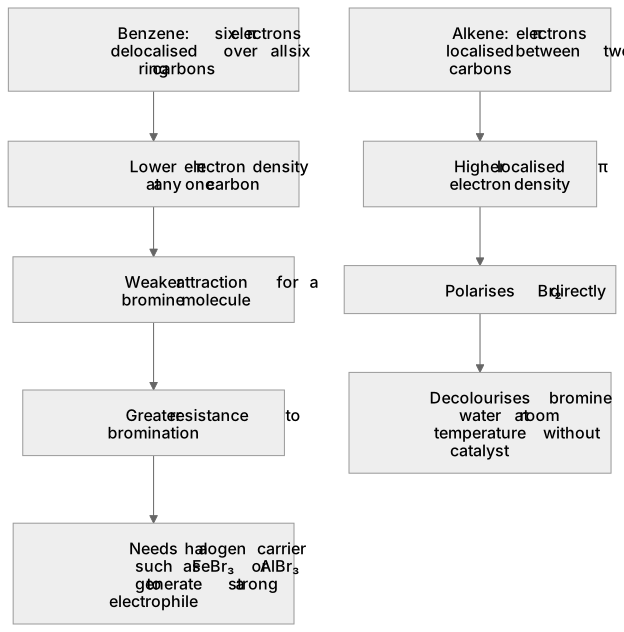
Benzene resists bromination compared with an alkene because its six π electrons are delocalised over the whole ring, so the π electron density at any one carbon is lower than the localised density of the π bond in an alkene such as ethene. Lower electron density means the ring is less able to induce a dipole in, and attract, a bromine molecule, so benzene needs a halogen carrier such as FeBr₃ or AlBr₃ to generate a strong electrophile (Br⁺-type). An alkene's localised π bond polarises Br₂ directly and decolourises bromine water at room temperature without a catalyst.
What earns the marks
- States that benzene's π electrons are delocalised over all six carbon atoms of the ring.
- States that an alkene's π electrons are localised between two carbon atoms.
- Explains that delocalisation gives lower π electron density at any one carbon in benzene than the localised density in an alkene.
- Links lower electron density in benzene to weaker attraction for a bromine molecule and hence greater resistance to bromination.
- States that benzene requires a halogen carrier such as FeBr₃ or AlBr₃ to react with bromine, whereas an alkene reacts directly.
Common mistakes and how to put them right
Claims that benzene has no π electrons.
Put it right by stating that benzene has six delocalised π electrons.
Says benzene is more reactive because delocalisation stabilises it.
Put it right by explaining that the same delocalisation lowers electron density and so reduces attraction for bromine.
States that benzene needs heat to react with bromine.
Put it right by noting that with a halogen carrier such as FeBr₃ or AlBr₃ bromination proceeds at room temperature.
Confuses the localised π bond of an alkene with a delocalised system.
Put it right by keeping the alkene's π electrons localised between two carbons.
Exam tips
- Compare electron density explicitly: delocalised over six carbons versus localised between two carbons.
- Name the halogen carrier (FeBr₃ or AlBr₃) when explaining how benzene is brominated.
- Use the term 'localised' for the alkene π bond and 'delocalised' for the benzene π system to show the contrast.
Try the lesson
The start of the Aromatic compounds: (f) the explanation of the relative resistance to bromination of benzene, compared with alkenes, in terms of the delocalised electron density of the π-system in benzene compared with the localised electron density of the π-bond in alkenes (see also 4.1.3 a, 6.1.1 a) lesson, made from teaching notes for this specification point.
Listen
Benzene resists bromination compared with an alkene because its six π electrons are delocalised over the whole ring, so the π electron density at any one carbon is lower than the localised density of the π bond in an alkene such as ethene. Lower electron density means the ring is less able to induce a dipole in, and attract, a bromine molecule, so benzene needs a halogen carrier such as FeBr₃ or AlBr₃ to generate a strong electrophile (Br⁺-type). An alkene's localised π bond polarises Br₂ directly and decolourises bromine water at room temperature without a catalyst. A strong answer earns marks for these points. States that benzene's π electrons are delocalised over all six carbon atoms of the ring. States that an alkene's π electrons are localised between two carbon atoms. Explains that delocalisation gives lower π electron density at any one carbon in benzene than the localised density in an alkene. Links lower electron density in benzene to weaker attraction for a bromine molecule and hence greater resistance to bromination. A common slip: Claims that benzene has no π electrons. Instead, stating that benzene has six delocalised π electrons. Exam tip: Compare electron density explicitly: delocalised over six carbons versus localised between two carbons.
See it
Key words
Say what each word means before you turn the card.
Delocalised π system in benzene
Try answering aloud or in your head before turning the card.
Localised π bond in alkenes
Try answering aloud or in your head before turning the card.
π electron density and electrophilic attack
Try answering aloud or in your head before turning the card.
Halogen carrier in benzene bromination
Try answering aloud or in your head before turning the card.
See every definition
- Delocalised π system in benzene
- Benzene's six π electrons are delocalised over all six carbon atoms of the ring, giving lower π electron density at any one carbon.
- Localised π bond in alkenes
- An alkene's π electrons are localised between two carbon atoms, giving a localised electron density.
- π electron density and electrophilic attack
- Lower π electron density in benzene means weaker attraction for a bromine molecule, so the ring is less able to induce a dipole in, and attract, bromine.
- Halogen carrier in benzene bromination
- Benzene needs a halogen carrier such as FeBr₃ or AlBr₃ to generate a strong electrophile, whereas an alkene reacts directly.
Label the diagram
Some boxes have lost their names. Pick the right name for each number.
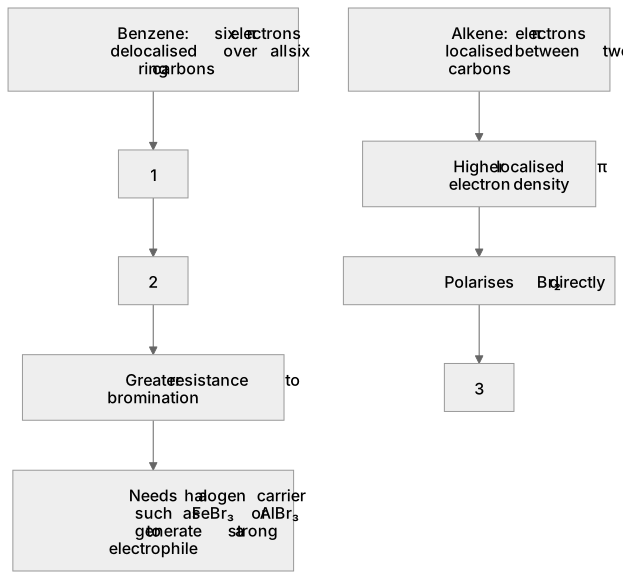
1Box 1
2Box 2
3Box 3
There is more to this lesson
The full lesson goes on to check your understanding and help you earn the marks. Create a free account to carry on, with your progress saved.
A week of Premium from your first lesson · Then the free plan continues · No card, no charge
Test your understanding of Aromatic compounds: (f) the explanation of the relative resistance to bromination of benzene, compared with alkenes, in terms of the delocalised electron density of the π-system in benzene compared with the localised electron density of the π-bond in alkenes (see also 4.1.3 a, 6.1.1 a)
Active recall beats re-reading. Take an instant quiz now to test what you’ve learned and lock it into long-term memory.
A week of Premium from your first lesson · Then the free plan continues · No card, no charge