OCR · A-Level · Chemistry
Course version: H432 · Version from Sept 2017
(g) the interpretation of unfamiliar electrophilic substitution reactions…
Full specification wording
Aromatic compounds: (g) the interpretation of unfamiliar electrophilic substitution reactions of aromatic compounds, including prediction of mechanisms
When an unfamiliar aromatic compound reacts with an electrophile, you can predict the mechanism by applying the general electrophilic substitution pattern.
- Point 9 of 16
- 3 key terms
Study notes
From the teaching notes for this specification point.
The idea
When an unfamiliar aromatic compound reacts with an electrophile, you can predict the mechanism by applying the general electrophilic substitution pattern. First identify the electrophile, often generated from a reagent by a catalyst such as FeBr₃, AlCl₃ or concentrated H₂SO₄. Then draw the ring with its delocalised π-system, show the electrophile attacking a ring carbon to form a positively charged intermediate (a Wheland-type intermediate) in which the delocalisation is temporarily broken, and show a proton being lost to restore the aromatic ring. The product keeps the ring and gains the substituent. Use curly arrows from the π-system to the electrophile and from the C–H bond to reform the π-system. Apply the same logic to unfamiliar substituents and reagents, checking charges and lone pairs at each step.
What earns the marks
- Identifies the electrophile in the unfamiliar reaction and states how the reagent and catalyst generate it.
- Draws the aromatic ring with its delocalised π-system and shows the electrophile attacking a ring carbon using a curly arrow from the π electrons.
- Shows the positively charged intermediate formed when the electrophile bonds to the ring, recognising that delocalisation is temporarily disrupted.
- Shows loss of a proton from the intermediate to restore the aromatic ring and give the substituted product.
- Applies the general pattern to an unfamiliar substituent or reagent, keeping charges, lone pairs and curly arrows consistent at each step.
Common mistakes and how to put them right
Draws an addition product in which the ring loses its delocalisation permanently.
Put it right by showing substitution, with a proton lost to restore the aromatic ring.
Omits the positively charged intermediate.
Put it right by showing the ring carbon bearing the electrophile as positively charged before the proton is lost.
Uses a curly arrow from a C–H σ bond to the electrophile instead of from the π-system.
Put it right by starting the attack arrow at the π electrons.
Fails to identify the electrophile and instead shows the whole reagent molecule attacking.
Put it right by naming the electrophile generated by the catalyst.
Exam tips
- Name the electrophile explicitly before drawing the mechanism, for example the bromonium-like Br⁺ generated with FeBr₃.
- Show curly arrows from the π-system to the electrophile and from the C–H bond to reform the ring, and check that every arrow starts at a lone pair or bond.
- For unfamiliar compounds, apply the same three stages: attack, positively charged intermediate, loss of proton.
Try the lesson
The start of the Aromatic compounds: (g) the interpretation of unfamiliar electrophilic substitution reactions of aromatic compounds, including prediction of mechanisms lesson, made from teaching notes for this specification point.
Listen
When an unfamiliar aromatic compound reacts with an electrophile, you can predict the mechanism by applying the general electrophilic substitution pattern. First identify the electrophile, often generated from a reagent by a catalyst such as FeBr₃, AlCl₃ or concentrated H₂SO₄. Then draw the ring with its delocalised π-system, show the electrophile attacking a ring carbon to form a positively charged intermediate (a Wheland-type intermediate) in which the delocalisation is temporarily broken, and show a proton being lost to restore the aromatic ring. The product keeps the ring and gains the substituent. Use curly arrows from the π-system to the electrophile and from the C–H bond to reform the π-system. Apply the same logic to unfamiliar substituents and reagents, checking charges and lone pairs at each step. A strong answer earns marks for these points. Identifies the electrophile in the unfamiliar reaction and states how the reagent and catalyst generate it. Draws the aromatic ring with its delocalised π-system and shows the electrophile attacking a ring carbon using a curly arrow from the π electrons. Shows the positively charged intermediate formed when the electrophile bonds to the ring, recognising that delocalisation is temporarily disrupted. Shows loss of a proton from the intermediate to restore the aromatic ring and give the substituted product. A common slip: Draws an addition product in which the ring loses its delocalisation permanently. Instead, showing substitution, with a proton lost to restore the aromatic ring. Exam tip: Name the electrophile explicitly before drawing the mechanism, for example the bromonium-like Br⁺ generated with FeBr₃.
See it
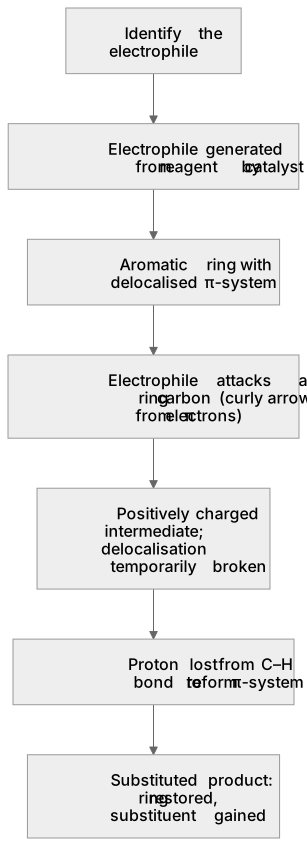
Put it in order
Put these steps in the order they happen.
- 1. Substituted product: ring restored, substituent gained
- 2. Proton lost from C–H bond to reform π-system
- 3. Aromatic ring with delocalised π-system
- 4. Positively charged intermediate; delocalisation temporarily broken
- 5. Identify the electrophile
- 6. Electrophile generated from reagent by catalyst
- 7. Electrophile attacks a ring carbon (curly arrow from π electrons)
Key words
Say what each word means before you turn the card.
Electrophilic substitution mechanism
Try answering aloud or in your head before turning the card.
Generation of electrophiles by catalysts
Try answering aloud or in your head before turning the card.
Applying general patterns to unfamiliar aromatic reactions
Try answering aloud or in your head before turning the card.
See every definition
- Electrophilic substitution mechanism
- The general pattern in which an electrophile attacks a ring carbon of the delocalised π-system, a positively charged intermediate forms, and a proton is lost to restore the aromatic ring.
- Generation of electrophiles by catalysts
- The electrophile is often generated from a reagent by a catalyst such as FeBr₃, AlCl₃ or concentrated H₂SO₄.
- Applying general patterns to unfamiliar aromatic reactions
- The same logic is applied to unfamiliar substituents and reagents, checking charges and lone pairs at each step.
Label the diagram
Some boxes have lost their names. Pick the right name for each number.
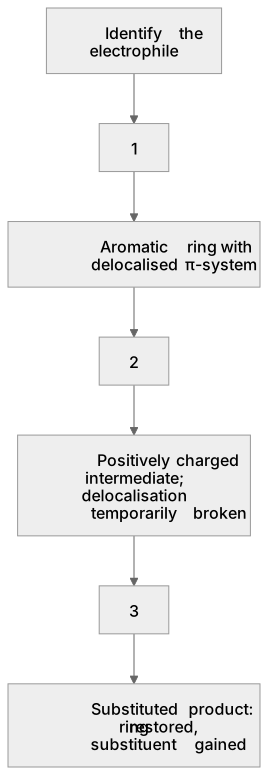
1Box 1
2Box 2
3Box 3
There is more to this lesson
The full lesson goes on to check your understanding and help you earn the marks. Create a free account to carry on, with your progress saved.
A week of Premium from your first lesson · Then the free plan continues · No card, no charge
Test your understanding of Aromatic compounds: (g) the interpretation of unfamiliar electrophilic substitution reactions of aromatic compounds, including prediction of mechanisms
Active recall beats re-reading. Take an instant quiz now to test what you’ve learned and lock it into long-term memory.
A week of Premium from your first lesson · Then the free plan continues · No card, no charge