OCR · A-Level · Chemistry
Course version: H432 · Version from Sept 2017
(i) concentrated nitric acid in the presence of concentrated sulfuric acid
Full specification wording
Aromatic compounds: (i) concentrated nitric acid in the presence of concentrated sulfuric acid
This row names the nitrating mixture used to introduce a nitro group into a benzene ring.
- Point 4 of 16
- 4 key terms
Study notes
From the teaching notes for this specification point.
The idea
This row names the nitrating mixture used to introduce a nitro group into a benzene ring. Concentrated nitric acid supplies the nitro group and concentrated sulfuric acid acts as the catalyst and dehydrating agent; together they generate the nitronium ion, NO₂⁺, which is the electrophile. The learner should recognise the reagent pair, identify the electrophile and the role of each acid, and write the overall equation for the formation of nitrobenzene from benzene. A typical question asks which species attacks the ring or what the sulfuric acid does. The reaction is electrophilic substitution, carried out under reflux at about 50–60 °C, and the product is nitrobenzene. Recognising that the sulfuric acid is regenerated, not consumed, is part of the teaching point.
What earns the marks
- Identifies the reagent pair as concentrated nitric acid with concentrated sulfuric acid acting as catalyst and dehydrating agent.
- Names the nitronium ion, NO₂⁺, as the electrophile generated by protonation and loss of water from nitric acid.
- States that the reaction is electrophilic substitution of a hydrogen atom on the benzene ring by a nitro group.
- Writes the overall equation showing benzene plus nitric acid forming nitrobenzene plus water, with sulfuric acid regenerated.
Common mistakes and how to put them right
Treats sulfuric acid as the source of the nitro group.
Put it right by stating that nitric acid supplies the nitro group and sulfuric acid generates the electrophile.
Describes the mechanism as nucleophilic substitution.
Put it right by identifying the attack of the nitronium ion on the electron-rich ring as electrophilic substitution.
Omits the role of the sulfuric acid entirely.
Put it right by explaining that it protonates nitric acid and is regenerated as a catalyst.
Exam tips
- Learn the formula of the nitronium ion and be ready to write it with the correct charge.
- Link each reagent to its specific job rather than listing the mixture without explanation.
- Practise writing the balanced overall equation, including water as a by-product.
Try the lesson
The start of the Aromatic compounds: (i) concentrated nitric acid in the presence of concentrated sulfuric acid lesson, made from teaching notes for this specification point.
Listen
This row names the nitrating mixture used to introduce a nitro group into a benzene ring. Concentrated nitric acid supplies the nitro group and concentrated sulfuric acid acts as the catalyst and dehydrating agent; together they generate the nitronium ion, NO₂⁺, which is the electrophile. The learner should recognise the reagent pair, identify the electrophile and the role of each acid, and write the overall equation for the formation of nitrobenzene from benzene. A typical question asks which species attacks the ring or what the sulfuric acid does. The reaction is electrophilic substitution, carried out under reflux at about 50–60 °C, and the product is nitrobenzene. Recognising that the sulfuric acid is regenerated, not consumed, is part of the teaching point. A strong answer earns marks for these points. Identifies the reagent pair as concentrated nitric acid with concentrated sulfuric acid acting as catalyst and dehydrating agent. Names the nitronium ion, NO₂⁺, as the electrophile generated by protonation and loss of water from nitric acid. States that the reaction is electrophilic substitution of a hydrogen atom on the benzene ring by a nitro group. Writes the overall equation showing benzene plus nitric acid forming nitrobenzene plus water, with sulfuric acid regenerated. A common slip: Treats sulfuric acid as the source of the nitro group. Instead, stating that nitric acid supplies the nitro group and sulfuric acid generates the electrophile. Exam tip: Learn the formula of the nitronium ion and be ready to write it with the correct charge.
See it
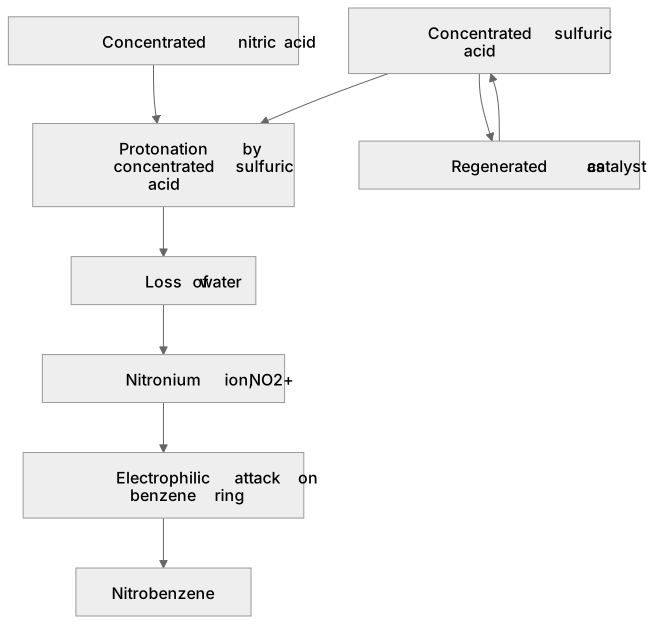
Key words
Say what each word means before you turn the card.
Electrophilic substitution of benzene
Try answering aloud or in your head before turning the card.
Generation of the nitronium ion
Try answering aloud or in your head before turning the card.
Role of concentrated sulfuric acid as catalyst
Try answering aloud or in your head before turning the card.
Nitration conditions and products
Try answering aloud or in your head before turning the card.
See every definition
- Electrophilic substitution of benzene
- A reaction in which a hydrogen atom on the benzene ring is replaced by a nitro group, attacked by the nitronium ion on the electron-rich ring.
- Generation of the nitronium ion
- The nitronium ion, NO₂⁺, is generated by protonation and loss of water from nitric acid, with concentrated sulfuric acid acting as catalyst and dehydrating agent.
- Role of concentrated sulfuric acid as catalyst
- It protonates nitric acid and is regenerated, not consumed, acting as catalyst and dehydrating agent rather than supplying the nitro group.
- Nitration conditions and products
- Carried out under reflux at about 50–60 °C, with benzene plus nitric acid forming nitrobenzene plus water and sulfuric acid regenerated.
Label the diagram
Some boxes have lost their names. Pick the right name for each number.
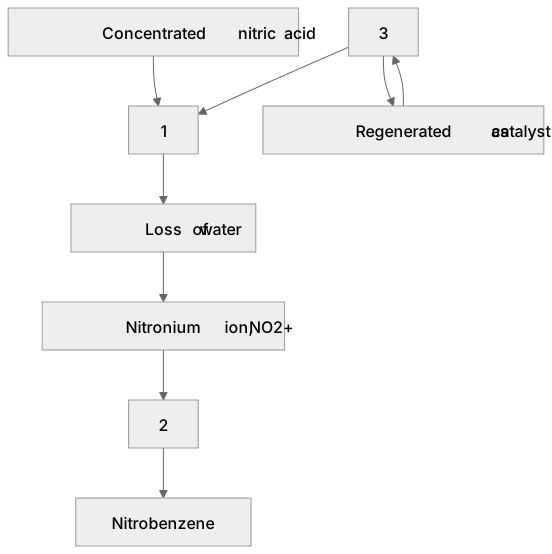
1Box 1
2Box 2
3Box 3
There is more to this lesson
The full lesson goes on to check your understanding and help you earn the marks. Create a free account to carry on, with your progress saved.
A week of Premium from your first lesson · Then the free plan continues · No card, no charge
Test your understanding of Aromatic compounds: (i) concentrated nitric acid in the presence of concentrated sulfuric acid
Active recall beats re-reading. Take an instant quiz now to test what you’ve learned and lock it into long-term memory.
A week of Premium from your first lesson · Then the free plan continues · No card, no charge