OCR · A-Level · Chemistry
Course version: H432 · Version from Sept 2017
Aromatic compounds: (i) with bromine to form 2,4,6-tribromophenol
When phenol reacts with bromine water at room temperature, substitution occurs at all three available 2-, 4- and 6-positions, giving 2,4,6-tribromophenol as a white precipitate and decolourising…
- Point 12 of 16
- 4 key terms
Study notes
From the teaching notes for this specification point.
The idea
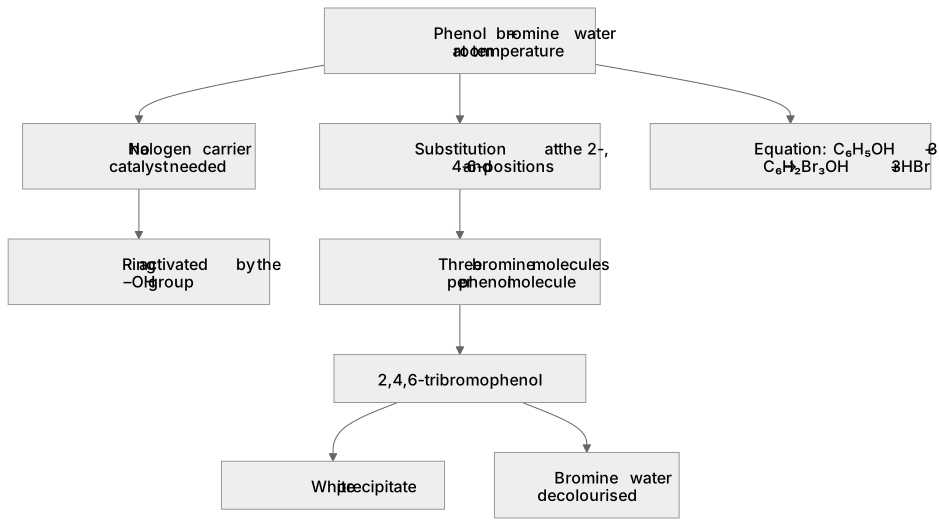
When phenol reacts with bromine water at room temperature, substitution occurs at all three available 2-, 4- and 6-positions, giving 2,4,6-tribromophenol as a white precipitate and decolourising the bromine water. No halogen carrier catalyst is needed because the –OH group makes the ring sufficiently electron-rich. The equation is C₆H₅OH + 3Br₂ → C₆H₂Br₃OH + 3HBr. Each substitution replaces one ring hydrogen with one bromine atom, so three bromine molecules are consumed per phenol molecule. The observation of decolourisation and a white precipitate is a test for phenol. Distinguish this from benzene, which needs a halogen carrier and gives only monosubstitution.
What earns the marks
- States that phenol reacts with bromine water at room temperature to give 2,4,6-tribromophenol.
- Identifies the product as a white precipitate and notes that the bromine water is decolourised.
- Explains that three bromine molecules react with each phenol molecule, substituting at the 2-, 4- and 6-positions.
- Notes that no halogen carrier catalyst is required because the ring is activated by the –OH group.
- Writes the equation C₆H₅OH + 3Br₂ → C₆H₂Br₃OH + 3HBr with correct formulae.
Common mistakes and how to put them right
Writes the product as monobromophenol.
Put it right by substituting at all three positions to give 2,4,6-tribromophenol.
Includes a halogen carrier such as FeBr₃.
Put it right by stating that bromine water reacts with phenol without a catalyst.
Balances the equation with one bromine molecule.
Put it right by using three bromine molecules and producing three HBr.
Describes the observation as a colourless solution only.
Put it right by including the white precipitate and decolourisation.
Exam tips
- Quote the observation (white precipitate, decolourisation) as evidence, not just the product name.
- Balance the equation carefully, counting three bromine molecules and three hydrogen bromide molecules.
- Contrast with benzene in one sentence to show why no catalyst is needed.
Try the lesson
The start of the Aromatic compounds: (i) with bromine to form 2,4,6-tribromophenol lesson, made from teaching notes for this specification point.
Listen
When phenol reacts with bromine water at room temperature, substitution occurs at all three available 2-, 4- and 6-positions, giving 2,4,6-tribromophenol as a white precipitate and decolourising the bromine water. No halogen carrier catalyst is needed because the –OH group makes the ring sufficiently electron-rich. The equation is C₆H₅OH + 3Br₂ → C₆H₂Br₃OH + 3HBr. Each substitution replaces one ring hydrogen with one bromine atom, so three bromine molecules are consumed per phenol molecule. The observation of decolourisation and a white precipitate is a test for phenol. Distinguish this from benzene, which needs a halogen carrier and gives only monosubstitution. A strong answer earns marks for these points. States that phenol reacts with bromine water at room temperature to give 2,4,6-tribromophenol. Identifies the product as a white precipitate and notes that the bromine water is decolourised. Explains that three bromine molecules react with each phenol molecule, substituting at the 2-, 4- and 6-positions. Notes that no halogen carrier catalyst is required because the ring is activated by the –OH group. A common slip: Writes the product as monobromophenol. Instead, substituting at all three positions to give 2,4,6-tribromophenol. Exam tip: Quote the observation (white precipitate, decolourisation) as evidence, not just the product name.
See it
Key words
Say what each word means before you turn the card.
Reaction of phenol with bromine water
Try answering aloud or in your head before turning the card.
Formation of 2,4,6-tribromophenol
Try answering aloud or in your head before turning the card.
Activation of the aromatic ring by the –OH group
Try answering aloud or in your head before turning the card.
Test for phenol using bromine water
Try answering aloud or in your head before turning the card.
See every definition
- Reaction of phenol with bromine water
- Phenol reacts with bromine water at room temperature, giving 2,4,6-tribromophenol as a white precipitate and decolourising the bromine water.
- Formation of 2,4,6-tribromophenol
- Substitution occurs at all three available 2-, 4- and 6-positions, each substitution replacing one ring hydrogen with one bromine atom, so three bromine molecules are consumed per phenol molecule.
- Activation of the aromatic ring by the –OH group
- The –OH group makes the ring sufficiently electron-rich, so no halogen carrier catalyst is needed.
- Test for phenol using bromine water
- The observation of decolourisation and a white precipitate is a test for phenol.
Label the diagram
Some boxes have lost their names. Pick the right name for each number.
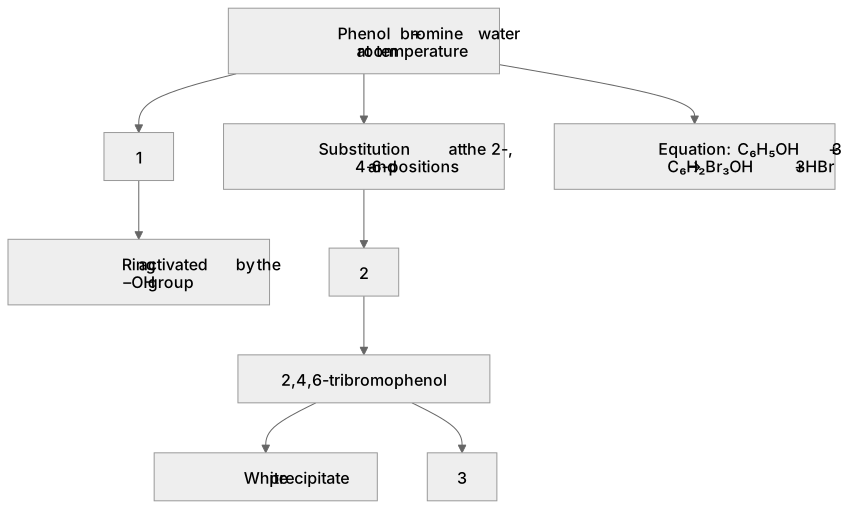
1Box 1
2Box 2
3Box 3
There is more to this lesson
The full lesson goes on to check your understanding and help you earn the marks. Create a free account to carry on, with your progress saved.
A week of Premium from your first lesson · Then the free plan continues · No card, no charge
Test your understanding of Aromatic compounds: (i) with bromine to form 2,4,6-tribromophenol
Active recall beats re-reading. Take an instant quiz now to test what you’ve learned and lock it into long-term memory.
A week of Premium from your first lesson · Then the free plan continues · No card, no charge