OCR · A-Level · Chemistry
Course version: H432 · Version from Sept 2017
(ii) with dilute nitric acid to form a mixture of 2-nitrophenol and…
Full specification wording
Aromatic compounds: (ii) with dilute nitric acid to form a mixture of 2-nitrophenol and 4-nitrophenol
Phenol reacts with dilute nitric acid at room temperature to give a mixture of two substitution products: 2-nitrophenol and 4-nitrophenol.
- Point 13 of 16
- 3 key terms
Study notes
From the teaching notes for this specification point.
The idea
Phenol reacts with dilute nitric acid at room temperature to give a mixture of two substitution products: 2-nitrophenol and 4-nitrophenol. The –OH group directs incoming electrophiles to the 2- and 4-positions because its oxygen lone pair donates electron density into the ring by resonance, raising electron density at the ortho and para positions and making those positions more attractive to the nitrating electrophile. Inductively the electronegative oxygen withdraws electron density, but resonance donation dominates the directing effect. The electrophile is the nitronium ion, NO₂⁺, generated from nitric acid. Because two positions are activated, both 2-nitrophenol and 4-nitrophenol form together, so the product is a mixture rather than a single compound.
What earns the marks
- Identifies 2-nitrophenol and 4-nitrophenol as the two products of the reaction of phenol with dilute nitric acid.
- Explains that the –OH group directs substitution to the 2- and 4-positions by resonance donation of the oxygen lone pair into the ring.
- States that the electrophile attacking the ring is the nitronium ion, NO₂⁺.
- Recognises that two activated positions give a mixture of two products rather than one.
- Distinguishes resonance donation, which activates the ring, from the inductive withdrawal by the electronegative oxygen.
Common mistakes and how to put them right
Claims that the –OH group activates the ring by electron donation through induction.
Put it right by attributing activation and 2,4-direction to resonance donation of the oxygen lone pair.
Names only one nitration product of phenol.
Put it right by stating that both 2-nitrophenol and 4-nitrophenol form as a mixture.
Describes the attacking species as a neutral nitric acid molecule.
Put it right by naming the nitronium ion, NO₂⁺, as the electrophile.
Places the nitro group at the 3-position.
Put it right by directing substitution to the 2- and 4-positions relative to the –OH group.
Exam tips
- Link the directing effect explicitly to resonance donation from the oxygen lone pair, not to induction.
- Name both products and state that they form as a mixture.
- Identify the electrophile as NO₂⁺ when explaining the mechanism.
Try the lesson
The start of the Aromatic compounds: (ii) with dilute nitric acid to form a mixture of 2-nitrophenol and 4-nitrophenol lesson, made from teaching notes for this specification point.
Listen
Phenol reacts with dilute nitric acid at room temperature to give a mixture of two substitution products: 2-nitrophenol and 4-nitrophenol. The –OH group directs incoming electrophiles to the 2- and 4-positions because its oxygen lone pair donates electron density into the ring by resonance, raising electron density at the ortho and para positions and making those positions more attractive to the nitrating electrophile. Inductively the electronegative oxygen withdraws electron density, but resonance donation dominates the directing effect. The electrophile is the nitronium ion, NO₂⁺, generated from nitric acid. Because two positions are activated, both 2-nitrophenol and 4-nitrophenol form together, so the product is a mixture rather than a single compound. A strong answer earns marks for these points. Identifies 2-nitrophenol and 4-nitrophenol as the two products of the reaction of phenol with dilute nitric acid. Explains that the –OH group directs substitution to the 2- and 4-positions by resonance donation of the oxygen lone pair into the ring. States that the electrophile attacking the ring is the nitronium ion, NO₂⁺. Recognises that two activated positions give a mixture of two products rather than one. A common slip: Claims that the –OH group activates the ring by electron donation through induction. Instead, attributing activation and 2,4-direction to resonance donation of the oxygen lone pair. Exam tip: Link the directing effect explicitly to resonance donation from the oxygen lone pair, not to induction.
See it
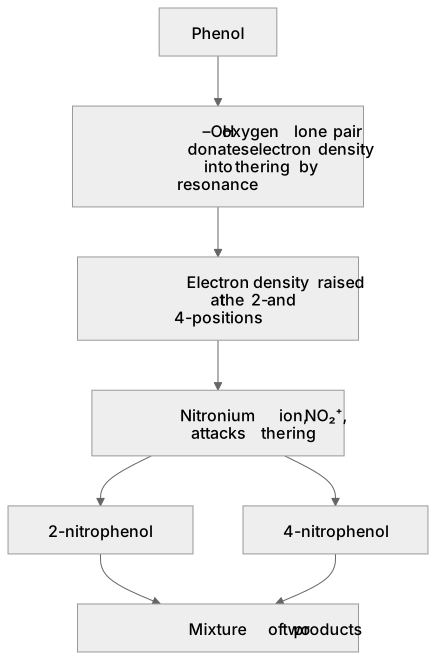
Key words
Say what each word means before you turn the card.
Directing effects of the –OH group
Try answering aloud or in your head before turning the card.
Resonance donation versus inductive withdrawal
Try answering aloud or in your head before turning the card.
Nitronium ion as electrophile
Try answering aloud or in your head before turning the card.
See every definition
- Directing effects of the –OH group
- The –OH group directs incoming electrophiles to the 2- and 4-positions because its oxygen lone pair donates electron density into the ring by resonance.
- Resonance donation versus inductive withdrawal
- Resonance donation of the oxygen lone pair raises electron density at the ortho and para positions, while inductively the electronegative oxygen withdraws electron density, but resonance donation dominates the directing effect.
- Nitronium ion as electrophile
- The electrophile is the nitronium ion, NO₂⁺, generated from nitric acid.
Label the diagram
Some boxes have lost their names. Pick the right name for each number.
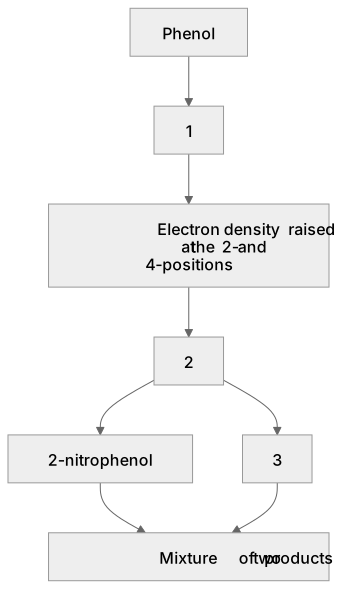
1Box 1
2Box 2
3Box 3
There is more to this lesson
The full lesson goes on to check your understanding and help you earn the marks. Create a free account to carry on, with your progress saved.
A week of Premium from your first lesson · Then the free plan continues · No card, no charge
Test your understanding of Aromatic compounds: (ii) with dilute nitric acid to form a mixture of 2-nitrophenol and 4-nitrophenol
Active recall beats re-reading. Take an instant quiz now to test what you’ve learned and lock it into long-term memory.
A week of Premium from your first lesson · Then the free plan continues · No card, no charge