OCR · A-Level · Chemistry
Course version: H432 · Version from Sept 2017
(l) the prediction of substitution products of aromatic compounds by…
Full specification wording
Aromatic compounds: (l) the prediction of substitution products of aromatic compounds by directing effects and the importance to organic synthesis (see also 6.2.5 Organic Synthesis).
Directing effects let a chemist predict which substitution product will dominate when an electrophile attacks a substituted benzene ring.
- Point 16 of 16
- 4 key terms
Study notes
From the teaching notes for this specification point.
The idea
Directing effects let a chemist predict which substitution product will dominate when an electrophile attacks a substituted benzene ring. Read the existing group first: an electron-donating group such as OH or NH₂ sends the next electrophile mainly to the 2- and 4-positions, while an electron-withdrawing group such as NO₂ sends it mainly to the 3-position. Apply that rule to a named reaction, for example nitration of phenol, and state the major product with its position. This predictive control matters in organic synthesis because it allows a target molecule to be built by choosing the order in which groups are introduced, so a desired substituent can be placed where it is needed rather than relying on chance. The section cross-refers to 6.2.5 Organic Synthesis, where such routes are planned.
What earns the marks
- Predicts the major substitution product by identifying whether the existing group is electron-donating or electron-withdrawing.
- Assigns the 2- and 4-positions for an electron-donating group such as OH or NH₂.
- Assigns the 3-position for an electron-withdrawing group such as NO₂.
- Explains that directing effects allow a synthesis route to be planned so substituents are placed in a chosen order.
- Applies the prediction to a named reaction, such as nitration of phenol giving mainly 2- and 4-nitrophenol.
Common mistakes and how to put them right
Predicts products without first classifying the existing group.
Put it right by deciding whether the group donates or withdraws electrons.
Names a single product where a mixture of 2- and 4-products is expected from an electron-donating group.
Put it right by acknowledging both positions.
Ignores the relevance to synthesis and treats directing effects as isolated facts.
Put it right by linking prediction to planning a multi-step route.
Exam tips
- State the existing group, its donating or withdrawing character, and the positions it directs to before naming the product.
- Give the major product with its position number relative to the existing substituent.
- Link the prediction explicitly to planning a synthesis route when the question asks about importance.
Try the lesson
The start of the Aromatic compounds: (l) the prediction of substitution products of aromatic compounds by directing effects and the importance to organic synthesis (see also 6.2.5 Organic Synthesis). lesson, made from teaching notes for this specification point.
Listen
Directing effects let a chemist predict which substitution product will dominate when an electrophile attacks a substituted benzene ring. Read the existing group first: an electron-donating group such as OH or NH₂ sends the next electrophile mainly to the 2- and 4-positions, while an electron-withdrawing group such as NO₂ sends it mainly to the 3-position. Apply that rule to a named reaction, for example nitration of phenol, and state the major product with its position. This predictive control matters in organic synthesis because it allows a target molecule to be built by choosing the order in which groups are introduced, so a desired substituent can be placed where it is needed rather than relying on chance. The section cross-refers to 6.2.5 Organic Synthesis, where such routes are planned. A strong answer earns marks for these points. Predicts the major substitution product by identifying whether the existing group is electron-donating or electron-withdrawing. Assigns the 2- and 4-positions for an electron-donating group such as OH or NH₂. Assigns the 3-position for an electron-withdrawing group such as NO₂. Explains that directing effects allow a synthesis route to be planned so substituents are placed in a chosen order. A common slip: Predicts products without first classifying the existing group. Instead, deciding whether the group donates or withdraws electrons. Exam tip: State the existing group, its donating or withdrawing character, and the positions it directs to before naming the product.
See it
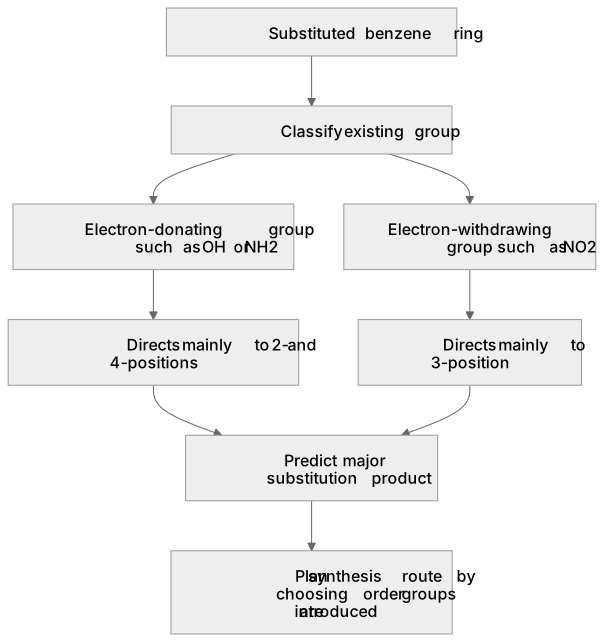
Key words
Say what each word means before you turn the card.
Directing effects
Try answering aloud or in your head before turning the card.
Electron-donating group
Try answering aloud or in your head before turning the card.
Electron-withdrawing group
Try answering aloud or in your head before turning the card.
Planning organic synthesis routes
Try answering aloud or in your head before turning the card.
See every definition
- Directing effects
- Effects that let a chemist predict which substitution product will dominate when an electrophile attacks a substituted benzene ring.
- Electron-donating group
- A group such as OH or NH₂ that sends the next electrophile mainly to the 2- and 4-positions.
- Electron-withdrawing group
- A group such as NO₂ that sends the next electrophile mainly to the 3-position.
- Planning organic synthesis routes
- Choosing the order in which groups are introduced so a desired substituent can be placed where it is needed rather than relying on chance.
Label the diagram
Some boxes have lost their names. Pick the right name for each number.
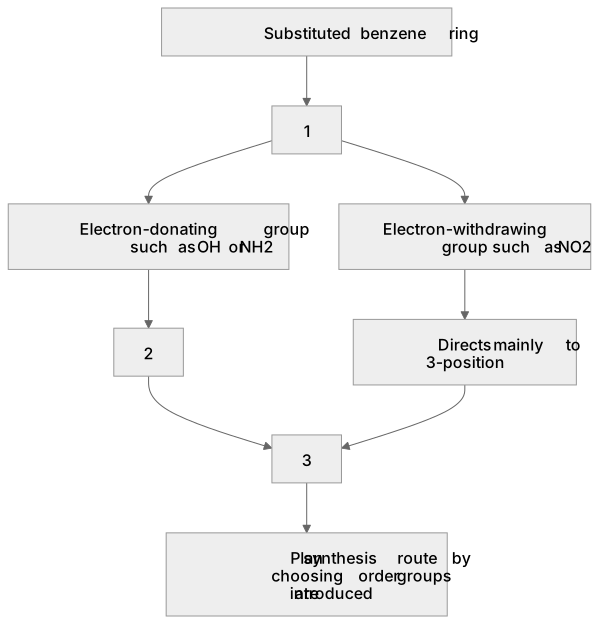
1Box 1
2Box 2
3Box 3
There is more to this lesson
The full lesson goes on to check your understanding and help you earn the marks. Create a free account to carry on, with your progress saved.
A week of Premium from your first lesson · Then the free plan continues · No card, no charge
Test your understanding of Aromatic compounds: (l) the prediction of substitution products of aromatic compounds by directing effects and the importance to organic synthesis (see also 6.2.5 Organic Synthesis).
Active recall beats re-reading. Take an instant quiz now to test what you’ve learned and lock it into long-term memory.
A week of Premium from your first lesson · Then the free plan continues · No card, no charge