OCR · A-Level · Chemistry
Course version: H432 · Version from Sept 2017
(k) the 2- and 4-directing effect of electron-donating groups (OH, NH₂)…
Full specification wording
Aromatic compounds: (k) the 2- and 4-directing effect of electron-donating groups (OH, NH₂) and the 3-directing effect of electron-withdrawing groups (NO₂) in electrophilic substitution of aromatic compounds
A substituent already on a benzene ring controls where the next electrophile attacks.
- Point 15 of 16
- 3 key terms
Study notes
From the teaching notes for this specification point.
The idea
A substituent already on a benzene ring controls where the next electrophile attacks. An electron-donating group such as OH or NH₂ pushes electron density into the ring, especially at the 2- and 4-positions relative to itself, so the next electrophile arrives mainly there; the 2-position is the same as the 6-position by symmetry. An electron-withdrawing group such as NO₂ pulls electron density out, leaving the 2- and 4-positions relatively electron-poor and the 3-position relatively favoured, so substitution occurs mainly at the 3-position. The mechanism is still electrophilic substitution: the ring attacks the electrophile, an unstable arenium intermediate forms, then a proton is lost to restore the delocalised ring. Directing effects follow from how the existing group stabilises or destabilises the positive charge in that intermediate at each position.
What earns the marks
- States that OH and NH₂ are electron-donating groups that direct the incoming electrophile to the 2- and 4-positions.
- States that NO₂ is an electron-withdrawing group that directs the incoming electrophile to the 3-position.
- Explains that electron-donating groups increase electron density at the 2- and 4-positions, making attack there more likely.
- Explains that electron-withdrawing groups reduce electron density at the 2- and 4-positions, so attack occurs mainly at the 3-position.
- Identifies the reaction as electrophilic substitution in which the ring attacks an electrophile and a hydrogen is replaced.
- Recognises that the 2-position and the 6-position are equivalent by symmetry.
Common mistakes and how to put them right
Reverses the two effects by claiming that OH directs to the 3-position.
Put it right by linking electron donation to the 2- and 4-positions.
Treats NO₂ as electron-donating because nitrogen is electronegative.
Put it right by noting that NO₂ withdraws electron density and directs to the 3-position.
Describes the reaction as nucleophilic substitution on the ring.
Put it right by naming electrophilic substitution.
Forgets that the 2- and 6-positions are equivalent.
Put it right by treating them as one position by symmetry.
Exam tips
- Link each group to its electron-donating or electron-withdrawing character before naming the positions it directs to.
- Use the arenium intermediate to justify why one position is favoured over another.
- Check the position numbering relative to the existing substituent, not to an arbitrary ring carbon.
Try the lesson
The start of the Aromatic compounds: (k) the 2- and 4-directing effect of electron-donating groups (OH, NH₂) and the 3-directing effect of electron-withdrawing groups (NO₂) in electrophilic substitution of aromatic compounds lesson, made from teaching notes for this specification point.
Listen
A substituent already on a benzene ring controls where the next electrophile attacks. An electron-donating group such as OH or NH₂ pushes electron density into the ring, especially at the 2- and 4-positions relative to itself, so the next electrophile arrives mainly there; the 2-position is the same as the 6-position by symmetry. An electron-withdrawing group such as NO₂ pulls electron density out, leaving the 2- and 4-positions relatively electron-poor and the 3-position relatively favoured, so substitution occurs mainly at the 3-position. The mechanism is still electrophilic substitution: the ring attacks the electrophile, an unstable arenium intermediate forms, then a proton is lost to restore the delocalised ring. Directing effects follow from how the existing group stabilises or destabilises the positive charge in that intermediate at each position. A strong answer earns marks for these points. States that OH and NH₂ are electron-donating groups that direct the incoming electrophile to the 2- and 4-positions. States that NO₂ is an electron-withdrawing group that directs the incoming electrophile to the 3-position. Explains that electron-donating groups increase electron density at the 2- and 4-positions, making attack there more likely. Explains that electron-withdrawing groups reduce electron density at the 2- and 4-positions, so attack occurs mainly at the 3-position. A common slip: Reverses the two effects by claiming that OH directs to the 3-position. Instead, linking electron donation to the 2- and 4-positions. Exam tip: Link each group to its electron-donating or electron-withdrawing character before naming the positions it directs to.
See it
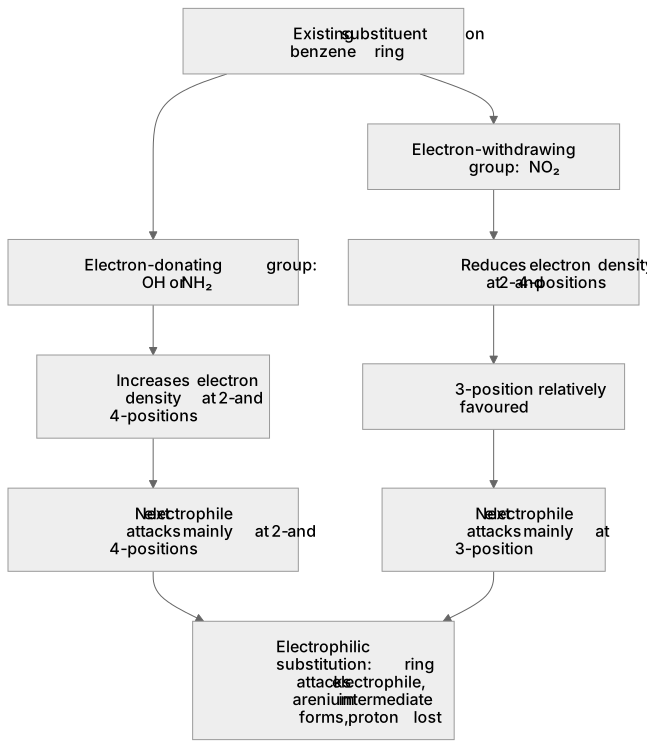
Key words
Say what each word means before you turn the card.
Electrophilic substitution of aromatic compounds
Try answering aloud or in your head before turning the card.
Directing effects of OH, NH₂ and NO₂
Try answering aloud or in your head before turning the card.
Stability of the arenium intermediate
Try answering aloud or in your head before turning the card.
See every definition
- Electrophilic substitution of aromatic compounds
- The ring attacks the electrophile, an unstable arenium intermediate forms, then a proton is lost to restore the delocalised ring.
- Directing effects of OH, NH₂ and NO₂
- OH and NH₂ push electron density into the ring so the next electrophile arrives mainly at the 2- and 4-positions, while NO₂ pulls electron density out so substitution occurs mainly at the 3-position.
- Stability of the arenium intermediate
- An unstable arenium intermediate forms when the ring attacks the electrophile, and its stability at each position explains why one position is favoured over another.
Label the diagram
Some boxes have lost their names. Pick the right name for each number.
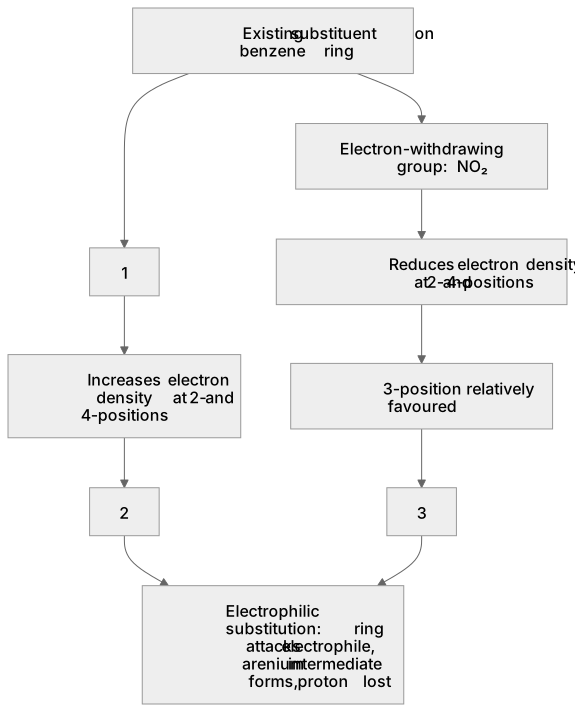
1Box 1
2Box 2
3Box 3
There is more to this lesson
The full lesson goes on to check your understanding and help you earn the marks. Create a free account to carry on, with your progress saved.
A week of Premium from your first lesson · Then the free plan continues · No card, no charge
Test your understanding of Aromatic compounds: (k) the 2- and 4-directing effect of electron-donating groups (OH, NH₂) and the 3-directing effect of electron-withdrawing groups (NO₂) in electrophilic substitution of aromatic compounds
Active recall beats re-reading. Take an instant quiz now to test what you’ve learned and lock it into long-term memory.
A week of Premium from your first lesson · Then the free plan continues · No card, no charge