OCR · A-Level · Chemistry
Course version: H432 · Version from Sept 2017
(i) the determination of relative isotopic masses and relative abundances…
Full specification wording
Atomic structure and isotopes: (i) the determination of relative isotopic masses and relative abundances of the isotope,
A mass spectrometer separates ions by mass-to-charge ratio and records the relative intensity of each peak.
- Point 5 of 7
- 4 key terms
Study notes
From the teaching notes for this specification point.
The idea
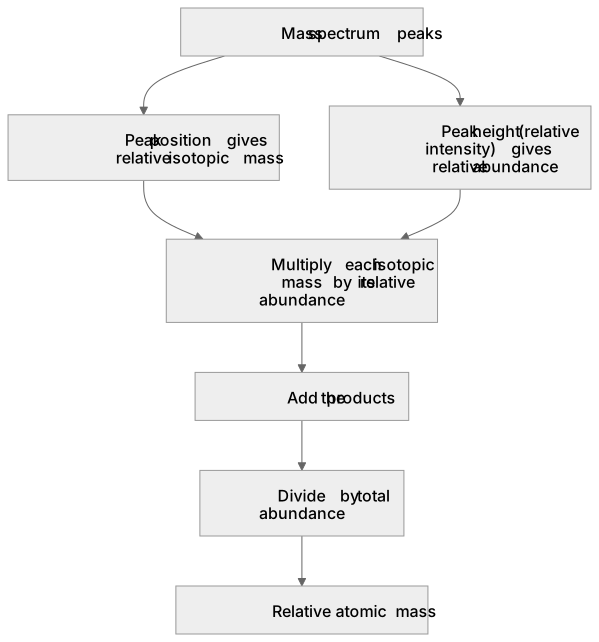
A mass spectrometer separates ions by mass-to-charge ratio and records the relative intensity of each peak. For a sample of an element, each peak corresponds to an isotope: its position gives the relative isotopic mass and its height (relative intensity) gives the relative abundance of that isotope. To find relative atomic mass you take each isotope's relative isotopic mass, multiply by its relative abundance, add the products and divide by the total abundance. For example, if an element has isotopes of relative mass 63 and 65 in relative abundances 69 and 31, the relative atomic mass is (63 × 69 + 65 × 31) ÷ 100 = 63.62. In a multiple-choice question, check whether the data are given as relative abundances or percentages, and confirm which quantity (isotopic mass, abundance or relative atomic mass) is being asked for.
What earns the marks
- Identifies that peak position on the mass spectrum gives the relative isotopic mass of each isotope.
- States that peak height or relative intensity gives the relative abundance of each isotope.
- Calculates relative atomic mass by multiplying each isotopic mass by its abundance, summing the products and dividing by total abundance.
- Distinguishes relative isotopic mass from relative atomic mass when interpreting the data.
- Selects the option consistent with the given abundances, checking whether they are percentages or relative values.
Common mistakes and how to put them right
Uses peak height as the isotopic mass.
Put it right: Read mass from peak position and abundance from peak height.
Averages the isotopic masses without weighting by abundance.
Put it right: Weight each mass by its relative abundance.
Divides by the number of isotopes rather than by total abundance.
Put it right: Divide the weighted sum by the sum of abundances.
Confuses relative atomic mass with relative molecular mass.
Put it right: Match the quantity to what the question asks.
Exam tips
- Write out the weighted-average calculation before looking at the options so you are not drawn to a distractor.
- Check whether abundances are percentages summing to 100 or relative values needing a total.
- Confirm the units and quantity requested, since relative atomic mass is dimensionless.
Try the lesson
The start of the Atomic structure and isotopes: (i) the determination of relative isotopic masses and relative abundances of the isotope, lesson, made from teaching notes for this specification point.
Listen
A mass spectrometer separates ions by mass-to-charge ratio and records the relative intensity of each peak. For a sample of an element, each peak corresponds to an isotope: its position gives the relative isotopic mass and its height (relative intensity) gives the relative abundance of that isotope. To find relative atomic mass you take each isotope's relative isotopic mass, multiply by its relative abundance, add the products and divide by the total abundance. For example, if an element has isotopes of relative mass 63 and 65 in relative abundances 69 and 31, the relative atomic mass is (63 × 69 + 65 × 31) ÷ 100 = 63.62. In a multiple-choice question, check whether the data are given as relative abundances or percentages, and confirm which quantity (isotopic mass, abundance or relative atomic mass) is being asked for. A strong answer earns marks for these points. Identifies that peak position on the mass spectrum gives the relative isotopic mass of each isotope. States that peak height or relative intensity gives the relative abundance of each isotope. Calculates relative atomic mass by multiplying each isotopic mass by its abundance, summing the products and dividing by total abundance. Distinguishes relative isotopic mass from relative atomic mass when interpreting the data. A common slip: Uses peak height as the isotopic mass. Instead, read mass from peak position and abundance from peak height. Exam tip: Write out the weighted-average calculation before looking at the options so you are not drawn to a distractor.
See it
Key words
Say what each word means before you turn the card.
Mass-to-charge separation of ions
Try answering aloud or in your head before turning the card.
Relative isotopic mass from peak position
Try answering aloud or in your head before turning the card.
Relative abundance from peak intensity
Try answering aloud or in your head before turning the card.
Weighted calculation of relative atomic mass
Try answering aloud or in your head before turning the card.
See every definition
- Mass-to-charge separation of ions
- A mass spectrometer separates ions by mass-to-charge ratio and records the relative intensity of each peak.
- Relative isotopic mass from peak position
- For a sample of an element, each peak corresponds to an isotope, and its position gives the relative isotopic mass of that isotope.
- Relative abundance from peak intensity
- The height, or relative intensity, of each peak gives the relative abundance of that isotope.
- Weighted calculation of relative atomic mass
- Each isotope's relative isotopic mass is multiplied by its relative abundance, the products are added and the total is divided by the total abundance.
Label the diagram
Some boxes have lost their names. Pick the right name for each number.
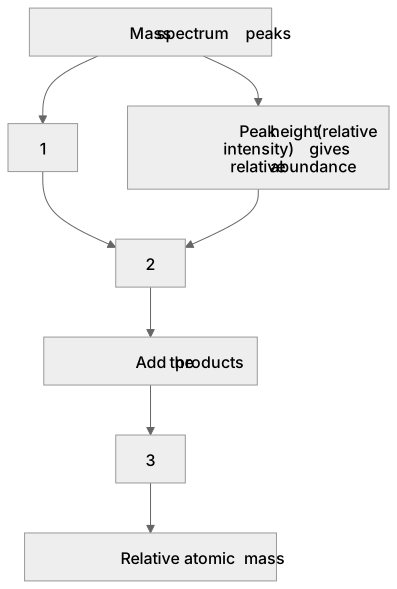
1Box 1
2Box 2
3Box 3
There is more to this lesson
The full lesson goes on to check your understanding and help you earn the marks. Create a free account to carry on, with your progress saved.
A week of Premium from your first lesson · Then the free plan continues · No card, no charge
Test your understanding of Atomic structure and isotopes: (i) the determination of relative isotopic masses and relative abundances of the isotope,
Active recall beats re-reading. Take an instant quiz now to test what you’ve learned and lock it into long-term memory.
A week of Premium from your first lesson · Then the free plan continues · No card, no charge