OCR · A-Level · Chemistry
Course version: H432 · Version from Sept 2017
(ii) calculation of the relative atomic mass of an element from the…
Full specification wording
Atomic structure and isotopes: (ii) calculation of the relative atomic mass of an element from the relative abundances of its isotopes
Relative atomic mass, Ar, is the weighted mean mass of the atoms of an element compared with 1/12 of the mass of an atom of carbon-12.
- Point 6 of 7
- 4 key terms
Study notes
From the teaching notes for this specification point.
The idea
Relative atomic mass, Ar, is the weighted mean mass of the atoms of an element compared with 1/12 of the mass of an atom of carbon-12. When an element has several isotopes, each with its own abundance, the weighted mean lies between the lightest and heaviest isotope masses and is pulled towards the more abundant isotope. To calculate it, multiply each isotope mass by its relative abundance, add the products, then divide by the total abundance. For example, an element with isotopes of mass 63 (abundance 70) and 65 (abundance 30) gives (63 × 70 + 65 × 30) ÷ 100 = (4410 + 1950) ÷ 100 = 6360 ÷ 100 = 63.6. If abundances are given as fractions or percentages, divide by the total (1 or 100) accordingly. The answer is a weighted mean, not a simple average, so it need not equal any single isotope mass.
What earns the marks
- Multiplies each isotope mass by its relative abundance before summing the products.
- Divides the sum of the products by the total relative abundance to obtain the weighted mean.
- Keeps the answer between the lightest and heaviest isotope masses as a check on reasonableness.
- Uses the correct total abundance (100 for percentages, 1 for fractions) as the divisor.
Common mistakes and how to put them right
Averages the isotope masses without weighting them by abundance.
Put it right: Multiply each mass by its abundance first.
Divides by the number of isotopes instead of the total abundance.
Put it right: Use the sum of the abundances as the divisor.
Mixes percentage and fractional abundances in one calculation.
Put it right: Convert all abundances to the same scale first.
Exam tips
- Write out each mass × abundance product before adding, so arithmetic is easy to check.
- Confirm the final value lies between the lightest and heaviest isotope masses.
- State the answer to a sensible number of significant figures, matching the data given.
Try the lesson
The start of the Atomic structure and isotopes: (ii) calculation of the relative atomic mass of an element from the relative abundances of its isotopes lesson, made from teaching notes for this specification point.
Listen
Relative atomic mass, Ar, is the weighted mean mass of the atoms of an element compared with 1/12 of the mass of an atom of carbon-12. When an element has several isotopes, each with its own abundance, the weighted mean lies between the lightest and heaviest isotope masses and is pulled towards the more abundant isotope. To calculate it, multiply each isotope mass by its relative abundance, add the products, then divide by the total abundance. For example, an element with isotopes of mass 63 (abundance 70) and 65 (abundance 30) gives (63 × 70 + 65 × 30) ÷ 100 = (4410 + 1950) ÷ 100 = 6360 ÷ 100 = 63.6. If abundances are given as fractions or percentages, divide by the total (1 or 100) accordingly. The answer is a weighted mean, not a simple average, so it need not equal any single isotope mass. A strong answer earns marks for these points. Multiplies each isotope mass by its relative abundance before summing the products. Divides the sum of the products by the total relative abundance to obtain the weighted mean. Keeps the answer between the lightest and heaviest isotope masses as a check on reasonableness. Uses the correct total abundance (100 for percentages, 1 for fractions) as the divisor. Exam tip: Write out each mass × abundance product before adding, so arithmetic is easy to check.
See it
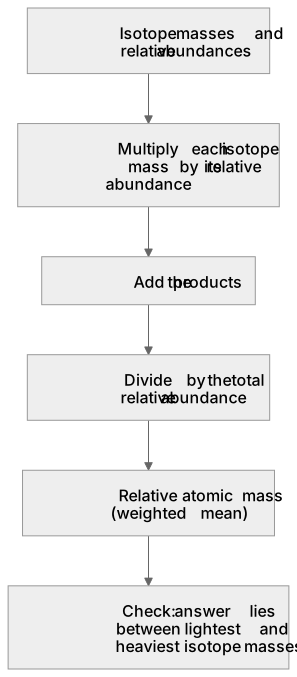
Put it in order
Put these steps in the order they happen.
- 1. Add the products
- 2. Multiply each isotope mass by its relative abundance
- 3. Isotope masses and relative abundances
- 4. Check: answer lies between lightest and heaviest isotope masses
- 5. Relative atomic mass (weighted mean)
- 6. Divide by the total relative abundance
Key words
Say what each word means before you turn the card.
Relative atomic mass
Try answering aloud or in your head before turning the card.
Weighted mean mass
Try answering aloud or in your head before turning the card.
Isotopic abundance
Try answering aloud or in your head before turning the card.
Calculation accuracy
Try answering aloud or in your head before turning the card.
See every definition
- Relative atomic mass
- The weighted mean mass of the atoms of an element compared with 1/12 of the mass of an atom of carbon-12.
- Weighted mean mass
- A mean in which each isotope mass is multiplied by its relative abundance, the products are added, and the sum is divided by the total abundance.
- Isotopic abundance
- The relative amount of each isotope of an element, given as fractions or percentages and used to weight each isotope mass in the calculation.
- Calculation accuracy
- Keeping the answer between the lightest and heaviest isotope masses as a check on reasonableness, and stating it to a sensible number of significant figures.
Label the diagram
Some boxes have lost their names. Pick the right name for each number.
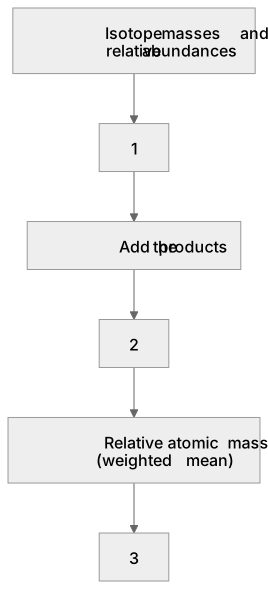
1Box 1
2Box 2
3Box 3
There is more to this lesson
The full lesson goes on to check your understanding and help you earn the marks. Create a free account to carry on, with your progress saved.
A week of Premium from your first lesson · Then the free plan continues · No card, no charge
Test your understanding of Atomic structure and isotopes: (ii) calculation of the relative atomic mass of an element from the relative abundances of its isotopes
Active recall beats re-reading. Take an instant quiz now to test what you’ve learned and lock it into long-term memory.
A week of Premium from your first lesson · Then the free plan continues · No card, no charge