OCR · A-Level · Chemistry
Course version: H432 · Version from Sept 2017
(a) application of IUPAC rules of nomenclature for systematically naming…
Full specification wording
Basic concepts of organic chemistry: (a) application of IUPAC rules of nomenclature for systematically naming organic compounds
IUPAC nomenclature gives every organic compound a single systematic name.
- Point 2 of 21
- 4 key terms
Study notes
From the teaching notes for this specification point.
The idea
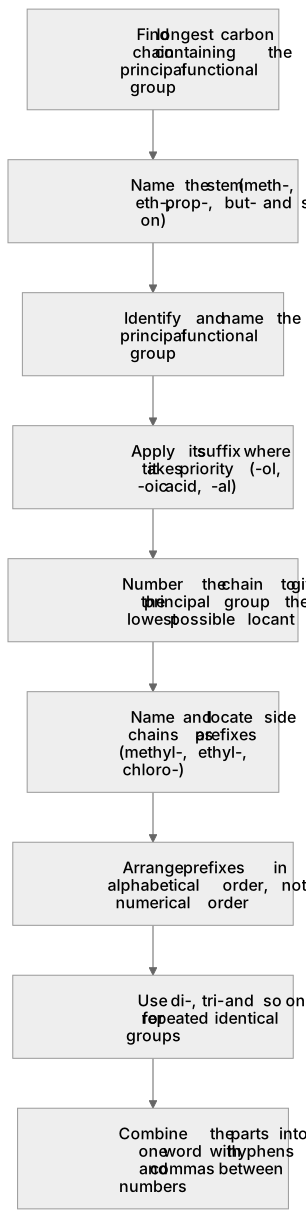
IUPAC nomenclature gives every organic compound a single systematic name. Apply the rules in order. First find the longest carbon chain containing the principal functional group; this gives the stem (meth-, eth-, prop-, but- and so on). Identify and name any functional group, using its suffix where it takes priority (for example -ol, -oic acid, -al). Number the chain so the principal group, or the first point of difference, gets the lowest possible locant. Name and locate side chains as prefixes (methyl-, ethyl-, chloro-) in alphabetical order, not numerical order. Use di-, tri- and so on for repeated identical groups. Combine the parts into one word with hyphens and commas between numbers. Practise working from a displayed or skeletal formula to a name, and back again.
What earns the marks
- Selects the longest carbon chain that contains the principal functional group as the parent chain.
- Numbers the parent chain to give the principal functional group the lowest possible locant.
- Names substituents as prefixes and arranges them in alphabetical order rather than numerical order.
- Uses multiplying prefixes such as di- and tri- for repeated identical substituents.
- Applies the correct suffix for the principal functional group, for example -ol for an alcohol or -oic acid for a carboxylic acid.
Common mistakes and how to put them right
Numbers the chain from the end nearest a substituent rather than the end giving the principal group the lowest locant.
Put it right: Prioritise the principal functional group.
Orders substituents by their position number instead of alphabetically.
Put it right: List them alphabetically.
Chooses a shorter chain that appears to contain a group but misses a longer parent chain.
Put it right: Recount to find the longest chain.
Omits multiplying prefixes when the same group appears more than once.
Put it right: Use di-, tri- and so on.
Exam tips
- Identify the principal functional group first, because it decides the suffix and the numbering.
- Number from the end that gives the lowest locant to the principal group, then check substituent locants.
- Write substituents alphabetically and use commas between numbers and hyphens between numbers and letters.
- Check the final name against the structure by rebuilding it from the name.
Try the lesson
The start of the Basic concepts of organic chemistry: (a) application of IUPAC rules of nomenclature for systematically naming organic compounds lesson, made from teaching notes for this specification point.
Listen
IUPAC nomenclature gives every organic compound a single systematic name. Apply the rules in order. First find the longest carbon chain containing the principal functional group; this gives the stem (meth-, eth-, prop-, but- and so on). Identify and name any functional group, using its suffix where it takes priority (for example -ol, -oic acid, -al). Number the chain so the principal group, or the first point of difference, gets the lowest possible locant. Name and locate side chains as prefixes (methyl-, ethyl-, chloro-) in alphabetical order, not numerical order. Use di-, tri- and so on for repeated identical groups. Combine the parts into one word with hyphens and commas between numbers. Practise working from a displayed or skeletal formula to a name, and back again. A strong answer earns marks for these points. Selects the longest carbon chain that contains the principal functional group as the parent chain. Numbers the parent chain to give the principal functional group the lowest possible locant. Names substituents as prefixes and arranges them in alphabetical order rather than numerical order. Uses multiplying prefixes such as di- and tri- for repeated identical substituents. Exam tip: Identify the principal functional group first, because it decides the suffix and the numbering.
See it
Key words
Say what each word means before you turn the card.
Longest-chain selection
Try answering aloud or in your head before turning the card.
Lowest-locant numbering
Try answering aloud or in your head before turning the card.
Suffixes for principal functional groups
Try answering aloud or in your head before turning the card.
Alphabetical ordering of substituents
Try answering aloud or in your head before turning the card.
See every definition
- Longest-chain selection
- Finding the longest carbon chain containing the principal functional group, which gives the stem such as meth-, eth-, prop- or but-.
- Lowest-locant numbering
- Numbering the chain so the principal group, or the first point of difference, gets the lowest possible locant.
- Suffixes for principal functional groups
- Naming a functional group using its suffix where it takes priority, for example -ol, -oic acid or -al.
- Alphabetical ordering of substituents
- Naming and locating side chains as prefixes such as methyl-, ethyl- and chloro- in alphabetical order, not numerical order.
Label the diagram
Some boxes have lost their names. Pick the right name for each number.
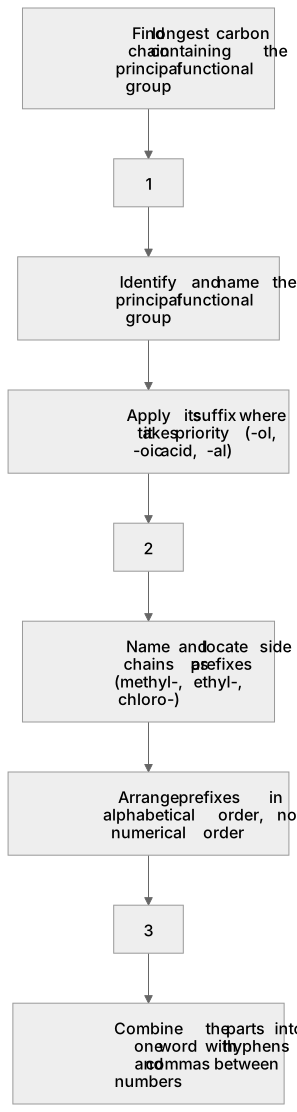
1Box 1
2Box 2
3Box 3
There is more to this lesson
The full lesson goes on to check your understanding and help you earn the marks. Create a free account to carry on, with your progress saved.
A week of Premium from your first lesson · Then the free plan continues · No card, no charge
Test your understanding of Basic concepts of organic chemistry: (a) application of IUPAC rules of nomenclature for systematically naming organic compounds
Active recall beats re-reading. Take an instant quiz now to test what you’ve learned and lock it into long-term memory.
A week of Premium from your first lesson · Then the free plan continues · No card, no charge