OCR · A-Level · Chemistry
Course version: H432 · Version from Sept 2017
Naming and representing the formulae of organic compounds
Full specification wording
Basic concepts of organic chemistry: Naming and representing the formulae of organic compounds
Organic formulae are written in several complementary ways, and each answers a different question.
- Point 1 of 21
- 4 key terms
Study notes
From the teaching notes for this specification point.
The idea
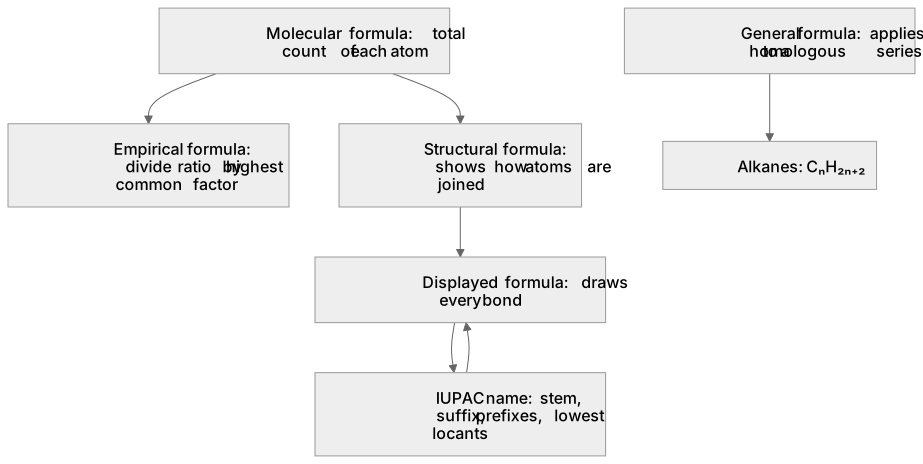
Organic formulae are written in several complementary ways, and each answers a different question. A molecular formula gives the total number of each atom, so ethanol is C₂H₆O. An empirical formula gives the simplest whole-number ratio of atoms; for ethanol the ratio 2:6:1 cannot be divided further, so the empirical formula is also C₂H₆O, whereas ethanoic acid, C₂H₄O₂, simplifies to CH₂O. A general formula applies to a homologous series, such as CₙH₂ₙ₊₂ for alkanes. A structural formula shows how atoms are joined, and a displayed formula draws every bond. Systematic IUPAC names are built from a stem for the carbon chain, a suffix for the principal functional group and prefixes for substituents, numbered to give the lowest locants. Learn to move between name, molecular, empirical, structural and displayed forms, and to check that each representation is consistent with the others.
What earns the marks
- Identifies the molecular formula as the total count of each type of atom in one molecule.
- Derives the empirical formula by dividing the atom ratio by its highest common factor.
- States the general formula of a homologous series such as CₙH₂ₙ₊₂ for alkanes.
- Distinguishes a structural formula, which shows atom connectivity, from a displayed formula, which shows every bond.
- Applies IUPAC rules to construct a systematic name using stem, suffix, prefixes and lowest locants.
Common mistakes and how to put them right
Treats the empirical formula as always identical to the molecular formula.
Put it right: Divide the ratio by its highest common factor and check whether it simplifies.
Writes a general formula with the wrong relationship between carbon and hydrogen.
Put it right: Recall that alkanes follow CₙH₂ₙ₊₂ and alkenes follow CₙH₂ₙ.
Confuses a structural formula with a displayed formula.
Put it right: A displayed formula draws every individual bond.
Numbers substituents from the end that gives the highest locants.
Put it right: Number from the end that gives the lowest locants.
Exam tips
- Read the question carefully to see whether it asks for molecular, empirical, structural or displayed formula before writing anything.
- Simplify the empirical formula fully by dividing by the highest common factor of all the subscripts.
- When naming, identify the longest chain containing the principal functional group first, then number to give the lowest locants.
- Check that the number of hydrogen atoms in your structure matches the valency of each carbon atom.
Try the lesson
The start of the Basic concepts of organic chemistry: Naming and representing the formulae of organic compounds lesson, made from teaching notes for this specification point.
Listen
Organic formulae are written in several complementary ways, and each answers a different question. A molecular formula gives the total number of each atom, so ethanol is C₂H₆O. An empirical formula gives the simplest whole-number ratio of atoms; for ethanol the ratio 2:6:1 cannot be divided further, so the empirical formula is also C₂H₆O, whereas ethanoic acid, C₂H₄O₂, simplifies to CH₂O. A general formula applies to a homologous series, such as CₙH₂ₙ₊₂ for alkanes. A structural formula shows how atoms are joined, and a displayed formula draws every bond. Systematic IUPAC names are built from a stem for the carbon chain, a suffix for the principal functional group and prefixes for substituents, numbered to give the lowest locants. Learn to move between name, molecular, empirical, structural and displayed forms, and to check that each representation is consistent with the others. A strong answer earns marks for these points. Identifies the molecular formula as the total count of each type of atom in one molecule. Derives the empirical formula by dividing the atom ratio by its highest common factor. States the general formula of a homologous series such as CₙH₂ₙ₊₂ for alkanes. Distinguishes a structural formula, which shows atom connectivity, from a displayed formula, which shows every bond. Exam tip: Read the question carefully to see whether it asks for molecular, empirical, structural or displayed formula before writing anything.
See it
Key words
Say what each word means before you turn the card.
Molecular formula
Try answering aloud or in your head before turning the card.
Empirical formula
Try answering aloud or in your head before turning the card.
General formula
Try answering aloud or in your head before turning the card.
Displayed formula
Try answering aloud or in your head before turning the card.
See every definition
- Molecular formula
- Gives the total number of each atom in one molecule, so ethanol is C₂H₆O.
- Empirical formula
- Gives the simplest whole-number ratio of atoms, found by dividing the atom ratio by its highest common factor.
- General formula
- Applies to a homologous series, such as CₙH₂ₙ₊₂ for alkanes.
- Displayed formula
- Draws every bond, unlike a structural formula, which shows how atoms are joined.
Label the diagram
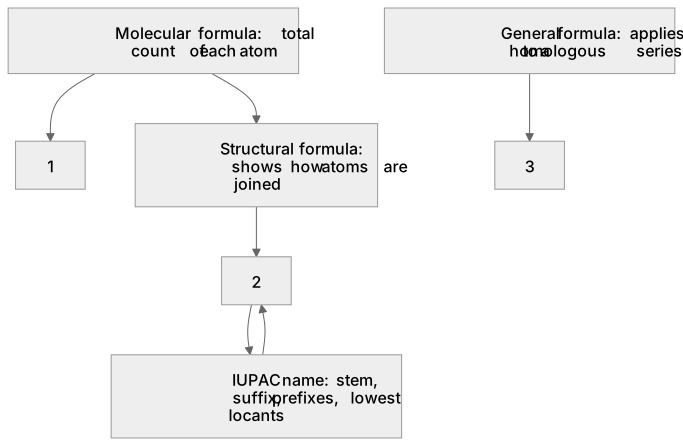
Some boxes have lost their names. Pick the right name for each number.
1Box 1
2Box 2
3Box 3
There is more to this lesson
The full lesson goes on to check your understanding and help you earn the marks. Create a free account to carry on, with your progress saved.
A week of Premium from your first lesson · Then the free plan continues · No card, no charge
Test your understanding of Basic concepts of organic chemistry: Naming and representing the formulae of organic compounds
Active recall beats re-reading. Take an instant quiz now to test what you’ve learned and lock it into long-term memory.
A week of Premium from your first lesson · Then the free plan continues · No card, no charge