OCR · A-Level · Chemistry
Course version: H432 · Version from Sept 2017
(h) a ‘curly arrow’ described as the movement of an electron pair, showing…
Full specification wording
Basic concepts of organic chemistry: (h) a ‘curly arrow’ described as the movement of an electron pair, showing either heterolytic fission or formation of a covalent bond
A curly arrow is a bookkeeping symbol for the movement of one electron pair during a reaction.
- Point 20 of 21
- 4 key terms
Study notes
From the teaching notes for this specification point.
The idea
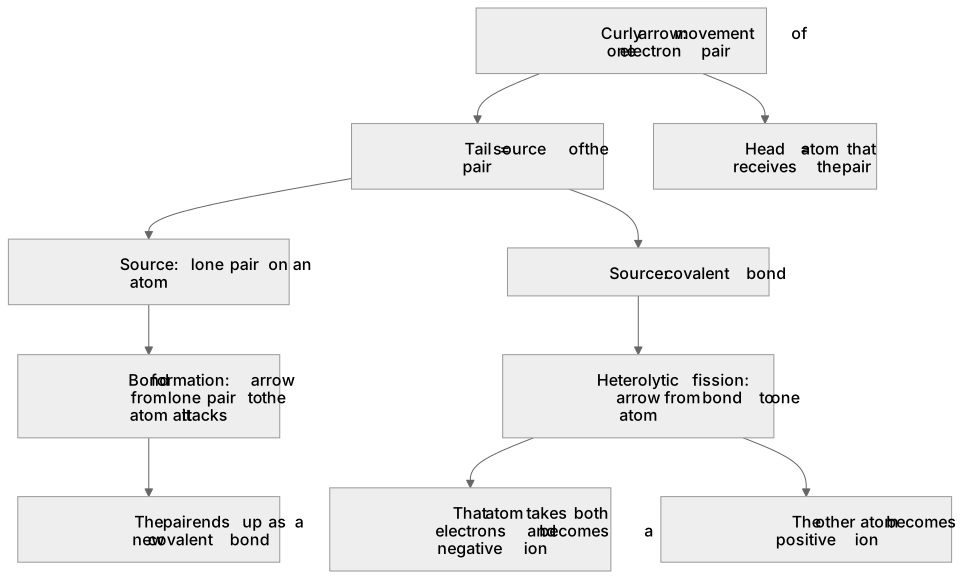
A curly arrow is a bookkeeping symbol for the movement of one electron pair during a reaction. The tail marks where that pair comes from: a lone pair on an atom, or the electron density of a covalent bond. The arrowhead points at the atom that receives the pair, so the pair ends up either as a new lone pair or as a new covalent bond. Heterolytic fission is shown by an arrow starting on a bond and pointing to one of the two atoms, which takes both electrons and becomes a negative ion while the other becomes positive. Bond formation is shown by an arrow from a lone pair on one atom to the atom it attacks. Draw the arrow once, from source to receiving atom, and never from a partial charge.
What earns the marks
- Identifies the tail of a curly arrow as the source of the electron pair, either a lone pair on an atom or a covalent bond.
- States that the arrowhead points to the atom that receives the electron pair.
- Describes heterolytic fission as an arrow from a bond to one atom, giving that atom both electrons of the pair.
- Explains that an arrow from a lone pair to another atom represents formation of a covalent bond.
- Recognises that one curly arrow represents the movement of one electron pair, not a single electron.
Common mistakes and how to put them right
Starts the arrow at a partial charge rather than at a lone pair or a bond.
Put it right: Begin every arrow at a lone pair or at a bond.
Points the arrowhead into empty space between two atoms rather than at the receiving atom.
Put it right: Aim the head at the atom that gains the pair.
Draws one arrow for a single electron rather than for an electron pair.
Put it right: Use one arrow per electron pair moved.
Exam tips
- Check each arrow by naming its source and its receiving atom before moving on.
- For heterolytic fission, confirm the arrow starts on the bond and ends on the atom that keeps both electrons.
- For bond formation, confirm the arrow starts on a lone pair and ends on the atom being attacked.
Try the lesson
The start of the Basic concepts of organic chemistry: (h) a ‘curly arrow’ described as the movement of an electron pair, showing either heterolytic fission or formation of a covalent bond lesson, made from teaching notes for this specification point.
Listen
A curly arrow is a bookkeeping symbol for the movement of one electron pair during a reaction. The tail marks where that pair comes from: a lone pair on an atom, or the electron density of a covalent bond. The arrowhead points at the atom that receives the pair, so the pair ends up either as a new lone pair or as a new covalent bond. Heterolytic fission is shown by an arrow starting on a bond and pointing to one of the two atoms, which takes both electrons and becomes a negative ion while the other becomes positive. Bond formation is shown by an arrow from a lone pair on one atom to the atom it attacks. Draw the arrow once, from source to receiving atom, and never from a partial charge. A strong answer earns marks for these points. Identifies the tail of a curly arrow as the source of the electron pair, either a lone pair on an atom or a covalent bond. States that the arrowhead points to the atom that receives the electron pair. Describes heterolytic fission as an arrow from a bond to one atom, giving that atom both electrons of the pair. Explains that an arrow from a lone pair to another atom represents formation of a covalent bond. Exam tip: Check each arrow by naming its source and its receiving atom before moving on.
See it
Key words
Say what each word means before you turn the card.
Curly arrow notation
Try answering aloud or in your head before turning the card.
Electron pair movement
Try answering aloud or in your head before turning the card.
Heterolytic fission
Try answering aloud or in your head before turning the card.
Covalent bond formation
Try answering aloud or in your head before turning the card.
See every definition
- Curly arrow notation
- A symbol for the movement of one electron pair, with the tail marking the source and the arrowhead pointing at the atom that receives the pair.
- Electron pair movement
- One curly arrow represents the movement of one electron pair, not a single electron.
- Heterolytic fission
- Shown by an arrow starting on a bond and pointing to one of the two atoms, which takes both electrons and becomes a negative ion while the other becomes positive.
- Covalent bond formation
- Shown by an arrow from a lone pair on one atom to the atom it attacks.
Label the diagram
Some boxes have lost their names. Pick the right name for each number.
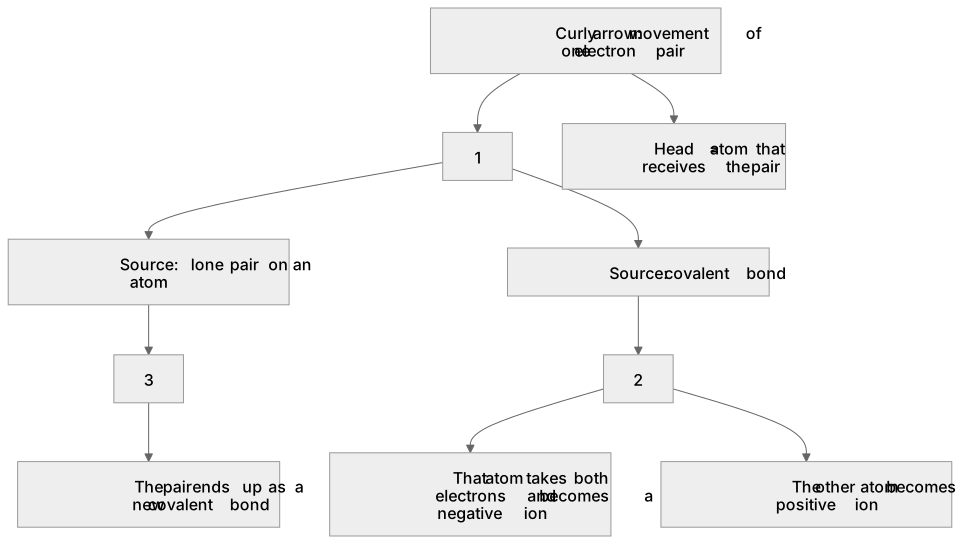
1Box 1
2Box 2
3Box 3
There is more to this lesson
The full lesson goes on to check your understanding and help you earn the marks. Create a free account to carry on, with your progress saved.
A week of Premium from your first lesson · Then the free plan continues · No card, no charge
Test your understanding of Basic concepts of organic chemistry: (h) a ‘curly arrow’ described as the movement of an electron pair, showing either heterolytic fission or formation of a covalent bond
Active recall beats re-reading. Take an instant quiz now to test what you’ve learned and lock it into long-term memory.
A week of Premium from your first lesson · Then the free plan continues · No card, no charge