OCR · A-Level · Chemistry
Course version: H432 · Version from Sept 2017
(i) reaction mechanisms, using diagrams, to show clearly the movement of…
Full specification wording
Basic concepts of organic chemistry: (i) reaction mechanisms, using diagrams, to show clearly the movement of an electron pair with ‘curly arrows’ and relevant dipoles.
A reaction mechanism is a step-by-step diagram of how bonds break and form, and it must show electron movement explicitly.
- Point 21 of 21
- 4 key terms
Study notes
From the teaching notes for this specification point.
The idea
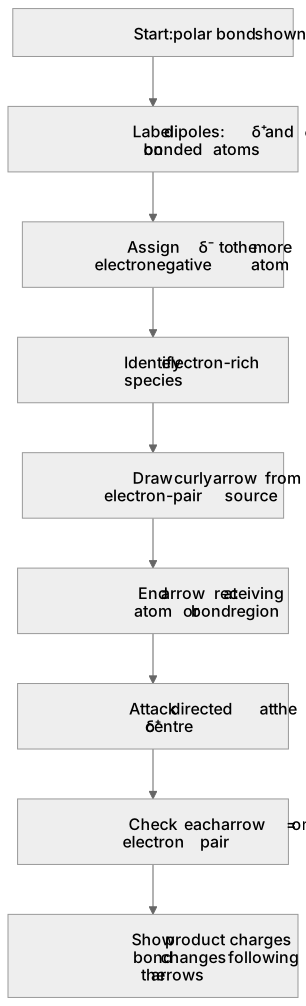
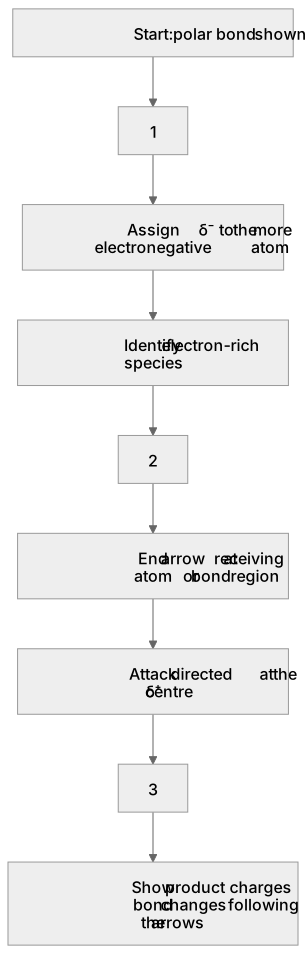
A reaction mechanism is a step-by-step diagram of how bonds break and form, and it must show electron movement explicitly. Each curly arrow represents one electron pair and runs from its source, such as a lone pair or a bond, to its destination, such as an atom or the gap where a new bond forms. Mechanisms also show relevant dipoles, because a polar bond such as C–Cl or C=O carries partial charges that direct where an attacking species sends its pair. Mark the dipole with δ⁺ and δ⁻ on the bonded atoms, choosing the more electronegative atom for δ⁻. Then draw arrows consistent with those charges: an electron-rich species attacks the δ⁺ centre. Check that every arrow starts and ends on a real electron source and destination, and that charges in the products follow from the arrows drawn.
What earns the marks
- Draws a step-by-step mechanism diagram in which each curly arrow represents the movement of one electron pair.
- Starts each arrow at a genuine electron-pair source, such as a lone pair or a bond, and ends it at the receiving atom or bond region.
- Labels relevant bond dipoles with δ⁺ and δ⁻ on the correct atoms according to electronegativity.
- Directs attack consistently with the shown dipole, sending an electron-rich species towards the δ⁺ centre.
- Shows charges and bond changes in the products that follow logically from the arrows drawn.
Common mistakes and how to put them right
Omits dipoles on polar bonds.
Put it right by labelling δ⁺ and δ⁻ where the polarity controls the attack.
Places δ⁻ on the less electronegative atom.
Put it right by assigning δ⁻ to the more electronegative atom of the bond.
Draws arrows that contradict the dipole, attacking the δ⁻ centre.
Put it right by aiming the electron pair at the δ⁺ atom.
Exam tips
- Draw dipoles before arrows so the direction of attack is justified by the diagram.
- Use one arrow per electron pair and check the count of pairs is unchanged.
- Confirm that the charges shown on products can be traced back to specific arrows.
Try the lesson
The start of the Basic concepts of organic chemistry: (i) reaction mechanisms, using diagrams, to show clearly the movement of an electron pair with ‘curly arrows’ and relevant dipoles. lesson, made from teaching notes for this specification point.
Listen
A reaction mechanism is a step-by-step diagram of how bonds break and form, and it must show electron movement explicitly. Each curly arrow represents one electron pair and runs from its source, such as a lone pair or a bond, to its destination, such as an atom or the gap where a new bond forms. Mechanisms also show relevant dipoles, because a polar bond such as C–Cl or C=O carries partial charges that direct where an attacking species sends its pair. Mark the dipole with δ⁺ and δ⁻ on the bonded atoms, choosing the more electronegative atom for δ⁻. Then draw arrows consistent with those charges: an electron-rich species attacks the δ⁺ centre. Check that every arrow starts and ends on a real electron source and destination, and that charges in the products follow from the arrows drawn. A strong answer earns marks for these points. Draws a step-by-step mechanism diagram in which each curly arrow represents the movement of one electron pair. Starts each arrow at a genuine electron-pair source, such as a lone pair or a bond, and ends it at the receiving atom or bond region. Labels relevant bond dipoles with δ⁺ and δ⁻ on the correct atoms according to electronegativity. Directs attack consistently with the shown dipole, sending an electron-rich species towards the δ⁺ centre. A common slip: Omits dipoles on polar bonds. Instead, labelling δ⁺ and δ⁻ where the polarity controls the attack. Exam tip: Draw dipoles before arrows so the direction of attack is justified by the diagram.
See it
Key words
Say what each word means before you turn the card.
Reaction mechanisms
Try answering aloud or in your head before turning the card.
Curly arrow notation
Try answering aloud or in your head before turning the card.
Electron-pair movement
Try answering aloud or in your head before turning the card.
Bond dipoles and partial charges
Try answering aloud or in your head before turning the card.
See every definition
- Reaction mechanisms
- Step-by-step diagrams of how bonds break and form, showing electron movement explicitly.
- Curly arrow notation
- Each arrow represents one electron pair and runs from its source, such as a lone pair or a bond, to its destination.
- Electron-pair movement
- An arrow starts at a genuine electron-pair source and ends at the receiving atom or bond region.
- Bond dipoles and partial charges
- A polar bond carries partial charges marked with δ⁺ and δ⁻, with the more electronegative atom chosen for δ⁻.
Label the diagram
Some boxes have lost their names. Pick the right name for each number.
1Box 1
2Box 2
3Box 3
There is more to this lesson
The full lesson goes on to check your understanding and help you earn the marks. Create a free account to carry on, with your progress saved.
A week of Premium from your first lesson · Then the free plan continues · No card, no charge
Test your understanding of Basic concepts of organic chemistry: (i) reaction mechanisms, using diagrams, to show clearly the movement of an electron pair with ‘curly arrows’ and relevant dipoles.
Active recall beats re-reading. Take an instant quiz now to test what you’ve learned and lock it into long-term memory.
A week of Premium from your first lesson · Then the free plan continues · No card, no charge