OCR · A-Level · Chemistry
Course version: H432 · Version from Sept 2017
(i) homologous series (a series of organic compounds having the same…
Full specification wording
Basic concepts of organic chemistry: (i) homologous series (a series of organic compounds having the same functional group but with each successive member differing by CH₂)
A homologous series is a family of organic compounds that share the same functional group, so they react in similar ways, and in which each successive member differs from the previous one by a CH₂…
- Point 8 of 21
- 4 key terms
Study notes
From the teaching notes for this specification point.
The idea
A homologous series is a family of organic compounds that share the same functional group, so they react in similar ways, and in which each successive member differs from the previous one by a CH₂ unit. That CH₂ step means relative molecular mass rises by 14 each time (C = 12, H₂ = 2, so 12 + 2 = 14) and the general formula stays the same. For example, methanol CH₃OH, ethanol C₂H₅OH and propan-1-ol C₃H₇OH form part of the alcohol series: each adds one carbon and two hydrogens. Members also show a gradual trend in physical properties such as boiling point as chain length increases. Check that a proposed pair really shares the functional group and differs by exactly CH₂ before calling them successive members.
What earns the marks
- States that members of a homologous series share the same functional group.
- Explains that each successive member differs from the previous member by a CH₂ unit.
- Applies the definition to a named example, such as methanol, ethanol and propan-1-ol in the alcohol series.
- Recognises that a CH₂ difference corresponds to a relative molecular mass increase of 14.
Common mistakes and how to put them right
Confuses a homologous series with an isomer family.
Put it right: Isomers share a molecular formula, whereas successive homologues differ by CH₂.
Accepts any two compounds with similar formulae as successive members without checking they share the same functional group.
Forgets that the CH₂ step raises relative molecular mass by 14.
Put it right: Recalculate 12 + 2 rather than guessing.
Exam tips
- Underline the two tests in the definition: same functional group, and successive members differ by CH₂.
- When checking a pair, count carbons and hydrogens to confirm the difference is exactly one carbon and two hydrogens.
- Link the CH₂ step to a relative molecular mass increase of 14 to answer numerical options quickly.
Try the lesson
The start of the Basic concepts of organic chemistry: (i) homologous series (a series of organic compounds having the same functional group but with each successive member differing by CH₂) lesson, made from teaching notes for this specification point.
Listen
A homologous series is a family of organic compounds that share the same functional group, so they react in similar ways, and in which each successive member differs from the previous one by a CH₂ unit. That CH₂ step means relative molecular mass rises by 14 each time (C = 12, H₂ = 2, so 12 + 2 = 14) and the general formula stays the same. For example, methanol CH₃OH, ethanol C₂H₅OH and propan-1-ol C₃H₇OH form part of the alcohol series: each adds one carbon and two hydrogens. Members also show a gradual trend in physical properties such as boiling point as chain length increases. Check that a proposed pair really shares the functional group and differs by exactly CH₂ before calling them successive members. A strong answer earns marks for these points. States that members of a homologous series share the same functional group. Explains that each successive member differs from the previous member by a CH₂ unit. Applies the definition to a named example, such as methanol, ethanol and propan-1-ol in the alcohol series. Recognises that a CH₂ difference corresponds to a relative molecular mass increase of 14. Exam tip: Underline the two tests in the definition: same functional group, and successive members differ by CH₂.
See it
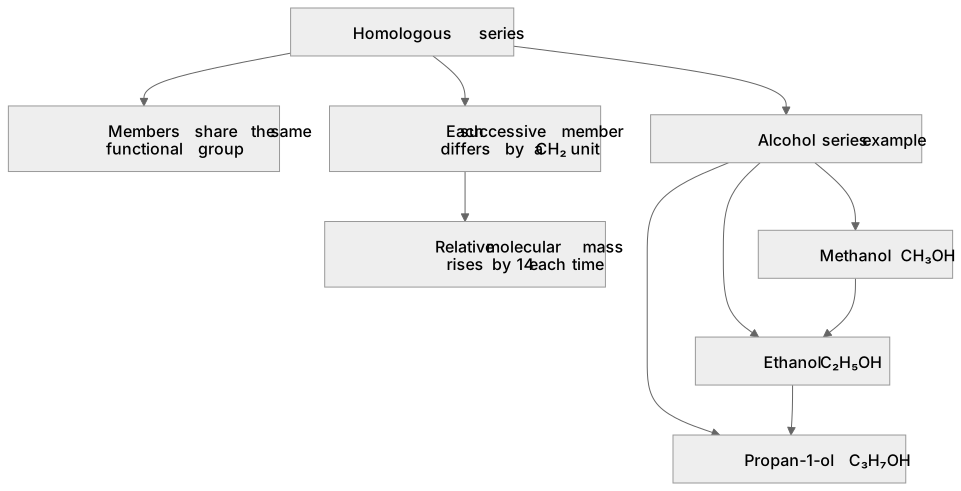
Key words
Say what each word means before you turn the card.
Homologous series
Try answering aloud or in your head before turning the card.
Same functional group across a series
Try answering aloud or in your head before turning the card.
Successive members differ by CH₂
Try answering aloud or in your head before turning the card.
General formula and relative molecular mass
Try answering aloud or in your head before turning the card.
See every definition
- Homologous series
- A series of organic compounds having the same functional group but with each successive member differing by CH₂.
- Same functional group across a series
- Members of a homologous series share the same functional group, so they react in similar ways.
- Successive members differ by CH₂
- Each successive member differs from the previous one by a CH₂ unit, adding one carbon and two hydrogens.
- General formula and relative molecular mass
- The general formula stays the same, and the CH₂ step means relative molecular mass rises by 14 each time.
Label the diagram
Some boxes have lost their names. Pick the right name for each number.
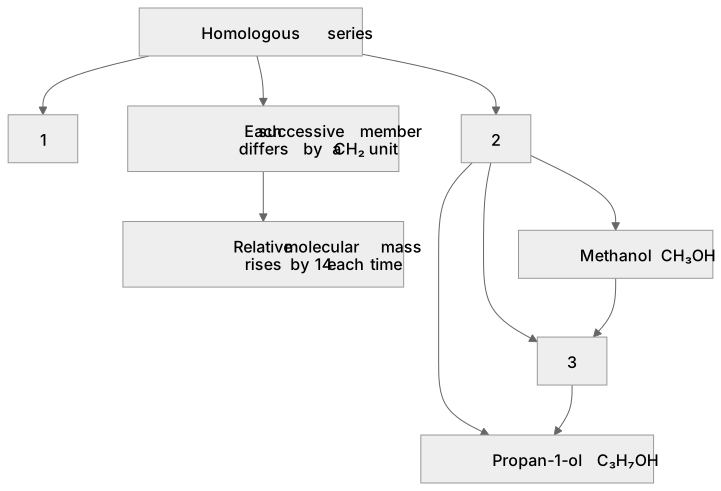
1Box 1
2Box 2
3Box 3
There is more to this lesson
The full lesson goes on to check your understanding and help you earn the marks. Create a free account to carry on, with your progress saved.
A week of Premium from your first lesson · Then the free plan continues · No card, no charge
Test your understanding of Basic concepts of organic chemistry: (i) homologous series (a series of organic compounds having the same functional group but with each successive member differing by CH₂)
Active recall beats re-reading. Take an instant quiz now to test what you’ve learned and lock it into long-term memory.
A week of Premium from your first lesson · Then the free plan continues · No card, no charge