OCR · A-Level · Chemistry
Course version: H432 · Version from Sept 2017
(ii) functional group (a group of atoms responsible for the characteristic…
Full specification wording
Basic concepts of organic chemistry: (ii) functional group (a group of atoms responsible for the characteristic reactions of a compound)
A functional group is a group of atoms within a molecule that is responsible for the characteristic reactions of a compound.
- Point 9 of 21
- 4 key terms
Study notes
From the teaching notes for this specification point.
The idea
A functional group is a group of atoms within a molecule that is responsible for the characteristic reactions of a compound. The definition has two parts that must both hold: the group is a defined cluster of atoms, and it governs how the compound typically reacts. So the hydroxyl group in ethanol, written as OH, makes ethanol behave as an alcohol, reacting with sodium to give hydrogen and with acidified dichromate(VI) to give ethanoic acid. The hydrocarbon chain attached to the group mainly tunes physical properties such as boiling point; the functional group drives the chemistry. Recognise the group from a displayed or skeletal formula, name it, and predict the reaction type it allows.
What earns the marks
- Identifies a functional group as a group of atoms within a molecule that determines the characteristic reactions of the compound.
- States that the functional group, not the carbon chain length, controls the characteristic reaction type of the compound.
- Recognises a named functional group such as the hydroxyl group in an alcohol or the carboxyl group in a carboxylic acid from a displayed formula.
- Links a recognised functional group to a characteristic reaction, for example an alcohol reacting with sodium to release hydrogen.
Common mistakes and how to put them right
Treats the whole carbon chain as the functional group.
Put it right: Restrict the functional group to the specific cluster of atoms that governs the reactions.
Assumes any oxygen-containing group behaves identically.
Put it right: Distinguish the hydroxyl group of an alcohol from the carboxyl group of a carboxylic acid by their reactions.
Ignores the reaction clause and defines a functional group only as a group of atoms.
Put it right: Include that it is responsible for the characteristic reactions.
Exam tips
- Learn the definition as two linked ideas: a group of atoms and the characteristic reactions it causes.
- Practise spotting functional groups in skeletal formulae, where OH and COOH may be drawn without every hydrogen shown.
- When a question asks for a functional group, name it precisely rather than describing the whole molecule.
Try the lesson
The start of the Basic concepts of organic chemistry: (ii) functional group (a group of atoms responsible for the characteristic reactions of a compound) lesson, made from teaching notes for this specification point.
Listen
A functional group is a group of atoms within a molecule that is responsible for the characteristic reactions of a compound. The definition has two parts that must both hold: the group is a defined cluster of atoms, and it governs how the compound typically reacts. So the hydroxyl group in ethanol, written as OH, makes ethanol behave as an alcohol, reacting with sodium to give hydrogen and with acidified dichromate(VI) to give ethanoic acid. The hydrocarbon chain attached to the group mainly tunes physical properties such as boiling point; the functional group drives the chemistry. Recognise the group from a displayed or skeletal formula, name it, and predict the reaction type it allows. A strong answer earns marks for these points. Identifies a functional group as a group of atoms within a molecule that determines the characteristic reactions of the compound. States that the functional group, not the carbon chain length, controls the characteristic reaction type of the compound. Recognises a named functional group such as the hydroxyl group in an alcohol or the carboxyl group in a carboxylic acid from a displayed formula. Links a recognised functional group to a characteristic reaction, for example an alcohol reacting with sodium to release hydrogen. Exam tip: Learn the definition as two linked ideas: a group of atoms and the characteristic reactions it causes.
See it
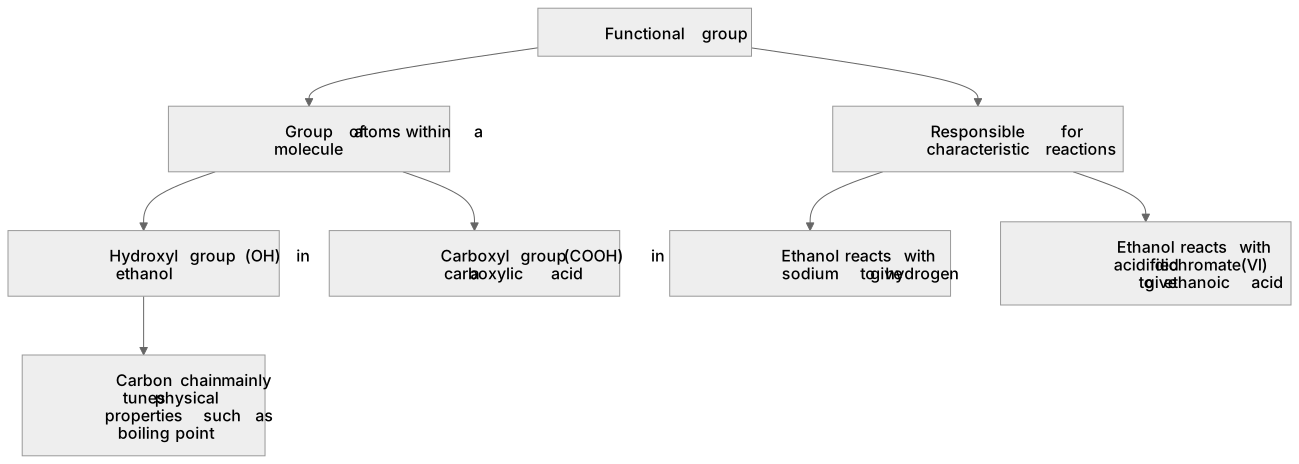
Key words
Say what each word means before you turn the card.
Functional group
Try answering aloud or in your head before turning the card.
Hydroxyl group
Try answering aloud or in your head before turning the card.
Carboxyl group
Try answering aloud or in your head before turning the card.
Characteristic reactions
Try answering aloud or in your head before turning the card.
See every definition
- Functional group
- A group of atoms responsible for the characteristic reactions of a compound.
- Hydroxyl group
- The OH group in ethanol, which makes ethanol behave as an alcohol.
- Carboxyl group
- A named functional group of a carboxylic acid, recognisable from a displayed formula.
- Characteristic reactions
- The reactions of a compound that the functional group, not the carbon chain length, controls.
Label the diagram
Some boxes have lost their names. Pick the right name for each number.
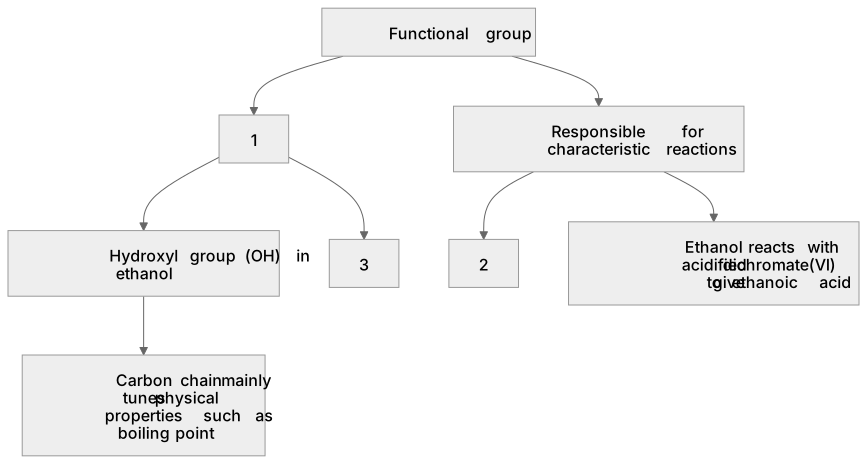
1Box 1
2Box 2
3Box 3
There is more to this lesson
The full lesson goes on to check your understanding and help you earn the marks. Create a free account to carry on, with your progress saved.
A week of Premium from your first lesson · Then the free plan continues · No card, no charge
Test your understanding of Basic concepts of organic chemistry: (ii) functional group (a group of atoms responsible for the characteristic reactions of a compound)
Active recall beats re-reading. Take an instant quiz now to test what you’ve learned and lock it into long-term memory.
A week of Premium from your first lesson · Then the free plan continues · No card, no charge