OCR · A-Level · Chemistry
Course version: H432 · Version from Sept 2017
(iv) aliphatic (a compound containing carbon and hydrogen joined together…
Full specification wording
Basic concepts of organic chemistry: (iv) aliphatic (a compound containing carbon and hydrogen joined together in straight chains, branched chains or non-aromatic rings)
An aliphatic compound is one whose carbon skeleton is not aromatic: the carbon and hydrogen atoms are joined together in straight chains, branched chains or non-aromatic rings.
- Point 11 of 21
- 4 key terms
Study notes
From the teaching notes for this specification point.
The idea
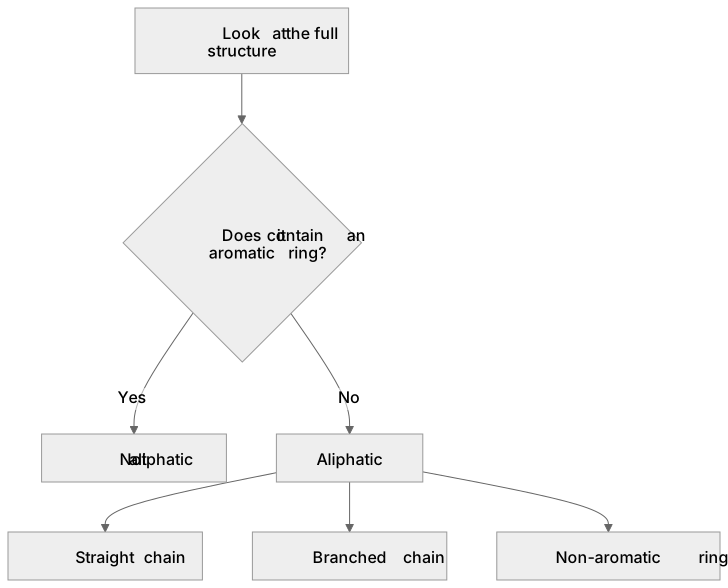
An aliphatic compound is one whose carbon skeleton is not aromatic: the carbon and hydrogen atoms are joined together in straight chains, branched chains or non-aromatic rings. So propane (a straight chain), 2-methylbutane (a branched chain) and cyclohexane (a non-aromatic ring) are all aliphatic, while benzene, with its delocalised ring, is not. When a multiple-choice option offers a structure, decide whether any aromatic ring is present; if none is, the compound is aliphatic. Check the whole structure, because a molecule can contain a ring and still be aliphatic provided that ring is not aromatic.
What earns the marks
- Selects the structure whose carbon and hydrogen atoms form only straight chains, branched chains or non-aromatic rings.
- Rejects an option that contains an aromatic ring because an aromatic ring is excluded from the aliphatic definition.
- Recognises a branched-chain example such as 2-methylbutane as aliphatic.
- Recognises a non-aromatic ring example such as cyclohexane as aliphatic.
Common mistakes and how to put them right
Assumes every ring is aromatic.
Put it right: Check whether the ring is aromatic before rejecting it, since a non-aromatic ring is still aliphatic.
Treats aliphatic as meaning only straight-chain compounds.
Put it right: Include branched chains and non-aromatic rings as well.
Confuses aliphatic with a functional-group class.
Put it right: Base the decision on the carbon skeleton, not on the presence of a functional group.
Exam tips
- Read each option's full structure before deciding, rather than judging from the name alone.
- Ask one question of each option: does it contain an aromatic ring? If not, it can be aliphatic.
- Eliminate options that show a delocalised aromatic ring first, then choose among the remainder.
Try the lesson
The start of the Basic concepts of organic chemistry: (iv) aliphatic (a compound containing carbon and hydrogen joined together in straight chains, branched chains or non-aromatic rings) lesson, made from teaching notes for this specification point.
Listen
An aliphatic compound is one whose carbon skeleton is not aromatic: the carbon and hydrogen atoms are joined together in straight chains, branched chains or non-aromatic rings. So propane (a straight chain), 2-methylbutane (a branched chain) and cyclohexane (a non-aromatic ring) are all aliphatic, while benzene, with its delocalised ring, is not. When a multiple-choice option offers a structure, decide whether any aromatic ring is present; if none is, the compound is aliphatic. Check the whole structure, because a molecule can contain a ring and still be aliphatic provided that ring is not aromatic. A strong answer earns marks for these points. Selects the structure whose carbon and hydrogen atoms form only straight chains, branched chains or non-aromatic rings. Rejects an option that contains an aromatic ring because an aromatic ring is excluded from the aliphatic definition. Recognises a branched-chain example such as 2-methylbutane as aliphatic. Recognises a non-aromatic ring example such as cyclohexane as aliphatic. Exam tip: Read each option's full structure before deciding, rather than judging from the name alone.
See it
Key words
Say what each word means before you turn the card.
Aliphatic
Try answering aloud or in your head before turning the card.
Straight chains
Try answering aloud or in your head before turning the card.
Branched chains
Try answering aloud or in your head before turning the card.
Non-aromatic rings
Try answering aloud or in your head before turning the card.
See every definition
- Aliphatic
- A compound containing carbon and hydrogen joined together in straight chains, branched chains or non-aromatic rings.
- Straight chains
- One way in which the carbon and hydrogen of an aliphatic compound are joined together.
- Branched chains
- One way in which the carbon and hydrogen of an aliphatic compound are joined together.
- Non-aromatic rings
- One way in which the carbon and hydrogen of an aliphatic compound are joined together.
There is more to this lesson
The full lesson goes on to check your understanding and help you earn the marks. Create a free account to carry on, with your progress saved.
A week of Premium from your first lesson · Then the free plan continues · No card, no charge
Test your understanding of Basic concepts of organic chemistry: (iv) aliphatic (a compound containing carbon and hydrogen joined together in straight chains, branched chains or non-aromatic rings)
Active recall beats re-reading. Take an instant quiz now to test what you’ve learned and lock it into long-term memory.
A week of Premium from your first lesson · Then the free plan continues · No card, no charge