OCR · A-Level · Chemistry
Course version: H432 · Version from Sept 2017
Basic concepts of organic chemistry: (iii) alkyl group (of formula CₙH₂ₙ₊₁)
An alkyl group is a saturated hydrocarbon group with the general formula CₙH₂ₙ₊₁, obtained by removing one hydrogen atom from an alkane.
- Point 10 of 21
- 4 key terms
Study notes
From the teaching notes for this specification point.
The idea
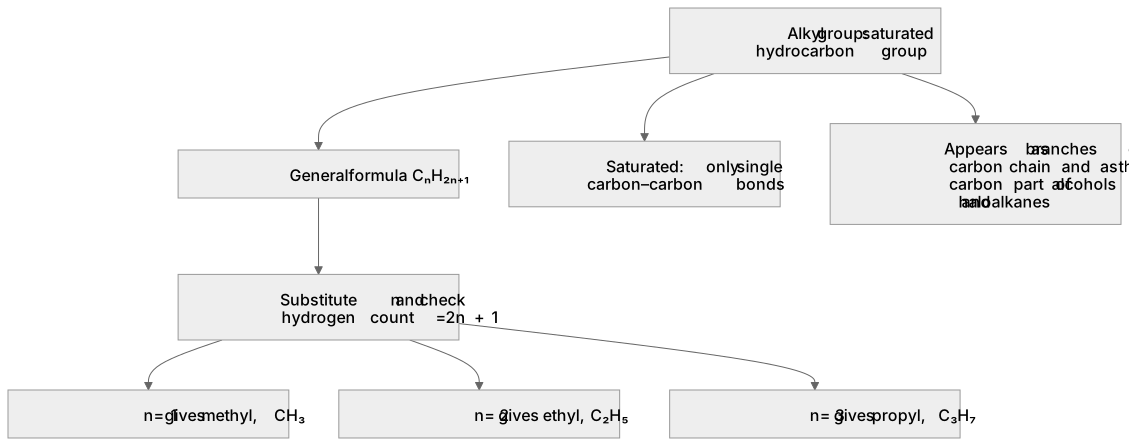
An alkyl group is a saturated hydrocarbon group with the general formula CₙH₂ₙ₊₁, obtained by removing one hydrogen atom from an alkane. The subscript relationship matters: for n carbon atoms there are 2n + 1 hydrogen atoms. So a methyl group has n = 1 and so CH₃, an ethyl group has n = 2 and so C₂H₅, and a propyl group has n = 3 and so C₃H₇. Check any candidate formula by substituting n and confirming the hydrogen count equals 2n + 1. Alkyl groups appear as branches on a carbon chain and as the carbon part of alcohols and haloalkanes. They are saturated, so they contain only single carbon–carbon bonds.
What earns the marks
- Defines an alkyl group as a saturated hydrocarbon group of general formula CₙH₂ₙ₊₁.
- Applies the formula by substituting a value of n and confirming the hydrogen count equals 2n + 1.
- Identifies a named alkyl group such as methyl, CH₃, or ethyl, C₂H₅, from its formula.
- States that an alkyl group is saturated and so contains only single carbon–carbon bonds.
Common mistakes and how to put them right
Uses the alkene general formula for an alkyl group.
Put it right: Apply CₙH₂ₙ₊₁, which gives one more hydrogen than the alkene formula for the same n.
Counts hydrogens incorrectly for a branch.
Put it right: Substitute n into 2n + 1 and check the total.
Describes an alkyl group as unsaturated.
Put it right: State that it is saturated with only single carbon–carbon bonds.
Exam tips
- Substitute a small value of n, such as n = 1 or n = 2, to test whether a formula fits CₙH₂ₙ₊₁.
- Remember that forming an alkyl group removes one hydrogen atom from the parent alkane.
- Distinguish the alkyl formula CₙH₂ₙ₊₁ from the alkene formula CₙH₂ₙ when reading a multiple-choice option.
Try the lesson
The start of the Basic concepts of organic chemistry: (iii) alkyl group (of formula CₙH₂ₙ₊₁) lesson, made from teaching notes for this specification point.
Listen
An alkyl group is a saturated hydrocarbon group with the general formula CₙH₂ₙ₊₁, obtained by removing one hydrogen atom from an alkane. The subscript relationship matters: for n carbon atoms there are 2n + 1 hydrogen atoms. So a methyl group has n = 1 and so CH₃, an ethyl group has n = 2 and so C₂H₅, and a propyl group has n = 3 and so C₃H₇. Check any candidate formula by substituting n and confirming the hydrogen count equals 2n + 1. Alkyl groups appear as branches on a carbon chain and as the carbon part of alcohols and haloalkanes. They are saturated, so they contain only single carbon–carbon bonds. A strong answer earns marks for these points. Defines an alkyl group as a saturated hydrocarbon group of general formula CₙH₂ₙ₊₁. Applies the formula by substituting a value of n and confirming the hydrogen count equals 2n + 1. Identifies a named alkyl group such as methyl, CH₃, or ethyl, C₂H₅, from its formula. States that an alkyl group is saturated and so contains only single carbon–carbon bonds. Exam tip: Substitute a small value of n, such as n = 1 or n = 2, to test whether a formula fits CₙH₂ₙ₊₁.
See it
Key words
Say what each word means before you turn the card.
Alkyl group
Try answering aloud or in your head before turning the card.
General formula of alkyl groups
Try answering aloud or in your head before turning the card.
Naming methyl, ethyl and propyl groups
Try answering aloud or in your head before turning the card.
Saturated hydrocarbon groups
Try answering aloud or in your head before turning the card.
See every definition
- Alkyl group
- A saturated hydrocarbon group of general formula CₙH₂ₙ₊₁, obtained by removing one hydrogen atom from an alkane.
- General formula of alkyl groups
- For n carbon atoms there are 2n + 1 hydrogen atoms, so the formula is CₙH₂ₙ₊₁.
- Naming methyl, ethyl and propyl groups
- A methyl group has n = 1 and so CH₃, an ethyl group has n = 2 and so C₂H₅, and a propyl group has n = 3 and so C₃H₇.
- Saturated hydrocarbon groups
- They are saturated, so they contain only single carbon–carbon bonds.
Label the diagram
Some boxes have lost their names. Pick the right name for each number.
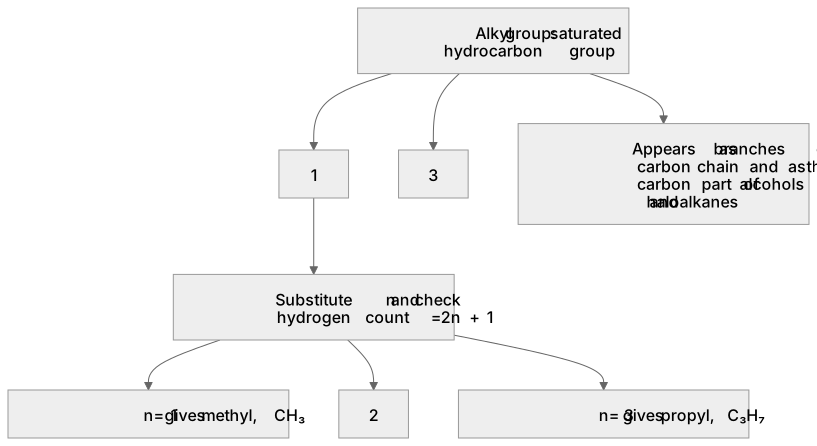
1Box 1
2Box 2
3Box 3
There is more to this lesson
The full lesson goes on to check your understanding and help you earn the marks. Create a free account to carry on, with your progress saved.
A week of Premium from your first lesson · Then the free plan continues · No card, no charge
Test your understanding of Basic concepts of organic chemistry: (iii) alkyl group (of formula CₙH₂ₙ₊₁)
Active recall beats re-reading. Take an instant quiz now to test what you’ve learned and lock it into long-term memory.
A week of Premium from your first lesson · Then the free plan continues · No card, no charge