OCR · A-Level · Chemistry
Course version: H432 · Version from Sept 2017
(vii) saturated (single carbon–carbon bonds only) and unsaturated (the…
Full specification wording
Basic concepts of organic chemistry: (vii) saturated (single carbon–carbon bonds only) and unsaturated (the presence of multiple carbon–carbon bonds, including C=C, C≡C and aromatic rings)
A saturated compound contains only single carbon–carbon bonds, so every carbon is bonded to four atoms by σ bonds, as in ethane CH₃CH₃ or cyclohexane C₆H₁₂.
- Point 14 of 21
- 4 key terms
Study notes
From the teaching notes for this specification point.
The idea
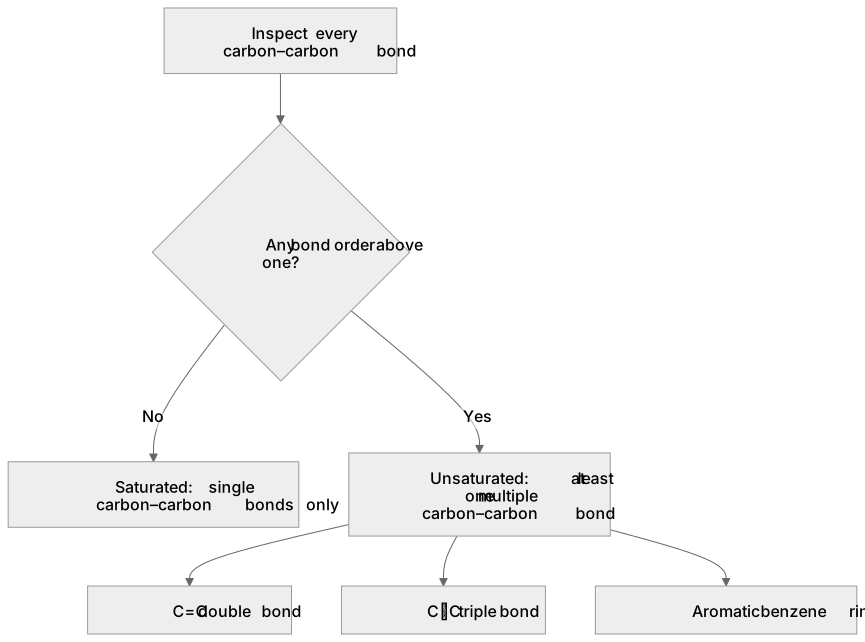
A saturated compound contains only single carbon–carbon bonds, so every carbon is bonded to four atoms by σ bonds, as in ethane CH₃CH₃ or cyclohexane C₆H₁₂. An unsaturated compound contains at least one multiple carbon–carbon bond: a C=C double bond as in ethene CH₂=CH₂, a C≡C triple bond as in ethyne HC≡CH, or an aromatic benzene ring whose delocalised π system also counts as unsaturation. To classify a structure, inspect every carbon–carbon link and ask whether any bond order exceeds one. A molecule can be unsaturated through a ring alone, for example benzene C₆H₆, even though no isolated double bond is drawn. In a multiple-choice question, test each option against all three sources of unsaturation rather than only looking for C=C.
What earns the marks
- Defines a saturated compound as containing single carbon–carbon bonds only.
- Defines an unsaturated compound as containing at least one multiple carbon–carbon bond.
- Recognises C=C and C≡C bonds as sources of unsaturation.
- Recognises an aromatic benzene ring as a source of unsaturation.
- Classifies a given structure as saturated or unsaturated by inspecting its carbon–carbon bonds.
Common mistakes and how to put them right
Assumes a compound is saturated because it contains only carbon and hydrogen.
Put it right: Check the bond orders instead.
Overlooks a benzene ring as a source of unsaturation.
Put it right: Treat the delocalised ring as multiple bonding.
Counts a C–H bond as a multiple bond.
Put it right: Only carbon–carbon multiple bonds create unsaturation.
Exam tips
- Check every carbon–carbon bond in the structure, not just the most obvious one.
- Remember that a benzene ring alone makes a compound unsaturated.
- Eliminate options that contain a C=C, C≡C or benzene ring when asked for a saturated compound.
Try the lesson
The start of the Basic concepts of organic chemistry: (vii) saturated (single carbon–carbon bonds only) and unsaturated (the presence of multiple carbon–carbon bonds, including C=C, C≡C and aromatic rings) lesson, made from teaching notes for this specification point.
Listen
A saturated compound contains only single carbon–carbon bonds, so every carbon is bonded to four atoms by σ bonds, as in ethane CH₃CH₃ or cyclohexane C₆H₁₂. An unsaturated compound contains at least one multiple carbon–carbon bond: a C=C double bond as in ethene CH₂=CH₂, a C≡C triple bond as in ethyne HC≡CH, or an aromatic benzene ring whose delocalised π system also counts as unsaturation. To classify a structure, inspect every carbon–carbon link and ask whether any bond order exceeds one. A molecule can be unsaturated through a ring alone, for example benzene C₆H₆, even though no isolated double bond is drawn. In a multiple-choice question, test each option against all three sources of unsaturation rather than only looking for C=C. A strong answer earns marks for these points. Defines a saturated compound as containing single carbon–carbon bonds only. Defines an unsaturated compound as containing at least one multiple carbon–carbon bond. Recognises C=C and C≡C bonds as sources of unsaturation. Recognises an aromatic benzene ring as a source of unsaturation. Exam tip: Check every carbon–carbon bond in the structure, not just the most obvious one.
See it
Key words
Say what each word means before you turn the card.
Saturated compound
Try answering aloud or in your head before turning the card.
Unsaturated compound
Try answering aloud or in your head before turning the card.
Aromatic ring
Try answering aloud or in your head before turning the card.
Classifying a structure
Try answering aloud or in your head before turning the card.
See every definition
- Saturated compound
- Contains single carbon–carbon bonds only, so every carbon is bonded to four atoms by σ bonds.
- Unsaturated compound
- Contains at least one multiple carbon–carbon bond, including C=C, C≡C and aromatic rings.
- Aromatic ring
- A benzene ring whose delocalised π system also counts as unsaturation, even though no isolated double bond is drawn.
- Classifying a structure
- Inspecting every carbon–carbon link and asking whether any bond order exceeds one.
There is more to this lesson
The full lesson goes on to check your understanding and help you earn the marks. Create a free account to carry on, with your progress saved.
A week of Premium from your first lesson · Then the free plan continues · No card, no charge
Test your understanding of Basic concepts of organic chemistry: (vii) saturated (single carbon–carbon bonds only) and unsaturated (the presence of multiple carbon–carbon bonds, including C=C, C≡C and aromatic rings)
Active recall beats re-reading. Take an instant quiz now to test what you’ve learned and lock it into long-term memory.
A week of Premium from your first lesson · Then the free plan continues · No card, no charge