OCR · A-Level · Chemistry
Course version: H432 · Version from Sept 2017
(d) use of the general formula of a homologous series to predict the…
Full specification wording
Basic concepts of organic chemistry: (d) use of the general formula of a homologous series to predict the formula of any member of the series
A homologous series is a family of organic compounds with the same functional group, the same general formula and similar chemical properties, where successive members differ by a CH₂ unit.
- Point 15 of 21
- 4 key terms
Study notes
From the teaching notes for this specification point.
The idea
A homologous series is a family of organic compounds with the same functional group, the same general formula and similar chemical properties, where successive members differ by a CH₂ unit. To predict a member's formula, take the general formula for that series and substitute the value of n for the member required. For alkanes the general formula is CₙH₂ₙ₊₂, so the member with n = 4 is C₄H₁₀. For alkenes CₙH₂ₙ gives C₄H₈ when n = 4. For alcohols CₙH₂ₙ₊₁OH gives C₄H₉OH when n = 4. Always identify the series first, then apply the correct general formula and substitute n carefully, checking the arithmetic in the subscript.
What earns the marks
- Identifies the homologous series from the functional group before selecting the general formula.
- Applies the correct general formula for the named series, such as CₙH₂ₙ₊₂ for alkanes or CₙH₂ₙ for alkenes.
- Substitutes the value of n correctly and evaluates the subscript arithmetic to give the molecular formula.
- Checks the predicted formula against the pattern that successive members differ by CH₂.
Common mistakes and how to put them right
Uses the alkane general formula for an alkene.
Put it right: Select CₙH₂ₙ for a series containing one C=C double bond.
Miscalculates the subscript when substituting n.
Put it right: Recompute 2n + 2 carefully, for example n = 4 gives H₁₀ not H₈.
Counts the carbon of a functional group separately from n.
Put it right: Include all carbon atoms when n is defined for the whole molecule.
Exam tips
- Name the series and write its general formula before substituting n, so the working is visible.
- Substitute n into the subscript expression and evaluate it step by step to avoid arithmetic slips.
- Sanity-check the answer by confirming it fits the CH₂ spacing pattern of the series.
Try the lesson
The start of the Basic concepts of organic chemistry: (d) use of the general formula of a homologous series to predict the formula of any member of the series lesson, made from teaching notes for this specification point.
Listen
A homologous series is a family of organic compounds with the same functional group, the same general formula and similar chemical properties, where successive members differ by a CH₂ unit. To predict a member's formula, take the general formula for that series and substitute the value of n for the member required. For alkanes the general formula is CₙH₂ₙ₊₂, so the member with n = 4 is C₄H₁₀. For alkenes CₙH₂ₙ gives C₄H₈ when n = 4. For alcohols CₙH₂ₙ₊₁OH gives C₄H₉OH when n = 4. Always identify the series first, then apply the correct general formula and substitute n carefully, checking the arithmetic in the subscript. A strong answer earns marks for these points. Identifies the homologous series from the functional group before selecting the general formula. Applies the correct general formula for the named series, such as CₙH₂ₙ₊₂ for alkanes or CₙH₂ₙ for alkenes. Substitutes the value of n correctly and evaluates the subscript arithmetic to give the molecular formula. Checks the predicted formula against the pattern that successive members differ by CH₂. Exam tip: Name the series and write its general formula before substituting n, so the working is visible.
See it
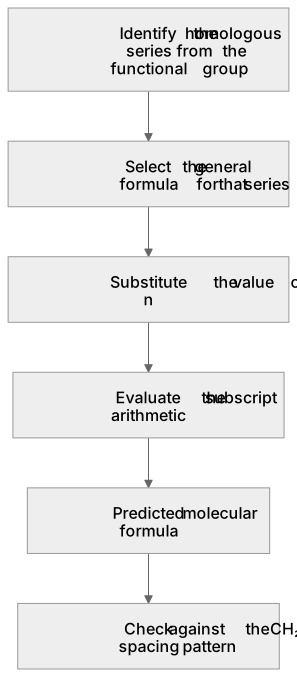
Put it in order
Put these steps in the order they happen.
- 1. Substitute the value of n
- 2. Select the general formula for that series
- 3. Identify the homologous series from the functional group
- 4. Check against the CH₂ spacing pattern
- 5. Predicted molecular formula
- 6. Evaluate the subscript arithmetic
Key words
Say what each word means before you turn the card.
Homologous series
Try answering aloud or in your head before turning the card.
General formula
Try answering aloud or in your head before turning the card.
Substitution of n
Try answering aloud or in your head before turning the card.
Molecular formula prediction
Try answering aloud or in your head before turning the card.
See every definition
- Homologous series
- A family of organic compounds with the same functional group, the same general formula and similar chemical properties, where successive members differ by a CH₂ unit.
- General formula
- The formula of a homologous series into which the value of n is substituted to predict the formula of any member of the series.
- Substitution of n
- Taking the general formula for a series and substituting the value of n for the member required, checking the arithmetic in the subscript.
- Molecular formula prediction
- Identifying the series from the functional group first, then applying the correct general formula and substituting n carefully to give the molecular formula.
Label the diagram
Some boxes have lost their names. Pick the right name for each number.
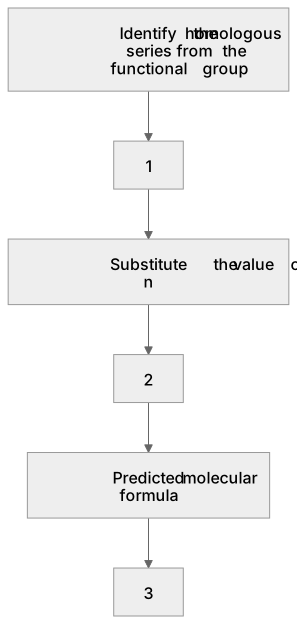
1Box 1
2Box 2
3Box 3
There is more to this lesson
The full lesson goes on to check your understanding and help you earn the marks. Create a free account to carry on, with your progress saved.
A week of Premium from your first lesson · Then the free plan continues · No card, no charge
Test your understanding of Basic concepts of organic chemistry: (d) use of the general formula of a homologous series to predict the formula of any member of the series
Active recall beats re-reading. Take an instant quiz now to test what you’ve learned and lock it into long-term memory.
A week of Premium from your first lesson · Then the free plan continues · No card, no charge