OCR · A-Level · Chemistry
Course version: H432 · Version from Sept 2017
(g) the shapes of, and bond angles in, molecules and ions with up to six…
Full specification wording
Bonding and structure: (g) the shapes of, and bond angles in, molecules and ions with up to six electron pairs (including lone pairs) surrounding the central atom as predicted by electron pair repulsion, including the relative repulsive strengths of bonded pairs and lone pairs of electrons
Electron pair repulsion treats every pair of electrons around a central atom as a charge cloud that pushes other pairs away, so the pairs spread out as far as possible.
- Point 13 of 24
- 4 key terms
Study notes
From the teaching notes for this specification point.
The idea
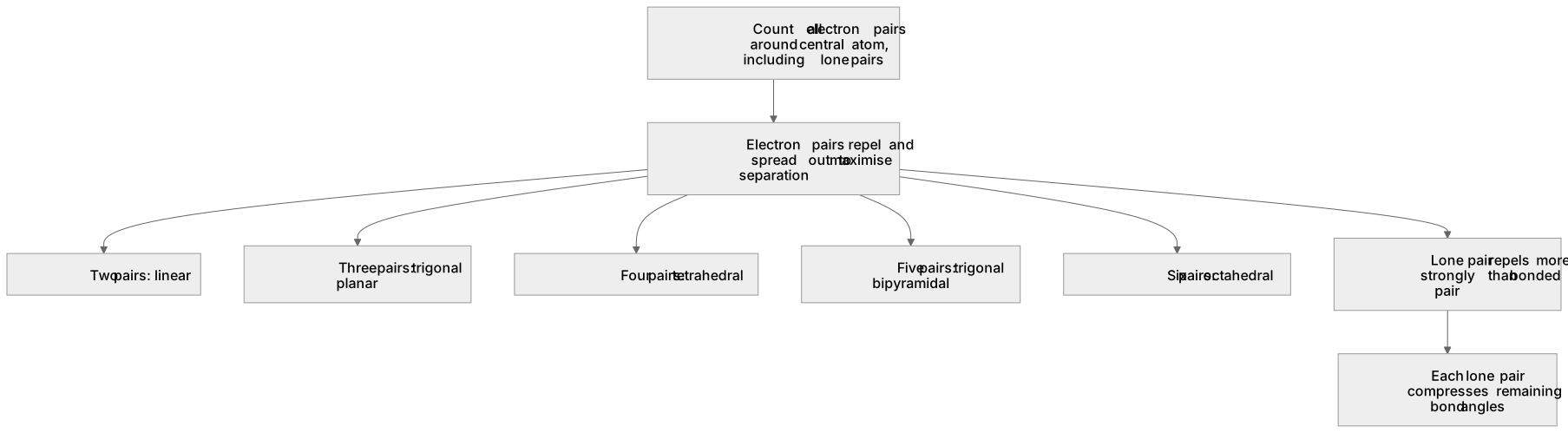
Electron pair repulsion treats every pair of electrons around a central atom as a charge cloud that pushes other pairs away, so the pairs spread out as far as possible. Count all pairs, bonding and lone, to fix the total arrangement: two pairs give a linear base arrangement, three trigonal planar, four tetrahedral, five trigonal bipyramidal and six octahedral. Lone pairs repel more strongly than bonded pairs, so each lone pair compresses the remaining bond angles. For example, methane has four bonded pairs and an H–C–H angle of 109.5°, ammonia has three bonded pairs plus one lone pair and an H–N–H angle of 107°, and water has two bonded pairs plus two lone pairs and an H–O–H angle of 104.5°. Multiple bonds count as one region of electron density but repel slightly more than a single bond.
What earns the marks
- Counts all electron pairs around the central atom, including lone pairs, to establish the total number of electron regions.
- States that electron pairs repel each other and adopt an arrangement that maximises their separation.
- Identifies that a lone pair repels more strongly than a bonded pair, so bond angles decrease as lone pairs are added.
- Applies the correct base arrangement for two, three, four, five or six electron pairs around the central atom.
- Explains a quoted bond angle by reference to the number of lone pairs and their greater repulsive strength.
Common mistakes and how to put them right
Counts only bonded pairs and ignores lone pairs.
Put it right: Include every lone pair when fixing the total number of electron regions.
Treats a lone pair as repelling less than a bonded pair.
Put it right: State that lone pairs repel more strongly and compress bond angles.
Assumes all molecules with four electron pairs have identical angles.
Put it right: Adjust the angle downward for each lone pair present.
Counts a double bond as two separate electron regions.
Put it right: Treat a multiple bond as one region of electron density.
Exam tips
- Count electron pairs first, then name the arrangement, then adjust angles for lone pairs in that order.
- Quote a specific angle such as 104.5° for water only when the lone-pair count supports it.
- Use the phrase 'lone pairs repel more than bonded pairs' to justify any angle smaller than the base arrangement.
Try the lesson
The start of the Bonding and structure: (g) the shapes of, and bond angles in, molecules and ions with up to six electron pairs (including lone pairs) surrounding the central atom as predicted by electron pair repulsion, including the relative repulsive strengths of bonded pairs and lone pairs of electrons lesson, made from teaching notes for this specification point.
Listen
Electron pair repulsion treats every pair of electrons around a central atom as a charge cloud that pushes other pairs away, so the pairs spread out as far as possible. Count all pairs, bonding and lone, to fix the total arrangement: two pairs give a linear base arrangement, three trigonal planar, four tetrahedral, five trigonal bipyramidal and six octahedral. Lone pairs repel more strongly than bonded pairs, so each lone pair compresses the remaining bond angles. For example, methane has four bonded pairs and an H–C–H angle of 109.5°, ammonia has three bonded pairs plus one lone pair and an H–N–H angle of 107°, and water has two bonded pairs plus two lone pairs and an H–O–H angle of 104.5°. Multiple bonds count as one region of electron density but repel slightly more than a single bond. A strong answer earns marks for these points. Counts all electron pairs around the central atom, including lone pairs, to establish the total number of electron regions. States that electron pairs repel each other and adopt an arrangement that maximises their separation. Identifies that a lone pair repels more strongly than a bonded pair, so bond angles decrease as lone pairs are added. Applies the correct base arrangement for two, three, four, five or six electron pairs around the central atom. Exam tip: Count electron pairs first, then name the arrangement, then adjust angles for lone pairs in that order.
See it
Key words
Say what each word means before you turn the card.
Electron pair repulsion
Try answering aloud or in your head before turning the card.
Lone pair versus bonded pair repulsion
Try answering aloud or in your head before turning the card.
Shapes of molecules and ions
Try answering aloud or in your head before turning the card.
Bond angles
Try answering aloud or in your head before turning the card.
See every definition
- Electron pair repulsion
- Every pair of electrons around a central atom acts as a charge cloud that pushes other pairs away, so the pairs spread out as far as possible.
- Lone pair versus bonded pair repulsion
- Lone pairs repel more strongly than bonded pairs, so each lone pair compresses the remaining bond angles.
- Shapes of molecules and ions
- Counting all pairs, bonding and lone, fixes the total arrangement: two pairs give a linear base arrangement, three trigonal planar, four tetrahedral, five trigonal bipyramidal and six octahedral.
- Bond angles
- These decrease as lone pairs are added, because a lone pair repels more strongly than a bonded pair.
Label the diagram
Some boxes have lost their names. Pick the right name for each number.
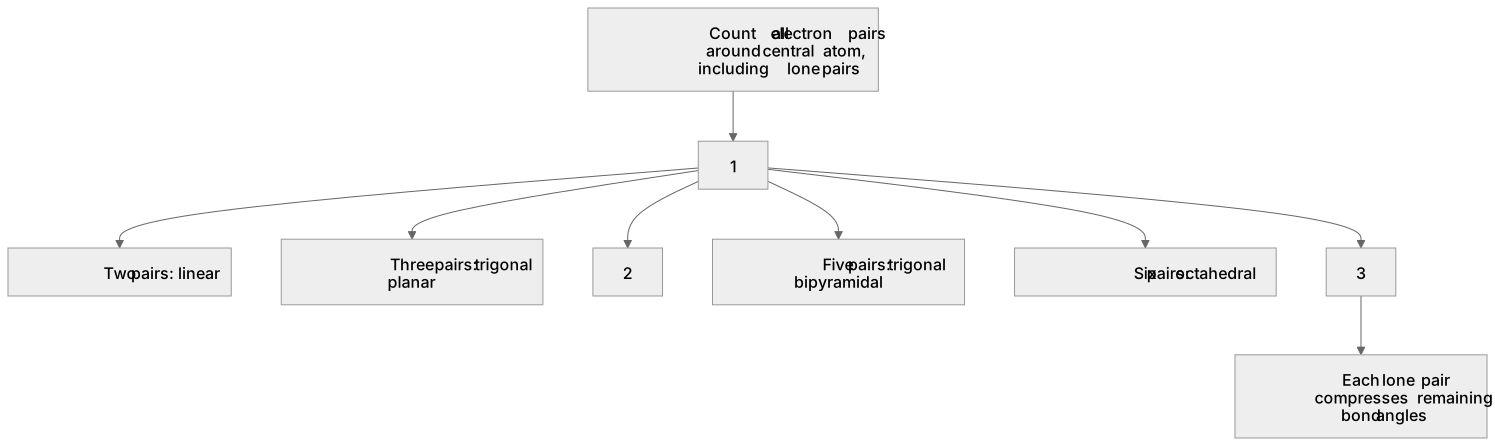
1Box 1
2Box 2
3Box 3
There is more to this lesson
The full lesson goes on to check your understanding and help you earn the marks. Create a free account to carry on, with your progress saved.
A week of Premium from your first lesson · Then the free plan continues · No card, no charge
Test your understanding of Bonding and structure: (g) the shapes of, and bond angles in, molecules and ions with up to six electron pairs (including lone pairs) surrounding the central atom as predicted by electron pair repulsion, including the relative repulsive strengths of bonded pairs and lone pairs of electrons
Active recall beats re-reading. Take an instant quiz now to test what you’ve learned and lock it into long-term memory.
A week of Premium from your first lesson · Then the free plan continues · No card, no charge