OCR · A-Level · Chemistry
Course version: H432 · Version from Sept 2017
Bonding and structure: (ii) multiple covalent bonding
Multiple covalent bonding occurs when two atoms share more than one pair of electrons, forming double bonds (two shared pairs) or triple bonds (three shared pairs).
- Point 9 of 24
- 4 key terms
Study notes
From the teaching notes for this specification point.
The idea
Multiple covalent bonding occurs when two atoms share more than one pair of electrons, forming double bonds (two shared pairs) or triple bonds (three shared pairs). Each shared pair contributes one electron from each bonded atom, so a double bond contains four shared electrons and a triple bond six. Common examples are O₂ (O=O), N₂ (N≡N), CO₂ (O=C=O) and ethene, C₂H₄. Multiple bonds are shorter and stronger than the corresponding single bond between the same atoms, which affects reactivity and shape.
What earns the marks
- Counts the number of shared electron pairs to distinguish a double bond (two pairs) from a triple bond (three pairs).
- Identifies that each atom in a multiple bond contributes one electron to each shared pair.
- Recognises O₂ as containing a double bond and N₂ as containing a triple bond.
- States that a multiple bond is shorter and stronger than the equivalent single bond between the same atoms.
- Applies the octet or stable electron arrangement to confirm the number of bonds formed.
Common mistakes and how to put them right
Counts a double bond as two electrons rather than two shared pairs.
Put it right: A double bond has four shared electrons.
Assumes every molecule with a multiple bond is linear.
Put it right: Check the actual molecular shape rather than the bond order.
Treats a triple bond as three single bonds in separate directions.
Put it right: Recognise it as one region of three shared pairs.
Forgets that both atoms must contribute electrons.
Put it right: Count one electron per atom per shared pair.
Exam tips
- Read the question to see whether it asks for the number of bonds, shared pairs or shared electrons, then answer in that unit.
- Draw the dot-and-cross diagram quickly to count shared pairs before choosing an option.
- Eliminate options that confuse bond order with molecular shape or with bond length.
- Check that each atom in your chosen structure has a full outer shell where the octet applies.
Try the lesson
The start of the Bonding and structure: (ii) multiple covalent bonding lesson, made from teaching notes for this specification point.
Listen
Multiple covalent bonding occurs when two atoms share more than one pair of electrons, forming double bonds (two shared pairs) or triple bonds (three shared pairs). Each shared pair contributes one electron from each bonded atom, so a double bond contains four shared electrons and a triple bond six. Common examples are O₂ (O=O), N₂ (N≡N), CO₂ (O=C=O) and ethene, C₂H₄. Multiple bonds are shorter and stronger than the corresponding single bond between the same atoms, which affects reactivity and shape. A strong answer earns marks for these points. Counts the number of shared electron pairs to distinguish a double bond (two pairs) from a triple bond (three pairs). Identifies that each atom in a multiple bond contributes one electron to each shared pair. Recognises O₂ as containing a double bond and N₂ as containing a triple bond. States that a multiple bond is shorter and stronger than the equivalent single bond between the same atoms. Exam tip: Read the question to see whether it asks for the number of bonds, shared pairs or shared electrons, then answer in that unit.
See it
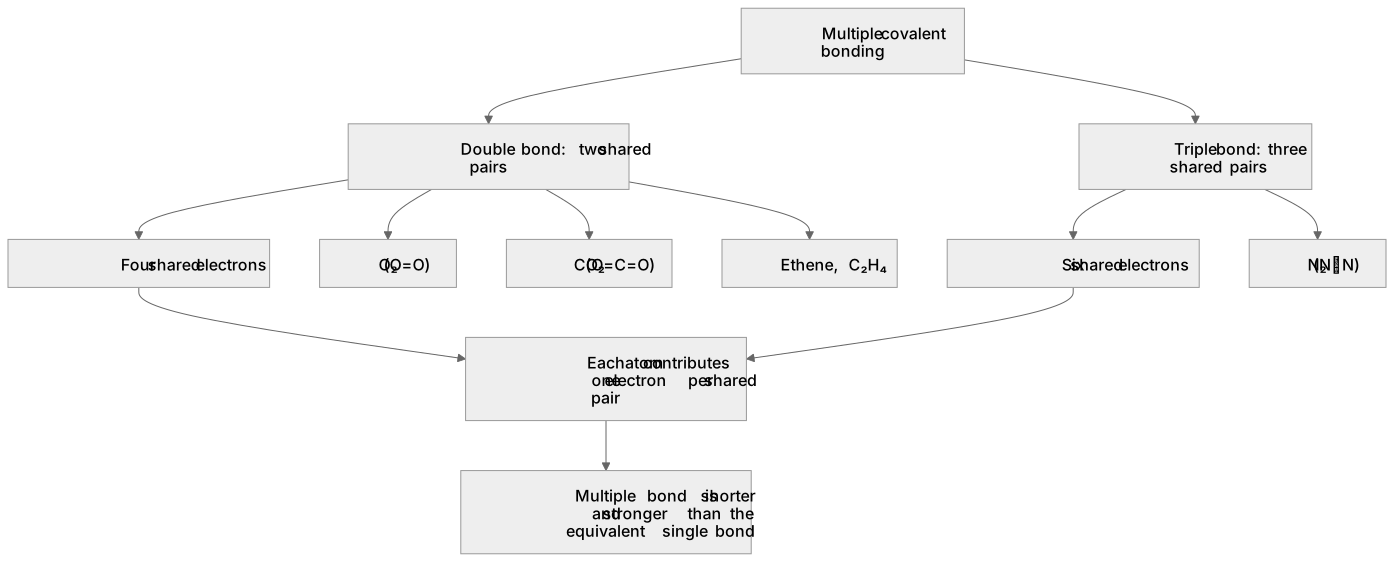
Key words
Say what each word means before you turn the card.
Multiple covalent bonding
Try answering aloud or in your head before turning the card.
Double and triple bonds
Try answering aloud or in your head before turning the card.
Shared electron pairs
Try answering aloud or in your head before turning the card.
Bond length and strength
Try answering aloud or in your head before turning the card.
See every definition
- Multiple covalent bonding
- Occurs when two atoms share more than one pair of electrons, forming double bonds or triple bonds.
- Double and triple bonds
- A double bond contains two shared pairs and a triple bond contains three shared pairs.
- Shared electron pairs
- Each shared pair contributes one electron from each bonded atom, so a double bond contains four shared electrons and a triple bond six.
- Bond length and strength
- Multiple bonds are shorter and stronger than the corresponding single bond between the same atoms.
Label the diagram
Some boxes have lost their names. Pick the right name for each number.
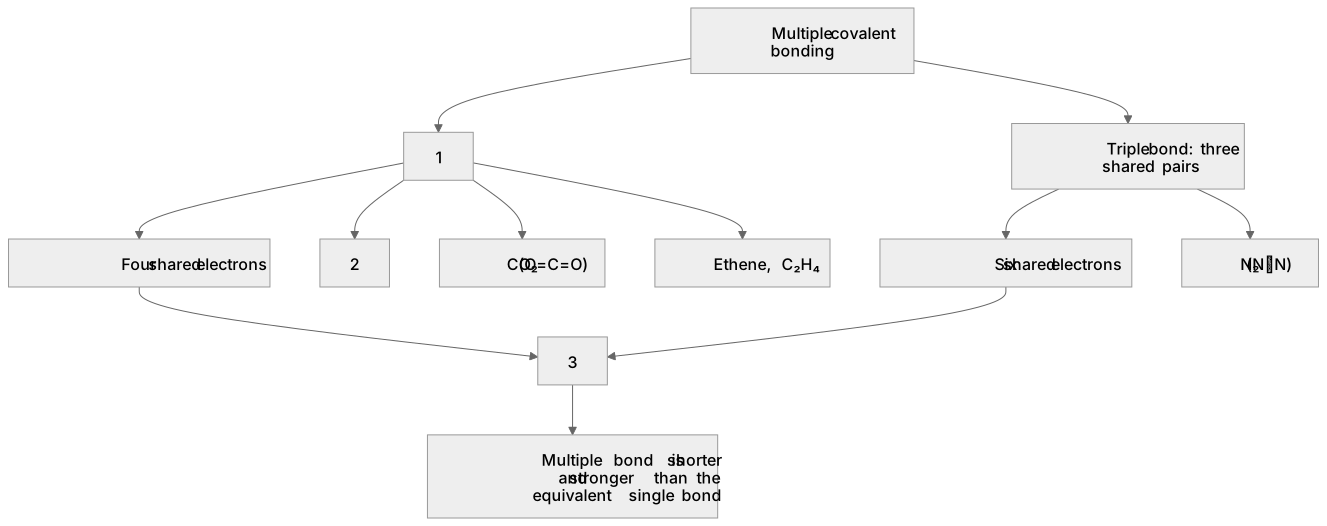
1Box 1
2Box 2
3Box 3
There is more to this lesson
The full lesson goes on to check your understanding and help you earn the marks. Create a free account to carry on, with your progress saved.
A week of Premium from your first lesson · Then the free plan continues · No card, no charge
Test your understanding of Bonding and structure: (ii) multiple covalent bonding
Active recall beats re-reading. Take an instant quiz now to test what you’ve learned and lock it into long-term memory.
A week of Premium from your first lesson · Then the free plan continues · No card, no charge