OCR · A-Level · Chemistry
Course version: H432 · Version from Sept 2017
Bonding and structure: (iii) dative covalent (coordinate) bonding
A dative covalent (coordinate) bond is a covalent bond in which both shared electrons come from the same atom, the donor.
- Point 10 of 24
- 4 key terms
Study notes
From the teaching notes for this specification point.
The idea
A dative covalent (coordinate) bond is a covalent bond in which both shared electrons come from the same atom, the donor. The acceptor atom supplies an empty orbital or a vacant position and shares the electron pair. Once formed, a dative bond is indistinguishable from an ordinary covalent bond. Classic examples are the ammonium ion, NH₄⁺, where the nitrogen lone pair is donated to an H⁺ ion, and the formation of H₃O⁺ from H₂O and H⁺.
What earns the marks
- States that in a dative bond both electrons in the shared pair come from one atom, the donor.
- Identifies the acceptor as an atom or ion with a vacant orbital that receives the shared pair.
- Recognises the formation of NH₄⁺ from NH₃ and H⁺ as donation of the nitrogen lone pair.
- Explains that a dative bond, once formed, is equivalent to an ordinary covalent bond.
- Locates the lone pair on the donor atom that is used to form the bond.
Common mistakes and how to put them right
Assumes each atom contributes one electron to a dative bond.
Put it right: Both electrons come from the donor.
Treats a dative bond as a different type of bond after formation.
Put it right: Recognise it as a normal covalent bond once made.
Selects an atom with no lone pair as the donor.
Put it right: Check that the donor has a lone pair to donate.
Ignores the charge on the acceptor ion.
Put it right: Account for the proton, H⁺, when forming NH₄⁺ or H₃O⁺.
Exam tips
- Identify the lone pair and the vacant orbital before deciding which atom donates.
- Draw the arrow from the donor lone pair to the acceptor to show the direction of donation.
- Check the overall charge of the resulting ion, such as NH₄⁺ or H₃O⁺.
- Remember that after formation the bond is counted like any other covalent bond.
Try the lesson
The start of the Bonding and structure: (iii) dative covalent (coordinate) bonding lesson, made from teaching notes for this specification point.
Listen
A dative covalent (coordinate) bond is a covalent bond in which both shared electrons come from the same atom, the donor. The acceptor atom supplies an empty orbital or a vacant position and shares the electron pair. Once formed, a dative bond is indistinguishable from an ordinary covalent bond. Classic examples are the ammonium ion, NH₄⁺, where the nitrogen lone pair is donated to an H⁺ ion, and the formation of H₃O⁺ from H₂O and H⁺. A strong answer earns marks for these points. States that in a dative bond both electrons in the shared pair come from one atom, the donor. Identifies the acceptor as an atom or ion with a vacant orbital that receives the shared pair. Recognises the formation of NH₄⁺ from NH₃ and H⁺ as donation of the nitrogen lone pair. Explains that a dative bond, once formed, is equivalent to an ordinary covalent bond. Exam tip: Identify the lone pair and the vacant orbital before deciding which atom donates.
See it
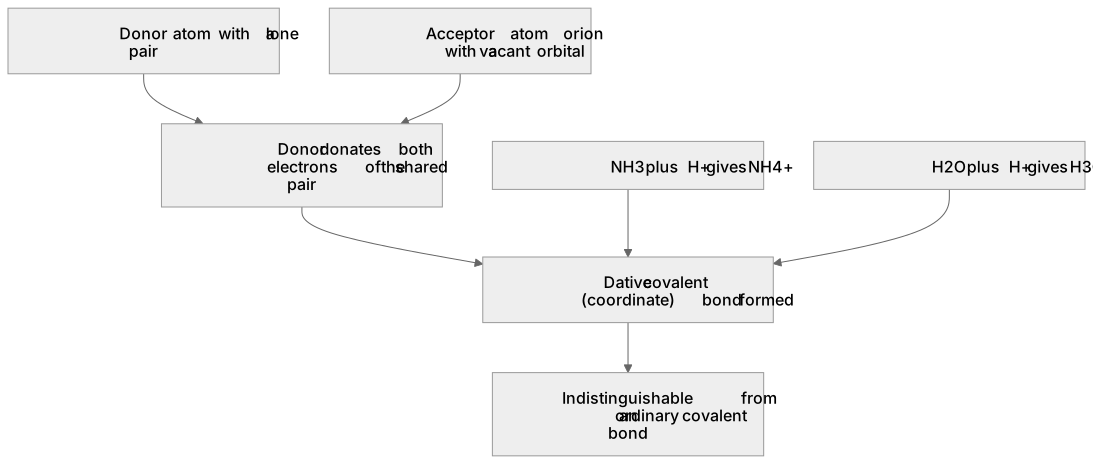
Key words
Say what each word means before you turn the card.
Dative covalent bonding
Try answering aloud or in your head before turning the card.
Electron-pair donation
Try answering aloud or in your head before turning the card.
Donor and acceptor
Try answering aloud or in your head before turning the card.
Ammonium ion formation
Try answering aloud or in your head before turning the card.
See every definition
- Dative covalent bonding
- A covalent bond in which both shared electrons come from the same atom, the donor.
- Electron-pair donation
- The nitrogen lone pair is donated to an H⁺ ion, as in the formation of NH₄⁺.
- Donor and acceptor
- The donor is the atom with a lone pair and the acceptor is the atom or ion with a vacant orbital.
- Ammonium ion formation
- NH₄⁺ forms from NH₃ and H⁺ by donation of the nitrogen lone pair.
Label the diagram
Some boxes have lost their names. Pick the right name for each number.
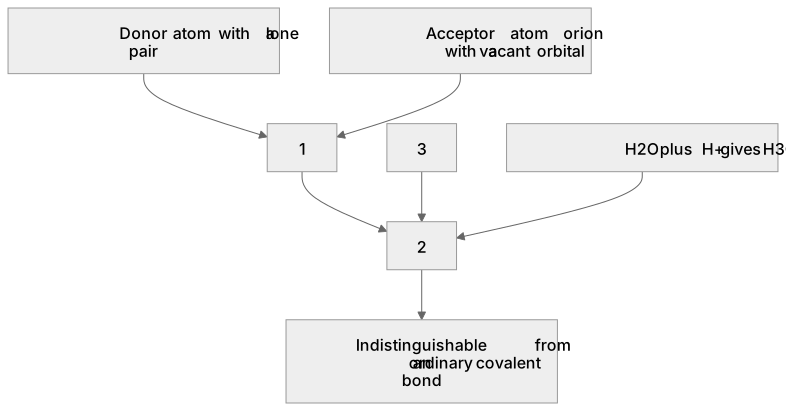
1Box 1
2Box 2
3Box 3
There is more to this lesson
The full lesson goes on to check your understanding and help you earn the marks. Create a free account to carry on, with your progress saved.
A week of Premium from your first lesson · Then the free plan continues · No card, no charge
Test your understanding of Bonding and structure: (iii) dative covalent (coordinate) bonding
Active recall beats re-reading. Take an instant quiz now to test what you’ve learned and lock it into long-term memory.
A week of Premium from your first lesson · Then the free plan continues · No card, no charge