OCR · A-Level · Chemistry
Course version: H432 · Version from Sept 2017
Carbon–carbon bond formation: Extending carbon chain length
OCR H432 section 6.2.4 covers two routes that build new carbon–carbon bonds and so lengthen a carbon chain.
- Point 1 of 9
- 4 key terms
Study notes
From the teaching notes for this specification point.
The idea
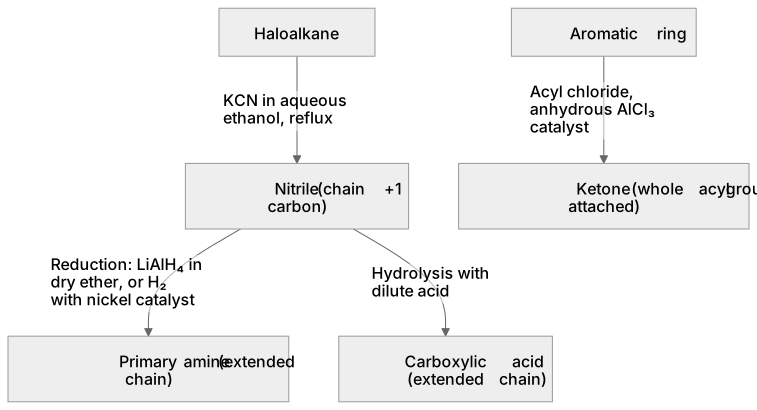
OCR H432 section 6.2.4 covers two routes that build new carbon–carbon bonds and so lengthen a carbon chain. The first uses cyanide: a haloalkane reacts with KCN in aqueous ethanol under reflux to give a nitrile, adding one carbon to the chain; reducing the nitrile (for example with LiAlH₄ in dry ether, or H₂ with a nickel catalyst) gives a primary amine, and hydrolysing the nitrile with dilute acid gives a carboxylic acid, each with the extended chain. The second is Friedel–Crafts acylation: an aromatic ring reacts with an acyl chloride in the presence of anhydrous AlCl₃ catalyst to give a ketone, attaching the acyl group's carbons to the ring. Count carbons carefully: the nitrile route adds exactly one carbon, whereas Friedel–Crafts adds the whole acyl group.
What earns the marks
- States that a haloalkane reacts with KCN to form a nitrile, extending the chain by one carbon.
- States that the nitrile can be reduced to a primary amine or hydrolysed to a carboxylic acid.
- Describes Friedel–Crafts acylation of an aromatic ring with an acyl chloride and anhydrous AlCl₃ catalyst.
- Explains that Friedel–Crafts attaches the whole acyl group, so the chain grows by the number of carbons in that group.
- Distinguishes the one-carbon growth of the nitrile route from the multi-carbon growth of Friedel–Crafts acylation.
Common mistakes and how to put them right
Assumes every C–C bond-forming route adds exactly one carbon.
Put it right by noting that Friedel–Crafts adds the whole acyl group.
Forgets the catalyst in Friedel–Crafts acylation.
Put it right by specifying anhydrous AlCl₃.
Claims the nitrile is reduced to a carboxylic acid.
Put it right by stating that reduction gives a primary amine and hydrolysis gives the acid.
Exam tips
- Count the carbons in reactant and product explicitly to confirm the chain has been extended.
- Quote the reagent and condition for each step, such as KCN in aqueous ethanol under reflux.
- State 'anhydrous AlCl₃' for Friedel–Crafts to show the catalyst is required.
Try the lesson
The start of the Carbon–carbon bond formation: Extending carbon chain length lesson, made from teaching notes for this specification point.
Listen
OCR H432 section 6.2.4 covers two routes that build new carbon–carbon bonds and so lengthen a carbon chain. The first uses cyanide: a haloalkane reacts with KCN in aqueous ethanol under reflux to give a nitrile, adding one carbon to the chain; reducing the nitrile (for example with LiAlH₄ in dry ether, or H₂ with a nickel catalyst) gives a primary amine, and hydrolysing the nitrile with dilute acid gives a carboxylic acid, each with the extended chain. The second is Friedel–Crafts acylation: an aromatic ring reacts with an acyl chloride in the presence of anhydrous AlCl₃ catalyst to give a ketone, attaching the acyl group's carbons to the ring. Count carbons carefully: the nitrile route adds exactly one carbon, whereas Friedel–Crafts adds the whole acyl group. A strong answer earns marks for these points. States that a haloalkane reacts with KCN to form a nitrile, extending the chain by one carbon. States that the nitrile can be reduced to a primary amine or hydrolysed to a carboxylic acid. Describes Friedel–Crafts acylation of an aromatic ring with an acyl chloride and anhydrous AlCl₃ catalyst. Explains that Friedel–Crafts attaches the whole acyl group, so the chain grows by the number of carbons in that group. A common slip: Assumes every C–C bond-forming route adds exactly one carbon. Instead, noting that Friedel–Crafts adds the whole acyl group. Exam tip: Count the carbons in reactant and product explicitly to confirm the chain has been extended.
See it
Key words
Say what each word means before you turn the card.
Nitrile formation from haloalkanes
Try answering aloud or in your head before turning the card.
Reduction and hydrolysis of nitriles
Try answering aloud or in your head before turning the card.
Friedel–Crafts acylation
Try answering aloud or in your head before turning the card.
Carbon chain extension and carbon counting
Try answering aloud or in your head before turning the card.
See every definition
- Nitrile formation from haloalkanes
- A haloalkane reacts with KCN in aqueous ethanol under reflux to give a nitrile, adding one carbon to the chain.
- Reduction and hydrolysis of nitriles
- Reducing the nitrile, for example with LiAlH₄ in dry ether or H₂ with a nickel catalyst, gives a primary amine, and hydrolysing it with dilute acid gives a carboxylic acid, each with the extended chain.
- Friedel–Crafts acylation
- An aromatic ring reacts with an acyl chloride in the presence of anhydrous AlCl₃ catalyst to give a ketone, attaching the acyl group's carbons to the ring.
- Carbon chain extension and carbon counting
- The nitrile route adds exactly one carbon, whereas Friedel–Crafts adds the whole acyl group, so carbons must be counted carefully.
Label the diagram
Some boxes have lost their names. Pick the right name for each number.
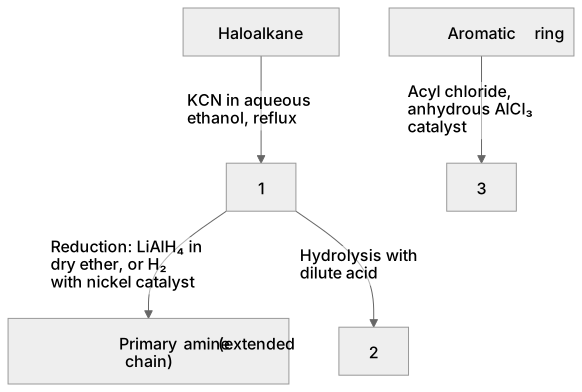
1Box 1
2Box 2
3Box 3
There is more to this lesson
The full lesson goes on to check your understanding and help you earn the marks. Create a free account to carry on, with your progress saved.
A week of Premium from your first lesson · Then the free plan continues · No card, no charge
Test your understanding of Carbon–carbon bond formation: Extending carbon chain length
Active recall beats re-reading. Take an instant quiz now to test what you’ve learned and lock it into long-term memory.
A week of Premium from your first lesson · Then the free plan continues · No card, no charge