OCR · A-Level · Chemistry
Course version: H432 · Version from Sept 2017
(a) the use of C–C bond formation in synthesis to increase the length of a…
Full specification wording
Carbon–carbon bond formation: (a) the use of C–C bond formation in synthesis to increase the length of a carbon chain (see also 6.1.1 d, 6.1.2 b)
Carbon–carbon bond formation is the key step that lengthens a carbon chain during synthesis.
- Point 2 of 9
- 4 key terms
Study notes
From the teaching notes for this specification point.
The idea
Carbon–carbon bond formation is the key step that lengthens a carbon chain during synthesis. In this specification the reactions to know are the Friedel–Crafts reactions of benzene with a halogenoalkane or an acyl chloride in the presence of an AlCl₃ catalyst, and the addition of a carbonyl compound to a cyanide ion followed by acid hydrolysis. In each case a new C–C bond joins two fragments, so the product has more carbon atoms than the starting material. For example, benzene reacting with CH₃CH₂Cl and AlCl₃ gives ethylbenzene, whose side chain adds two carbons to the ring. A carbonyl compound reacting with HCN/KCN gives a hydroxynitrile, and acid hydrolysis converts the nitrile group into a carboxylic acid, adding one carbon. Count carbons before and after to confirm the chain has grown.
What earns the marks
- Identifies Friedel–Crafts alkylation or acylation of benzene as a reaction that forms a new carbon–carbon bond.
- States that the Friedel–Crafts reaction requires an AlCl₃ catalyst and a halogenoalkane or acyl chloride.
- Describes addition of cyanide to a carbonyl compound as forming a new carbon–carbon bond in a hydroxynitrile.
- Explains that acid hydrolysis of the hydroxynitrile gives a carboxylic acid with one more carbon than the original carbonyl compound.
- Counts the carbon atoms in reactant and product to confirm that the carbon chain has been lengthened.
Common mistakes and how to put them right
Names a Grignard reagent as the C–C bond-forming reagent in this specification.
Put it right: Use the Friedel–Crafts and carbonyl-plus-cyanide reactions instead.
Omits the AlCl₃ catalyst from the Friedel–Crafts reaction.
Put it right: Include it as a required condition.
Treats the cyanide addition as producing an amine.
Put it right: Recognise that the nitrile is hydrolysed to a carboxylic acid.
Forgets to count carbons and so fails to show the chain has actually grown.
Put it right: Compare carbon numbers explicitly.
Exam tips
- Learn the two named routes: Friedel–Crafts on benzene and cyanide addition to a carbonyl compound.
- Write the catalyst and reagents clearly for each route so the C–C bond formation is unambiguous.
- Practise counting carbon atoms in starting material and product to justify chain lengthening.
Try the lesson
The start of the Carbon–carbon bond formation: (a) the use of C–C bond formation in synthesis to increase the length of a carbon chain (see also 6.1.1 d, 6.1.2 b) lesson, made from teaching notes for this specification point.
Listen
Carbon–carbon bond formation is the key step that lengthens a carbon chain during synthesis. In this specification the reactions to know are the Friedel–Crafts reactions of benzene with a halogenoalkane or an acyl chloride in the presence of an AlCl₃ catalyst, and the addition of a carbonyl compound to a cyanide ion followed by acid hydrolysis. In each case a new C–C bond joins two fragments, so the product has more carbon atoms than the starting material. For example, benzene reacting with CH₃CH₂Cl and AlCl₃ gives ethylbenzene, whose side chain adds two carbons to the ring. A carbonyl compound reacting with HCN/KCN gives a hydroxynitrile, and acid hydrolysis converts the nitrile group into a carboxylic acid, adding one carbon. Count carbons before and after to confirm the chain has grown. A strong answer earns marks for these points. Identifies Friedel–Crafts alkylation or acylation of benzene as a reaction that forms a new carbon–carbon bond. States that the Friedel–Crafts reaction requires an AlCl₃ catalyst and a halogenoalkane or acyl chloride. Describes addition of cyanide to a carbonyl compound as forming a new carbon–carbon bond in a hydroxynitrile. Explains that acid hydrolysis of the hydroxynitrile gives a carboxylic acid with one more carbon than the original carbonyl compound. Exam tip: Learn the two named routes: Friedel–Crafts on benzene and cyanide addition to a carbonyl compound.
See it
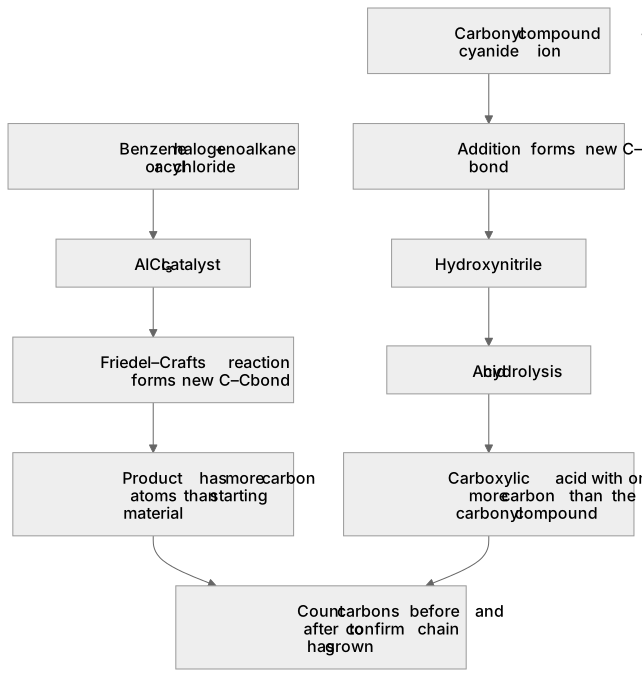
Key words
Say what each word means before you turn the card.
Carbon–carbon bond formation
Try answering aloud or in your head before turning the card.
Chain lengthening in synthesis
Try answering aloud or in your head before turning the card.
Friedel–Crafts reactions
Try answering aloud or in your head before turning the card.
Nitrile formation and hydrolysis
Try answering aloud or in your head before turning the card.
See every definition
- Carbon–carbon bond formation
- The key step that lengthens a carbon chain during synthesis, joining two fragments so the product has more carbon atoms than the starting material.
- Chain lengthening in synthesis
- Increasing the length of a carbon chain by forming a new carbon–carbon bond, confirmed by counting carbons before and after.
- Friedel–Crafts reactions
- Reactions of benzene with a halogenoalkane or an acyl chloride in the presence of an AlCl₃ catalyst, forming a new carbon–carbon bond.
- Nitrile formation and hydrolysis
- Addition of a carbonyl compound to a cyanide ion gives a hydroxynitrile, and acid hydrolysis converts the nitrile group into a carboxylic acid, adding one carbon.
Label the diagram
Some boxes have lost their names. Pick the right name for each number.
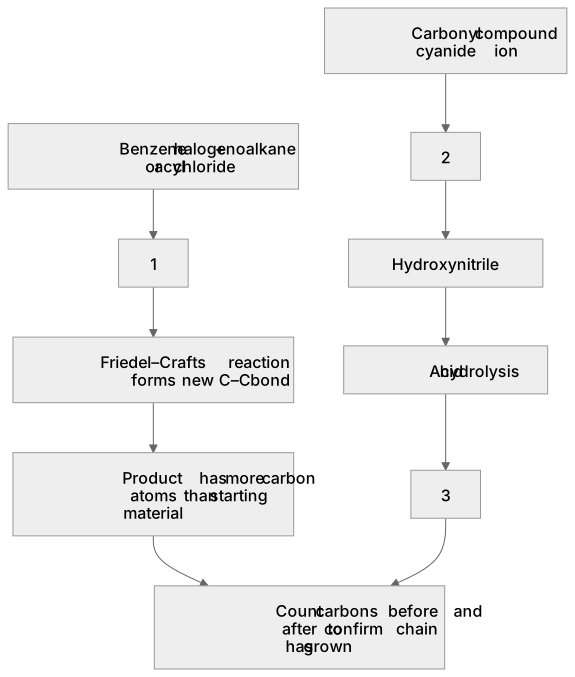
1Box 1
2Box 2
3Box 3
There is more to this lesson
The full lesson goes on to check your understanding and help you earn the marks. Create a free account to carry on, with your progress saved.
A week of Premium from your first lesson · Then the free plan continues · No card, no charge
Test your understanding of Carbon–carbon bond formation: (a) the use of C–C bond formation in synthesis to increase the length of a carbon chain (see also 6.1.1 d, 6.1.2 b)
Active recall beats re-reading. Take an instant quiz now to test what you’ve learned and lock it into long-term memory.
A week of Premium from your first lesson · Then the free plan continues · No card, no charge