OCR · A-Level · Chemistry
Course version: H432 · Version from Sept 2017
(i) haloalkanes with CN⁻ and ethanol, including nucleophilic substitution…
Full specification wording
Carbon–carbon bond formation: (i) haloalkanes with CN⁻ and ethanol, including nucleophilic substitution mechanism (see also 4.2.2 c)
This item tests whether you can extend the nucleophilic substitution chemistry of haloalkanes (met in 4.2.2 c) to a new nucleophile, the cyanide ion.
- Point 4 of 9
- 4 key terms
Study notes
From the teaching notes for this specification point.
The idea
This item tests whether you can extend the nucleophilic substitution chemistry of haloalkanes (met in 4.2.2 c) to a new nucleophile, the cyanide ion. When a haloalkane is warmed with a solution containing CN⁻ in ethanol, the cyanide ion acts as a nucleophile and attacks the electron-deficient carbon atom that carries the halogen. The carbon–halogen bond breaks and a new carbon–carbon bond forms, so the carbon chain lengthens by one carbon atom and a nitrile is produced. For a primary haloalkane such as bromoethane, the organic product is propanenitrile. The mechanism is nucleophilic substitution: the lone pair on the carbon of CN⁻ attacks the δ⁺ carbon, the C–X bond breaks heterolytically and the halide ion leaves. Ethanol is the solvent that brings the ionic cyanide into contact with the organic haloalkane.
What earns the marks
- Identifies CN⁻ as the nucleophile that attacks the electron-deficient carbon atom of the haloalkane.
- States that a new carbon–carbon bond forms and the carbon chain is lengthened by one carbon atom.
- Names the organic product as a nitrile, for example propanenitrile from bromoethane.
- Describes the mechanism as nucleophilic substitution in which the halide ion is displaced.
- Recognises that ethanol acts as the solvent allowing the ionic cyanide to react with the haloalkane.
Common mistakes and how to put them right
Treats CN⁻ as an electrophile.
Put it right by identifying the carbon of the cyanide ion as a nucleophile with a lone pair.
Claims the carbon chain length is unchanged.
Put it right by counting the added carbon from CN⁻, giving one extra carbon in the nitrile.
Describes the reaction as electrophilic addition.
Put it right by naming nucleophilic substitution, since a group is replaced on an sp³ carbon.
Exam tips
- Count carbon atoms carefully when naming the nitrile product, remembering the cyanide carbon is added to the chain.
- Link the mechanism explicitly to the electron-deficient carbon and the leaving halide ion.
- Use the term nucleophile precisely and state which species supplies the lone pair.
Try the lesson
The start of the Carbon–carbon bond formation: (i) haloalkanes with CN⁻ and ethanol, including nucleophilic substitution mechanism (see also 4.2.2 c) lesson, made from teaching notes for this specification point.
Listen
This item tests whether you can extend the nucleophilic substitution chemistry of haloalkanes (met in 4.2.2 c) to a new nucleophile, the cyanide ion. When a haloalkane is warmed with a solution containing CN⁻ in ethanol, the cyanide ion acts as a nucleophile and attacks the electron-deficient carbon atom that carries the halogen. The carbon–halogen bond breaks and a new carbon–carbon bond forms, so the carbon chain lengthens by one carbon atom and a nitrile is produced. For a primary haloalkane such as bromoethane, the organic product is propanenitrile. The mechanism is nucleophilic substitution: the lone pair on the carbon of CN⁻ attacks the δ⁺ carbon, the C–X bond breaks heterolytically and the halide ion leaves. Ethanol is the solvent that brings the ionic cyanide into contact with the organic haloalkane. A strong answer earns marks for these points. Identifies CN⁻ as the nucleophile that attacks the electron-deficient carbon atom of the haloalkane. States that a new carbon–carbon bond forms and the carbon chain is lengthened by one carbon atom. Names the organic product as a nitrile, for example propanenitrile from bromoethane. Describes the mechanism as nucleophilic substitution in which the halide ion is displaced. A common slip: Treats CN⁻ as an electrophile. Instead, identifying the carbon of the cyanide ion as a nucleophile with a lone pair. Exam tip: Count carbon atoms carefully when naming the nitrile product, remembering the cyanide carbon is added to the chain.
See it
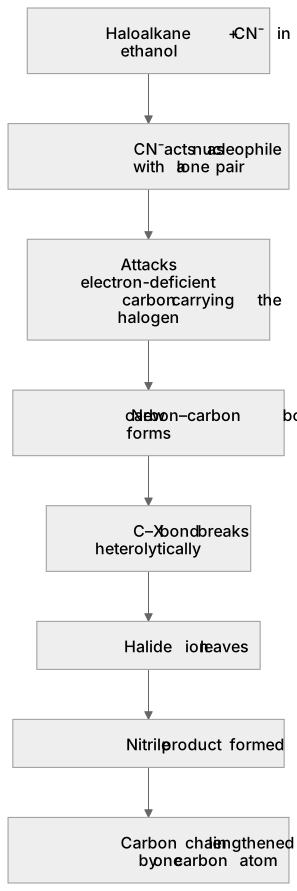
Put it in order
Put these steps in the order they happen.
- 1. C–X bond breaks heterolytically
- 2. Carbon chain lengthened by one carbon atom
- 3. Halide ion leaves
- 4. Haloalkane + CN⁻ in ethanol
- 5. CN⁻ acts as nucleophile with a lone pair
- 6. Nitrile product formed
- 7. Attacks electron-deficient carbon carrying the halogen
- 8. New carbon–carbon bond forms
Key words
Say what each word means before you turn the card.
Nucleophilic substitution of haloalkanes
Try answering aloud or in your head before turning the card.
Carbon–carbon bond formation
Try answering aloud or in your head before turning the card.
Nitrile synthesis
Try answering aloud or in your head before turning the card.
Role of ethanol as solvent
Try answering aloud or in your head before turning the card.
See every definition
- Nucleophilic substitution of haloalkanes
- The mechanism in which the lone pair on the carbon of CN⁻ attacks the δ⁺ carbon, the C–X bond breaks heterolytically and the halide ion leaves.
- Carbon–carbon bond formation
- The carbon–halogen bond breaks and a new carbon–carbon bond forms, so the carbon chain lengthens by one carbon atom and a nitrile is produced.
- Nitrile synthesis
- Warming a haloalkane with a solution containing CN⁻ in ethanol produces a nitrile, for example propanenitrile from bromoethane.
- Role of ethanol as solvent
- Ethanol is the solvent that brings the ionic cyanide into contact with the organic haloalkane.
Label the diagram
Some boxes have lost their names. Pick the right name for each number.
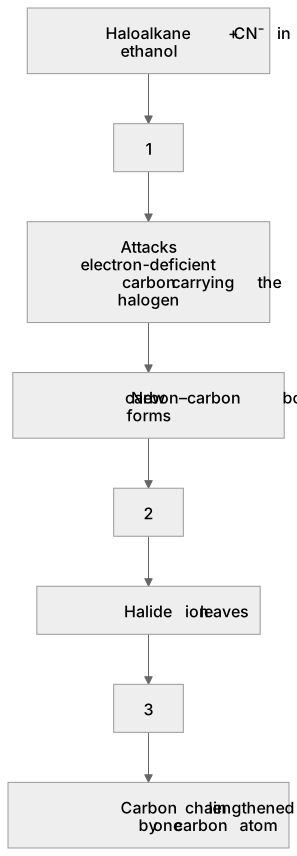
1Box 1
2Box 2
3Box 3
There is more to this lesson
The full lesson goes on to check your understanding and help you earn the marks. Create a free account to carry on, with your progress saved.
A week of Premium from your first lesson · Then the free plan continues · No card, no charge
Test your understanding of Carbon–carbon bond formation: (i) haloalkanes with CN⁻ and ethanol, including nucleophilic substitution mechanism (see also 4.2.2 c)
Active recall beats re-reading. Take an instant quiz now to test what you’ve learned and lock it into long-term memory.
A week of Premium from your first lesson · Then the free plan continues · No card, no charge