OCR · A-Level · Chemistry
Course version: H432 · Version from Sept 2017
Carbon–carbon bond formation: (b) formation of C–C≡N by reaction of:
This statement introduces the formation of a nitrile group, written C–C≡N, in which a carbon atom of the skeleton is bonded to a carbon that is triply bonded to nitrogen.
- Point 3 of 9
Study notes
From the teaching notes for this specification point.
The idea
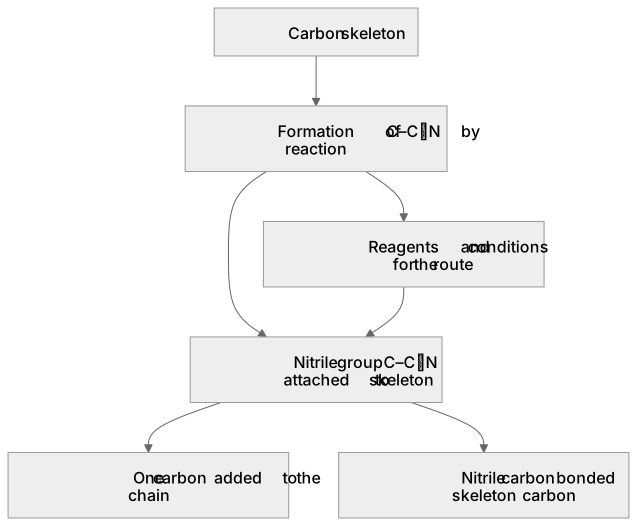
This statement introduces the formation of a nitrile group, written C–C≡N, in which a carbon atom of the skeleton is bonded to a carbon that is triply bonded to nitrogen. The nitrile carbon counts as one added carbon, so making a nitrile is a one-carbon chain-lengthening step. The statement is a heading whose sub-clauses list the specific reactions; learners should be ready to recognise the reagents and conditions for each route and to write the organic product with the C–C≡N group attached to the correct carbon. Because the sub-clauses are not reproduced here, treat the heading as the scope boundary and rely on the reactions taught in the course rather than inventing routes.
What earns the marks
- Recognises the C–C≡N group as a nitrile attached to a carbon skeleton.
- States that forming the nitrile adds one carbon atom to the chain.
- Identifies the reagent and conditions for the nitrile-forming reaction being tested.
- Draws the organic product with the C–C≡N group on the correct carbon atom.
Common mistakes and how to put them right
Writes the nitrile group with the nitrogen bonded to the chain carbon.
Put it right: Attach the carbon of C≡N to the skeleton instead.
Miscounts the added carbons as two.
Put it right: The nitrile group contributes one carbon to the chain.
Omits the reaction conditions needed for the nitrile to form.
Put it right: Include the reagents and conditions taught for that route.
Places the nitrile group on the wrong carbon of an unsymmetrical skeleton.
Put it right: Check which carbon bears the leaving group or electrophilic centre.
Exam tips
- Draw the full displayed structure of the nitrile product so the C–C≡N linkage is unambiguous.
- State the number of carbon atoms added when the nitrile is formed, as this is often the point being tested.
- Match the named reaction to its reagents and conditions rather than giving a generic reagent.
Try the lesson
The start of the Carbon–carbon bond formation: (b) formation of C–C≡N by reaction of: lesson, made from teaching notes for this specification point.
Listen
This statement introduces the formation of a nitrile group, written C–C≡N, in which a carbon atom of the skeleton is bonded to a carbon that is triply bonded to nitrogen. The nitrile carbon counts as one added carbon, so making a nitrile is a one-carbon chain-lengthening step. The statement is a heading whose sub-clauses list the specific reactions; learners should be ready to recognise the reagents and conditions for each route and to write the organic product with the C–C≡N group attached to the correct carbon. Because the sub-clauses are not reproduced here, treat the heading as the scope boundary and rely on the reactions taught in the course rather than inventing routes. A strong answer earns marks for these points. Recognises the C–C≡N group as a nitrile attached to a carbon skeleton. States that forming the nitrile adds one carbon atom to the chain. Identifies the reagent and conditions for the nitrile-forming reaction being tested. Draws the organic product with the C–C≡N group on the correct carbon atom. Exam tip: Draw the full displayed structure of the nitrile product so the C–C≡N linkage is unambiguous.
See it
Label the diagram
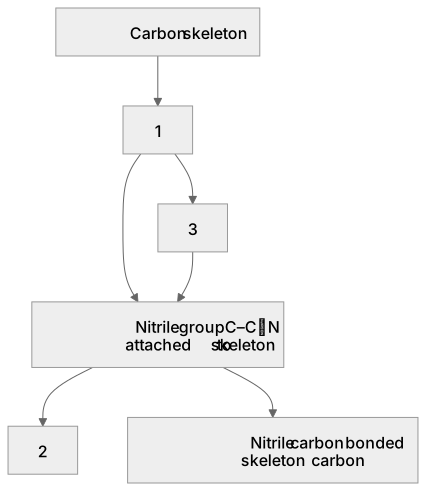
Some boxes have lost their names. Pick the right name for each number.
1Box 1
2Box 2
3Box 3
There is more to this lesson
The full lesson goes on to check your understanding and help you earn the marks. Create a free account to carry on, with your progress saved.
A week of Premium from your first lesson · Then the free plan continues · No card, no charge
Test your understanding of Carbon–carbon bond formation: (b) formation of C–C≡N by reaction of:
Active recall beats re-reading. Take an instant quiz now to test what you’ve learned and lock it into long-term memory.
A week of Premium from your first lesson · Then the free plan continues · No card, no charge