OCR · A-Level · Chemistry
Course version: H432 · Version from Sept 2017
(e) use of Tollens’ reagent (ammoniacal silver nitrate) to:
Full specification wording
Carbonyl compounds: (e) use of Tollens’ reagent (ammoniacal silver nitrate) to:
Tollens’ reagent is ammoniacal silver nitrate: silver nitrate solution treated with ammonia until the grey-brown silver oxide just redissolves, leaving the colourless complex ion [Ag(NH₃)₂]⁺ in…
- Point 11 of 13
- 4 key terms
Study notes
From the teaching notes for this specification point.
The idea
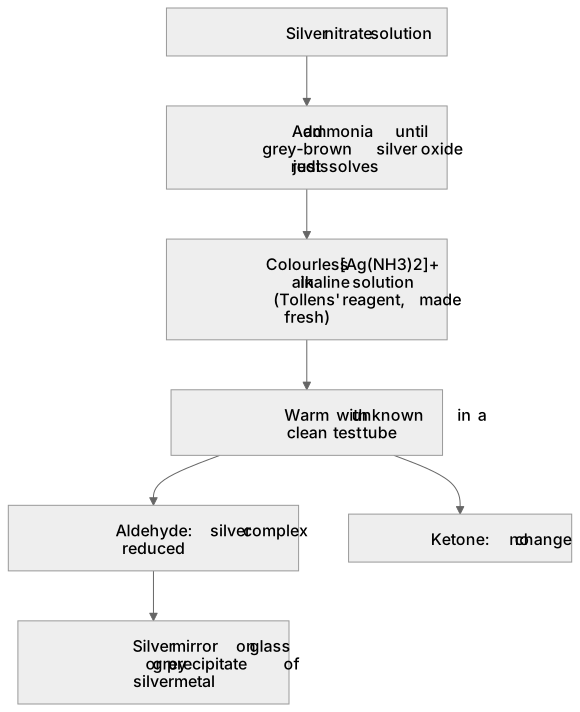
Tollens’ reagent is ammoniacal silver nitrate: silver nitrate solution treated with ammonia until the grey-brown silver oxide just redissolves, leaving the colourless complex ion [Ag(NH₃)₂]⁺ in alkaline solution. It is a mild oxidising agent that tests for an aldehyde group. Warm the unknown with freshly prepared Tollens’ reagent in a clean test tube; an aldehyde reduces the silver complex, and silver metal deposits as a mirror on the glass or as a grey precipitate. A ketone gives no change. The reagent must be made fresh because it decomposes on standing, and the tube should be clean so the mirror is visible. This row covers the reagent and its use; the positive observation is developed in the linked detect-the-aldehyde row.
What earns the marks
- Identifies Tollens’ reagent as ammoniacal silver nitrate, formed by adding ammonia to silver nitrate solution until the precipitate just redissolves.
- States that Tollens’ reagent acts as a mild oxidising agent that is reduced by an aldehyde.
- Describes warming the sample with freshly prepared Tollens’ reagent in a clean test tube.
- Recalls that a positive result is a silver mirror or grey precipitate of silver metal.
- Distinguishes the outcome for an aldehyde, which gives the silver deposit, from a ketone, which gives no change.
Common mistakes and how to put them right
Confuses Tollens’ reagent with Fehling’s solution.
Put it right: Keep Tollens’ as ammoniacal silver nitrate giving a silver mirror.
Uses acidified silver nitrate as if it were Tollens’ reagent.
Put it right: Add ammonia until the silver oxide just redissolves to form the complex.
Expects a ketone to give a silver mirror.
Put it right: State that ketones give no change with Tollens’ reagent.
Omits the need for a clean tube and fresh reagent.
Put it right: Explain that dirt or aged reagent spoils the visible mirror.
Exam tips
- Name the reagent in full as ammoniacal silver nitrate and give its formula as the diamminesilver(I) complex ion.
- Link the observation to reduction of silver(I) to silver metal, so the chemistry explains the mirror.
- Contrast aldehyde and ketone results in one sentence to show the test is a distinguishing test.
- State that the mixture is warmed and that the reagent is prepared fresh.
Try the lesson
The start of the Carbonyl compounds: (e) use of Tollens’ reagent (ammoniacal silver nitrate) to: lesson, made from teaching notes for this specification point.
Listen
Tollens’ reagent is ammoniacal silver nitrate: silver nitrate solution treated with ammonia until the grey-brown silver oxide just redissolves, leaving the colourless complex ion [Ag(NH₃)₂]⁺ in alkaline solution. It is a mild oxidising agent that tests for an aldehyde group. Warm the unknown with freshly prepared Tollens’ reagent in a clean test tube; an aldehyde reduces the silver complex, and silver metal deposits as a mirror on the glass or as a grey precipitate. A ketone gives no change. The reagent must be made fresh because it decomposes on standing, and the tube should be clean so the mirror is visible. This row covers the reagent and its use; the positive observation is developed in the linked detect-the-aldehyde row. A strong answer earns marks for these points. Identifies Tollens’ reagent as ammoniacal silver nitrate, formed by adding ammonia to silver nitrate solution until the precipitate just redissolves. States that Tollens’ reagent acts as a mild oxidising agent that is reduced by an aldehyde. Describes warming the sample with freshly prepared Tollens’ reagent in a clean test tube. Recalls that a positive result is a silver mirror or grey precipitate of silver metal. Exam tip: Name the reagent in full as ammoniacal silver nitrate and give its formula as the diamminesilver(I) complex ion.
See it
Key words
Say what each word means before you turn the card.
Tollens’ reagent composition
Try answering aloud or in your head before turning the card.
Oxidation of aldehydes
Try answering aloud or in your head before turning the card.
Reduction of silver(I) to silver metal
Try answering aloud or in your head before turning the card.
Distinguishing aldehydes from ketones
Try answering aloud or in your head before turning the card.
See every definition
- Tollens’ reagent composition
- Ammoniacal silver nitrate, made by treating silver nitrate solution with ammonia until the grey-brown silver oxide just redissolves, leaving the colourless complex ion [Ag(NH₃)₂]⁺ in alkaline solution.
- Oxidation of aldehydes
- Tollens’ reagent is a mild oxidising agent that is reduced by an aldehyde when the unknown is warmed with freshly prepared reagent in a clean test tube.
- Reduction of silver(I) to silver metal
- An aldehyde reduces the silver complex, and silver metal deposits as a mirror on the glass or as a grey precipitate.
- Distinguishing aldehydes from ketones
- An aldehyde gives the silver deposit, whereas a ketone gives no change with Tollens’ reagent.
Label the diagram
Some boxes have lost their names. Pick the right name for each number.
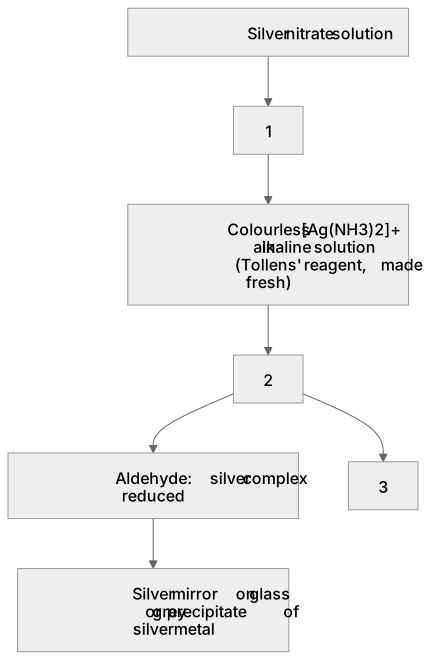
1Box 1
2Box 2
3Box 3
There is more to this lesson
The full lesson goes on to check your understanding and help you earn the marks. Create a free account to carry on, with your progress saved.
A week of Premium from your first lesson · Then the free plan continues · No card, no charge
Test your understanding of Carbonyl compounds: (e) use of Tollens’ reagent (ammoniacal silver nitrate) to:
Active recall beats re-reading. Take an instant quiz now to test what you’ve learned and lock it into long-term memory.
A week of Premium from your first lesson · Then the free plan continues · No card, no charge