OCR · A-Level · Chemistry
Course version: H432 · Version from Sept 2017
(ii) identify a carbonyl compound from the melting point of the derivative
Full specification wording
Carbonyl compounds: (ii) identify a carbonyl compound from the melting point of the derivative
A carbonyl compound is identified by converting it to a solid derivative, usually the 2,4-dinitrophenylhydrazone, then measuring the melting point of the purified solid and comparing it with…
- Point 10 of 13
- 4 key terms
Study notes
From the teaching notes for this specification point.
The idea
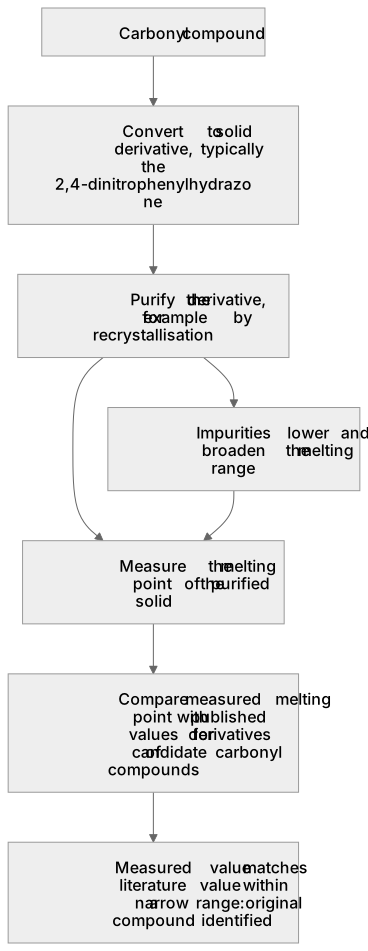
A carbonyl compound is identified by converting it to a solid derivative, usually the 2,4-dinitrophenylhydrazone, then measuring the melting point of the purified solid and comparing it with published values. Each pure derivative has a sharp, characteristic melting point, so a measured value that matches a literature value within a narrow range identifies the original carbonyl compound. The solid is recrystallised to remove impurities, because impurities lower and broaden the melting range. A measured melting point close to a known value but a few degrees low, with a wide range, suggests impurity rather than a different compound.
What earns the marks
- Converts the carbonyl compound to a solid derivative, typically the 2,4-dinitrophenylhydrazone, before measuring a melting point.
- Purifies the derivative, for example by recrystallisation, so the melting point is sharp and reliable.
- Compares the measured melting point with published values for derivatives of candidate carbonyl compounds.
- Matches the measured value to the literature value within a narrow range to identify the original compound.
- Explains that an impure sample gives a lower and broader melting range than the pure derivative.
Common mistakes and how to put them right
Compares the melting point of the original carbonyl compound rather than its solid derivative.
Put it right: Measure the derivative instead.
Ignores purification and accepts a broad, low melting range as identification.
Put it right: Recrystallise the derivative first.
Treats any melting point as a match without comparing to a literature value.
Put it right: Match the measured value to published data.
Assumes a single melting point measurement identifies the compound without a reference value.
Put it right: Compare with known values.
Exam tips
- Check that the option measures the melting point of the solid derivative, not of the starting carbonyl compound.
- Look for the step that purifies the derivative before the melting point is taken.
- Choose the option that compares the measured value with a published value for the same derivative.
Try the lesson
The start of the Carbonyl compounds: (ii) identify a carbonyl compound from the melting point of the derivative lesson, made from teaching notes for this specification point.
Listen
A carbonyl compound is identified by converting it to a solid derivative, usually the 2,4-dinitrophenylhydrazone, then measuring the melting point of the purified solid and comparing it with published values. Each pure derivative has a sharp, characteristic melting point, so a measured value that matches a literature value within a narrow range identifies the original carbonyl compound. The solid is recrystallised to remove impurities, because impurities lower and broaden the melting range. A measured melting point close to a known value but a few degrees low, with a wide range, suggests impurity rather than a different compound. A strong answer earns marks for these points. Converts the carbonyl compound to a solid derivative, typically the 2,4-dinitrophenylhydrazone, before measuring a melting point. Purifies the derivative, for example by recrystallisation, so the melting point is sharp and reliable. Compares the measured melting point with published values for derivatives of candidate carbonyl compounds. Matches the measured value to the literature value within a narrow range to identify the original compound. Exam tip: Check that the option measures the melting point of the solid derivative, not of the starting carbonyl compound.
See it
Key words
Say what each word means before you turn the card.
Derivative formation
Try answering aloud or in your head before turning the card.
Melting point determination
Try answering aloud or in your head before turning the card.
Comparison with literature values
Try answering aloud or in your head before turning the card.
Purity and recrystallisation
Try answering aloud or in your head before turning the card.
See every definition
- Derivative formation
- The carbonyl compound is converted to a solid derivative, typically the 2,4-dinitrophenylhydrazone, before a melting point is measured.
- Melting point determination
- The melting point of the purified solid derivative is measured and compared with published values for derivatives of candidate carbonyl compounds.
- Comparison with literature values
- The measured value is matched to the literature value within a narrow range to identify the original compound.
- Purity and recrystallisation
- The solid is recrystallised to remove impurities, because impurities lower and broaden the melting range, so the melting point is sharp and reliable.
Label the diagram
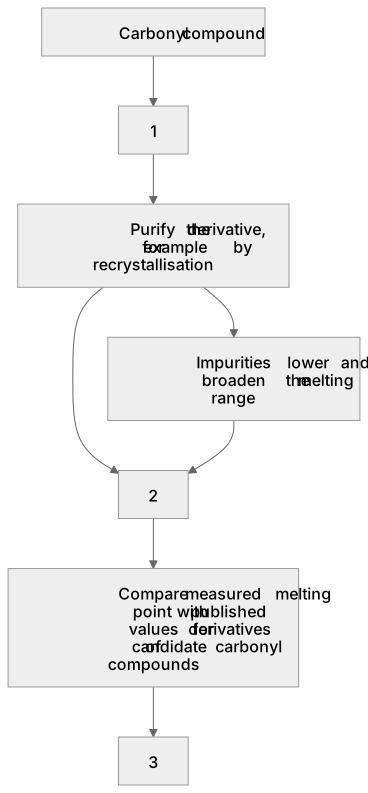
Some boxes have lost their names. Pick the right name for each number.
1Box 1
2Box 2
3Box 3
There is more to this lesson
The full lesson goes on to check your understanding and help you earn the marks. Create a free account to carry on, with your progress saved.
A week of Premium from your first lesson · Then the free plan continues · No card, no charge
Test your understanding of Carbonyl compounds: (ii) identify a carbonyl compound from the melting point of the derivative
Active recall beats re-reading. Take an instant quiz now to test what you’ve learned and lock it into long-term memory.
A week of Premium from your first lesson · Then the free plan continues · No card, no charge