OCR · A-Level · Chemistry
Course version: H432 · Version from Sept 2017
Carbonyl compounds: (i) NaBH₄ to form alcohols
Sodium tetrahydridoborate, NaBH₄, is a source of hydride ions, H⁻, which act as the nucleophile in addition to a carbonyl group.
- Point 4 of 13
- 4 key terms
Study notes
From the teaching notes for this specification point.
The idea
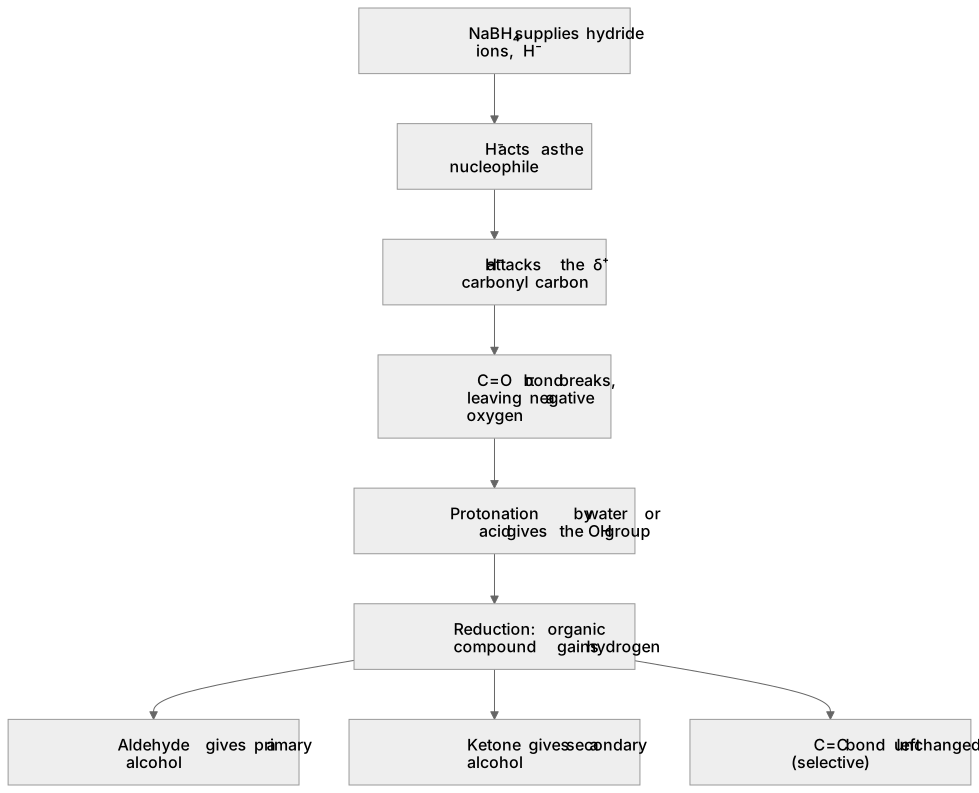
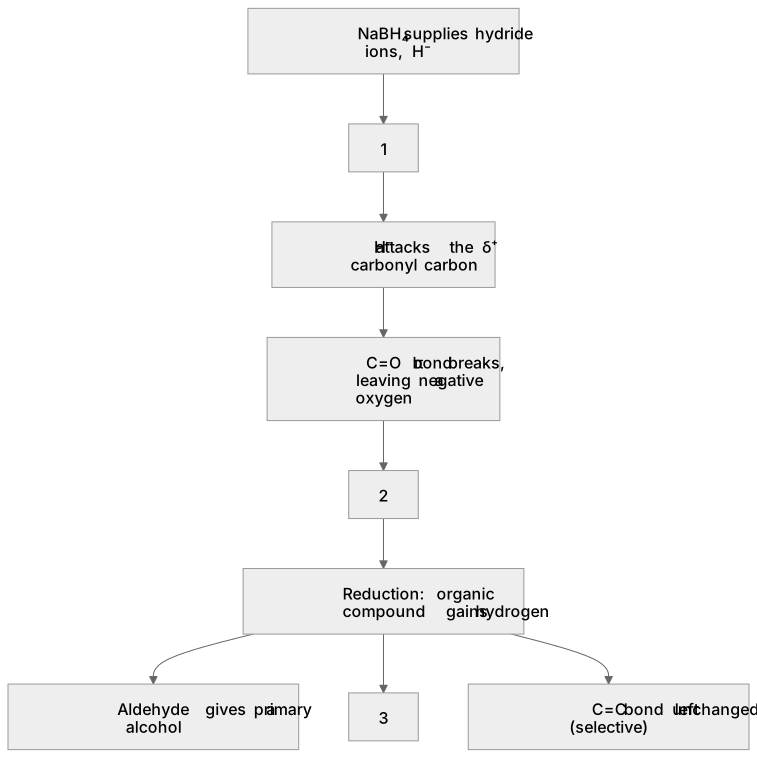
Sodium tetrahydridoborate, NaBH₄, is a source of hydride ions, H⁻, which act as the nucleophile in addition to a carbonyl group. The reagent is used in aqueous or alcoholic solution, and the reaction is a reduction because the organic compound gains hydrogen. An aldehyde reacts with NaBH₄ to form a primary alcohol, for example ethanal gives ethanol. A ketone reacts to form a secondary alcohol, for example propanone gives propan-2-ol. The mechanism follows nucleophilic addition: H⁻ attacks the δ⁺ carbonyl carbon, the C=O π bond breaks to leave a negative oxygen, and protonation by water or acid gives the OH group. NaBH₄ does not reduce C=C bonds, so it is a selective reducing agent for the carbonyl group.
What earns the marks
- States that NaBH₄ supplies hydride ions, H⁻, which act as the nucleophile.
- Predicts a primary alcohol from an aldehyde and a secondary alcohol from a ketone.
- Describes the reduction as addition of hydrogen across the C=O bond.
- Explains that NaBH₄ reduces the carbonyl group but leaves a C=C bond unchanged.
Common mistakes and how to put them right
Predicts a tertiary alcohol from a ketone.
Put it right by stating that a ketone gives a secondary alcohol.
Claims NaBH₄ also reduces an alkene C=C bond.
Put it right by noting the reagent is selective for the carbonyl group.
Names the hydride ion as H⁺.
Put it right by writing H⁻ as the nucleophile.
Exam tips
- Write the product structure fully, showing the new O–H bond and the hydrogen on the carbon.
- Use the words primary, secondary or tertiary accurately when naming the alcohol formed.
- State the conditions as NaBH₄ in water or ethanol rather than inventing a temperature.
Try the lesson
The start of the Carbonyl compounds: (i) NaBH₄ to form alcohols lesson, made from teaching notes for this specification point.
Listen
Sodium tetrahydridoborate, NaBH₄, is a source of hydride ions, H⁻, which act as the nucleophile in addition to a carbonyl group. The reagent is used in aqueous or alcoholic solution, and the reaction is a reduction because the organic compound gains hydrogen. An aldehyde reacts with NaBH₄ to form a primary alcohol, for example ethanal gives ethanol. A ketone reacts to form a secondary alcohol, for example propanone gives propan-2-ol. The mechanism follows nucleophilic addition: H⁻ attacks the δ⁺ carbonyl carbon, the C=O π bond breaks to leave a negative oxygen, and protonation by water or acid gives the OH group. NaBH₄ does not reduce C=C bonds, so it is a selective reducing agent for the carbonyl group. A strong answer earns marks for these points. States that NaBH₄ supplies hydride ions, H⁻, which act as the nucleophile. Predicts a primary alcohol from an aldehyde and a secondary alcohol from a ketone. Describes the reduction as addition of hydrogen across the C=O bond. Explains that NaBH₄ reduces the carbonyl group but leaves a C=C bond unchanged. A common slip: Predicts a tertiary alcohol from a ketone. Instead, stating that a ketone gives a secondary alcohol. Exam tip: Write the product structure fully, showing the new O–H bond and the hydrogen on the carbon.
See it
Key words
Say what each word means before you turn the card.
Reduction of carbonyl compounds
Try answering aloud or in your head before turning the card.
Hydride as a nucleophile
Try answering aloud or in your head before turning the card.
Primary versus secondary alcohols
Try answering aloud or in your head before turning the card.
Selectivity of reducing agents
Try answering aloud or in your head before turning the card.
See every definition
- Reduction of carbonyl compounds
- A reaction in which the organic compound gains hydrogen, with NaBH₄ used in aqueous or alcoholic solution.
- Hydride as a nucleophile
- Hydride ions, H⁻, supplied by NaBH₄, act as the nucleophile that attacks the δ⁺ carbonyl carbon.
- Primary versus secondary alcohols
- An aldehyde reacts with NaBH₄ to form a primary alcohol, while a ketone reacts to form a secondary alcohol.
- Selectivity of reducing agents
- NaBH₄ does not reduce C=C bonds, so it is a selective reducing agent for the carbonyl group.
Label the diagram
Some boxes have lost their names. Pick the right name for each number.
1Box 1
2Box 2
3Box 3
There is more to this lesson
The full lesson goes on to check your understanding and help you earn the marks. Create a free account to carry on, with your progress saved.
A week of Premium from your first lesson · Then the free plan continues · No card, no charge
Test your understanding of Carbonyl compounds: (i) NaBH₄ to form alcohols
Active recall beats re-reading. Take an instant quiz now to test what you’ve learned and lock it into long-term memory.
A week of Premium from your first lesson · Then the free plan continues · No card, no charge