OCR · A-Level · Chemistry
Course version: H432 · Version from Sept 2017
(ii) HCN [i.e. NaCN(aq)/H⁺(aq)], to form hydroxynitriles (see also 6.2.4 b)
Full specification wording
Carbonyl compounds: (ii) HCN [i.e. NaCN(aq)/H⁺(aq)], to form hydroxynitriles (see also 6.2.4 b)
Aldehydes and ketones react with hydrogen cyanide to give hydroxynitriles.
- Point 5 of 13
- 4 key terms
Study notes
From the teaching notes for this specification point.
The idea
Aldehydes and ketones react with hydrogen cyanide to give hydroxynitriles. Because HCN is a weak acid and hazardous as the pure gas or liquid, the reagent is supplied in practice as sodium cyanide solution followed by dilute acid: NaCN(aq) provides the cyanide ion CN⁻ nucleophile, and H⁺(aq) protonates the intermediate alkoxide. The carbonyl carbon is attacked by CN⁻, the C=O π bond breaks and the oxygen takes the electron pair, giving an alkoxide that is then protonated to an –OH group. The product therefore contains both a hydroxyl group and a nitrile group on the same carbon skeleton, which is why it is called a hydroxynitrile. For ethanal the product is CH₃CH(OH)CN, and for propanone it is (CH₃)₂C(OH)CN. The carbon chain is lengthened by one carbon, so this is a useful carbon–carbon bond-forming step.
What earns the marks
- Identifies CN⁻ from NaCN(aq) as the nucleophile that attacks the electrophilic carbonyl carbon.
- States that H⁺(aq) is added to protonate the alkoxide intermediate and form the –OH group.
- Names the product class as a hydroxynitrile containing both –OH and –C≡N groups.
- Explains that the carbon chain is extended by one carbon because the cyanide carbon becomes part of the skeleton.
- Recognises that the C=O π bond breaks and the oxygen retains the electron pair as an alkoxide ion.
Common mistakes and how to put them right
Treats HCN itself as the attacking nucleophile rather than the cyanide ion CN⁻.
Put it right by naming CN⁻ as the nucleophile.
Omits the acid protonation step and leaves an alkoxide.
Put it right by adding H⁺(aq) to convert the alkoxide into the –OH group.
Writes the product without the nitrile group or mislabels it as an alcohol only.
Put it right by naming the product a hydroxynitrile with both functional groups.
Exam tips
- Write the reagent as NaCN followed by dilute acid, and state that this supplies HCN in a safe, controlled way.
- Show the curly arrow from the lone pair on CN⁻ to the carbonyl carbon and a second arrow from the C=O π bond to the oxygen.
- Check the product formula by counting carbons: the cyanide carbon adds one carbon to the chain.
Try the lesson
The start of the Carbonyl compounds: (ii) HCN [i.e. NaCN(aq)/H⁺(aq)], to form hydroxynitriles (see also 6.2.4 b) lesson, made from teaching notes for this specification point.
Listen
Aldehydes and ketones react with hydrogen cyanide to give hydroxynitriles. Because HCN is a weak acid and hazardous as the pure gas or liquid, the reagent is supplied in practice as sodium cyanide solution followed by dilute acid: NaCN(aq) provides the cyanide ion CN⁻ nucleophile, and H⁺(aq) protonates the intermediate alkoxide. The carbonyl carbon is attacked by CN⁻, the C=O π bond breaks and the oxygen takes the electron pair, giving an alkoxide that is then protonated to an –OH group. The product therefore contains both a hydroxyl group and a nitrile group on the same carbon skeleton, which is why it is called a hydroxynitrile. For ethanal the product is CH₃CH(OH)CN, and for propanone it is (CH₃)₂C(OH)CN. The carbon chain is lengthened by one carbon, so this is a useful carbon–carbon bond-forming step. A strong answer earns marks for these points. Identifies CN⁻ from NaCN(aq) as the nucleophile that attacks the electrophilic carbonyl carbon. States that H⁺(aq) is added to protonate the alkoxide intermediate and form the –OH group. Names the product class as a hydroxynitrile containing both –OH and –C≡N groups. Explains that the carbon chain is extended by one carbon because the cyanide carbon becomes part of the skeleton. A common slip: Treats HCN itself as the attacking nucleophile rather than the cyanide ion CN⁻. Instead, naming CN⁻ as the nucleophile. Exam tip: Write the reagent as NaCN followed by dilute acid, and state that this supplies HCN in a safe, controlled way.
See it
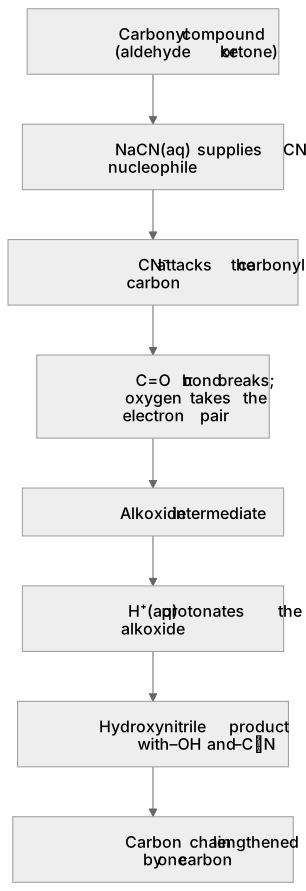
Put it in order
Put these steps in the order they happen.
- 1. Alkoxide intermediate
- 2. Carbon chain lengthened by one carbon
- 3. H⁺(aq) protonates the alkoxide
- 4. Carbonyl compound (aldehyde or ketone)
- 5. NaCN(aq) supplies CN⁻ nucleophile
- 6. Hydroxynitrile product with –OH and –C≡N
- 7. CN⁻ attacks the carbonyl carbon
- 8. C=O π bond breaks; oxygen takes the electron pair
Key words
Say what each word means before you turn the card.
Nucleophilic addition to carbonyl compounds
Try answering aloud or in your head before turning the card.
Formation of hydroxynitriles
Try answering aloud or in your head before turning the card.
Carbon–carbon bond formation
Try answering aloud or in your head before turning the card.
Reagent choice and safe delivery of HCN
Try answering aloud or in your head before turning the card.
See every definition
- Nucleophilic addition to carbonyl compounds
- The carbonyl carbon is attacked by CN⁻, the C=O π bond breaks and the oxygen takes the electron pair, giving an alkoxide.
- Formation of hydroxynitriles
- The product contains both a hydroxyl group and a nitrile group on the same carbon skeleton, which is why it is called a hydroxynitrile.
- Carbon–carbon bond formation
- The carbon chain is lengthened by one carbon, so this is a useful carbon–carbon bond-forming step.
- Reagent choice and safe delivery of HCN
- Because HCN is a weak acid and hazardous as the pure gas or liquid, the reagent is supplied in practice as sodium cyanide solution followed by dilute acid.
Label the diagram
Some boxes have lost their names. Pick the right name for each number.
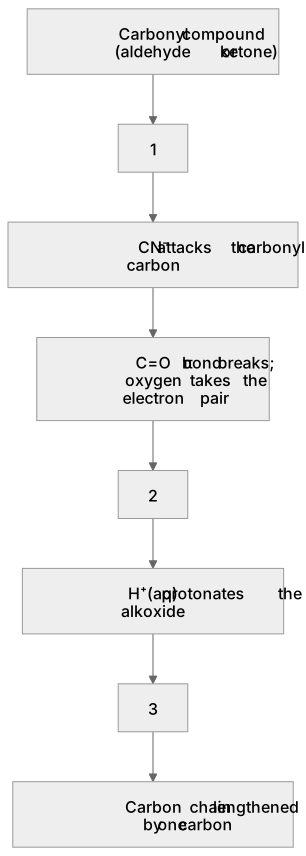
1Box 1
2Box 2
3Box 3
There is more to this lesson
The full lesson goes on to check your understanding and help you earn the marks. Create a free account to carry on, with your progress saved.
A week of Premium from your first lesson · Then the free plan continues · No card, no charge
Test your understanding of Carbonyl compounds: (ii) HCN [i.e. NaCN(aq)/H⁺(aq)], to form hydroxynitriles (see also 6.2.4 b)
Active recall beats re-reading. Take an instant quiz now to test what you’ve learned and lock it into long-term memory.
A week of Premium from your first lesson · Then the free plan continues · No card, no charge