OCR · A-Level · Chemistry
Course version: H432 · Version from Sept 2017
Carboxylic acids and esters: Esters
Esters are compounds formed when a carboxylic acid reacts with an alcohol, releasing water.
- Point 4 of 13
- 4 key terms
Study notes
From the teaching notes for this specification point.
The idea
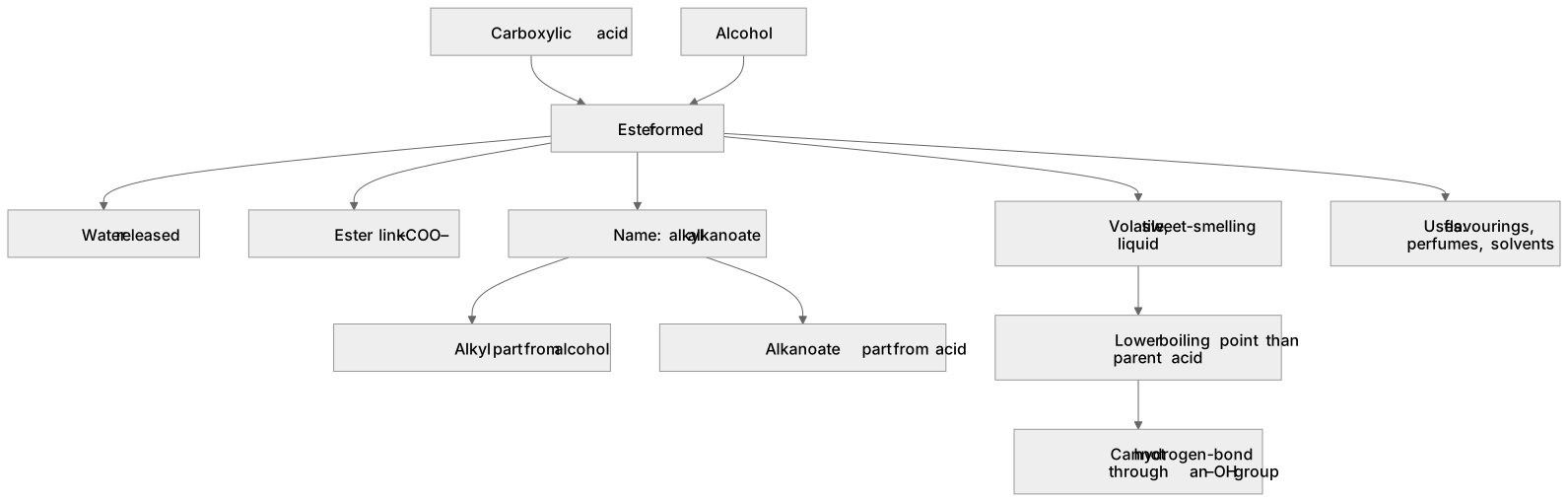
Esters are compounds formed when a carboxylic acid reacts with an alcohol, releasing water. The functional group is the ester link, written as –COO–, in which a carbonyl carbon is bonded to an oxygen that is itself bonded to a carbon chain. Naming follows the pattern alkyl alkanoate: the alcohol supplies the first part of the name and the acid supplies the second, so ethanol with ethanoic acid gives ethyl ethanoate. Esters are typically volatile, sweet-smelling liquids with boiling points lower than the parent acids because they cannot hydrogen-bond to each other through an –OH group. They are used as flavourings, perfumes and solvents, and they hydrolyse back to acid and alcohol with water.
What earns the marks
- Identifies the ester functional group as –COO– with a carbonyl carbon bonded to an oxygen attached to a carbon chain.
- Names an ester as alkyl alkanoate, taking the alkyl part from the alcohol and the alkanoate part from the carboxylic acid.
- Explains that esters have lower boiling points than the parent carboxylic acids because ester molecules cannot hydrogen-bond to one another.
- States that esters are formed by reaction of a carboxylic acid with an alcohol and that water is released.
- Recognises a stated use of esters such as flavourings, perfumes or solvents.
Common mistakes and how to put them right
Confuses the ester link with the carboxylic acid group.
Put it right: Keep the ester group as –COO– with no hydrogen on the single-bonded oxygen.
Reverses the two parts of the ester name.
Put it right: Take the alkyl part from the alcohol and the alkanoate part from the acid.
Claims esters hydrogen-bond strongly to each other.
Put it right: State that they lack an –OH group and so have weaker intermolecular forces than the parent acid.
Exam tips
- Write the structural formula of the ester link before naming, so the carbonyl carbon and the bridging oxygen are clear.
- Derive the name systematically: alcohol first as an alkyl group, acid second as an alkanoate.
- Link the low boiling point to the absence of hydrogen bonding between ester molecules rather than to molar mass.
Try the lesson
The start of the Carboxylic acids and esters: Esters lesson, made from teaching notes for this specification point.
Listen
Esters are compounds formed when a carboxylic acid reacts with an alcohol, releasing water. The functional group is the ester link, written as –COO–, in which a carbonyl carbon is bonded to an oxygen that is itself bonded to a carbon chain. Naming follows the pattern alkyl alkanoate: the alcohol supplies the first part of the name and the acid supplies the second, so ethanol with ethanoic acid gives ethyl ethanoate. Esters are typically volatile, sweet-smelling liquids with boiling points lower than the parent acids because they cannot hydrogen-bond to each other through an –OH group. They are used as flavourings, perfumes and solvents, and they hydrolyse back to acid and alcohol with water. A strong answer earns marks for these points. Identifies the ester functional group as –COO– with a carbonyl carbon bonded to an oxygen attached to a carbon chain. Names an ester as alkyl alkanoate, taking the alkyl part from the alcohol and the alkanoate part from the carboxylic acid. Explains that esters have lower boiling points than the parent carboxylic acids because ester molecules cannot hydrogen-bond to one another. States that esters are formed by reaction of a carboxylic acid with an alcohol and that water is released. Exam tip: Write the structural formula of the ester link before naming, so the carbonyl carbon and the bridging oxygen are clear.
See it
Key words
Say what each word means before you turn the card.
Ester functional group structure
Try answering aloud or in your head before turning the card.
Systematic nomenclature of esters
Try answering aloud or in your head before turning the card.
Intermolecular forces and physical properties
Try answering aloud or in your head before turning the card.
Formation of esters from carboxylic acids and alcohols
Try answering aloud or in your head before turning the card.
See every definition
- Ester functional group structure
- The ester link is written as –COO–, in which a carbonyl carbon is bonded to an oxygen that is itself bonded to a carbon chain.
- Systematic nomenclature of esters
- Naming follows the pattern alkyl alkanoate, with the alcohol supplying the first part of the name and the acid supplying the second.
- Intermolecular forces and physical properties
- Esters have boiling points lower than the parent acids because they cannot hydrogen-bond to each other through an –OH group.
- Formation of esters from carboxylic acids and alcohols
- Esters are compounds formed when a carboxylic acid reacts with an alcohol, releasing water.
Label the diagram
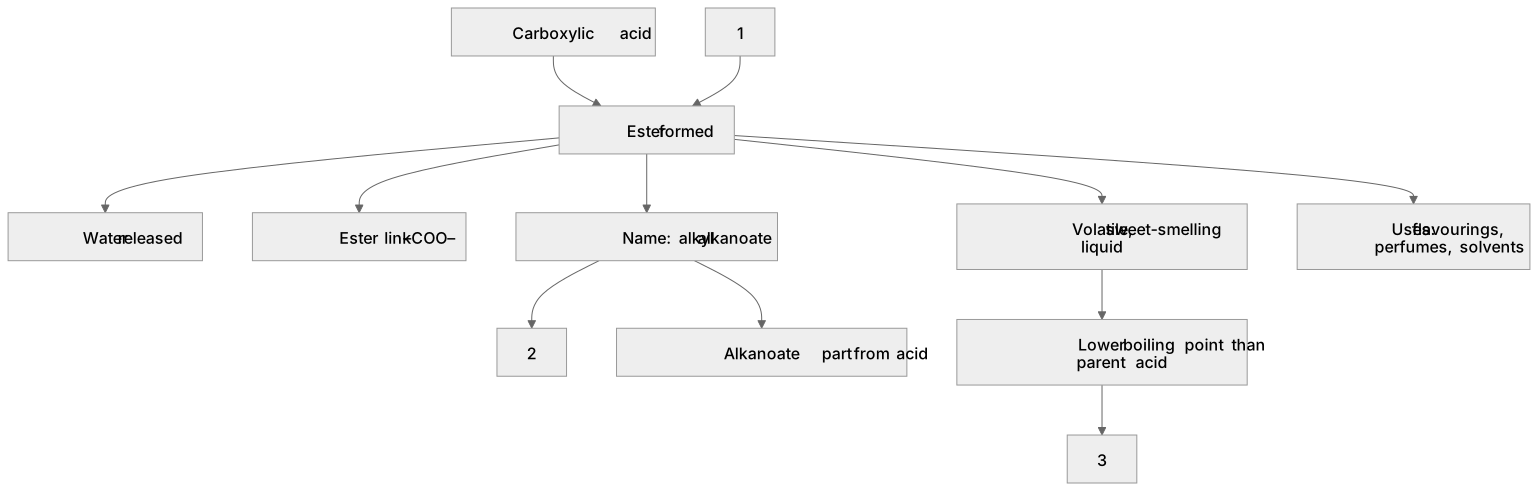
Some boxes have lost their names. Pick the right name for each number.
1Box 1
2Box 2
3Box 3
There is more to this lesson
The full lesson goes on to check your understanding and help you earn the marks. Create a free account to carry on, with your progress saved.
A week of Premium from your first lesson · Then the free plan continues · No card, no charge
Test your understanding of Carboxylic acids and esters: Esters
Active recall beats re-reading. Take an instant quiz now to test what you’ve learned and lock it into long-term memory.
A week of Premium from your first lesson · Then the free plan continues · No card, no charge