OCR · A-Level · Chemistry
Course version: H432 · Version from Sept 2017
Carboxylic acids and esters: (c) esterification of:
Esterification is the reaction in which a carboxylic acid and an alcohol combine to form an ester and water.
- Point 5 of 13
- 4 key terms
Study notes
From the teaching notes for this specification point.
The idea
Esterification is the reaction in which a carboxylic acid and an alcohol combine to form an ester and water. The reaction is slow at room temperature, so it is heated under reflux with a small amount of concentrated sulfuric acid catalyst. The acid protonates the carbonyl group, making it more susceptible to attack by the alcohol, and water is eliminated. The equation for ethanoic acid with ethanol is CH₃COOH + C₂H₅OH ⇌ CH₃COOC₂H₅ + H₂O. The reaction is reversible, so yield can be improved by removing water or using an excess of one reactant. The process is also called condensation because a small molecule, water, is lost.
What earns the marks
- States that esterification combines a carboxylic acid with an alcohol to produce an ester and water.
- Writes a balanced equation for a named esterification, for example CH₃COOH + C₂H₅OH ⇌ CH₃COOC₂H₅ + H₂O.
- Explains that concentrated sulfuric acid acts as a catalyst and that heating under reflux is used.
- Describes the reaction as reversible and identifies a method of improving yield such as removing water or using excess reactant.
- Identifies the ester product by name or formula from the given acid and alcohol.
Common mistakes and how to put them right
Omits water as a product.
Put it right: Include H₂O on the product side of the equation.
Treats the sulfuric acid as a reactant that is consumed.
Put it right: Describe it as a catalyst that is not used up.
Writes the reaction as irreversible.
Put it right: Show the equilibrium arrow because the reaction is reversible.
Exam tips
- Balance the equation and check that the ester link and the water molecule account for every atom.
- Name the ester from the alcohol and acid before writing the formula, then check the formula matches the name.
- State the role of the acid catalyst and the purpose of reflux in one clear sentence each.
Try the lesson
The start of the Carboxylic acids and esters: (c) esterification of: lesson, made from teaching notes for this specification point.
Listen
Esterification is the reaction in which a carboxylic acid and an alcohol combine to form an ester and water. The reaction is slow at room temperature, so it is heated under reflux with a small amount of concentrated sulfuric acid catalyst. The acid protonates the carbonyl group, making it more susceptible to attack by the alcohol, and water is eliminated. The equation for ethanoic acid with ethanol is CH₃COOH + C₂H₅OH ⇌ CH₃COOC₂H₅ + H₂O. The reaction is reversible, so yield can be improved by removing water or using an excess of one reactant. The process is also called condensation because a small molecule, water, is lost. A strong answer earns marks for these points. States that esterification combines a carboxylic acid with an alcohol to produce an ester and water. Writes a balanced equation for a named esterification, for example CH₃COOH + C₂H₅OH ⇌ CH₃COOC₂H₅ + H₂O. Explains that concentrated sulfuric acid acts as a catalyst and that heating under reflux is used. Describes the reaction as reversible and identifies a method of improving yield such as removing water or using excess reactant. Exam tip: Balance the equation and check that the ester link and the water molecule account for every atom.
See it
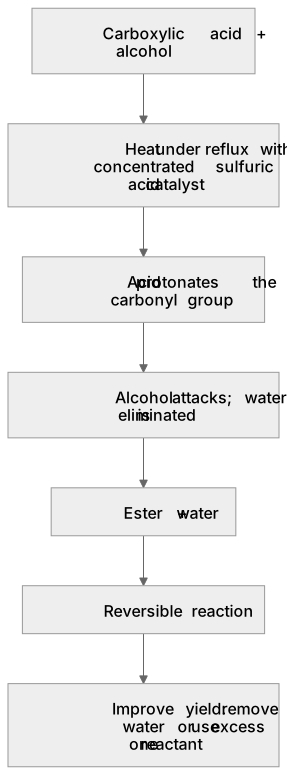
Put it in order
Put these steps in the order they happen.
- 1. Improve yield: remove water or use excess of one reactant
- 2. Reversible reaction
- 3. Acid protonates the carbonyl group
- 4. Ester + water
- 5. Carboxylic acid + alcohol
- 6. Heat under reflux with concentrated sulfuric acid catalyst
- 7. Alcohol attacks; water is eliminated
Key words
Say what each word means before you turn the card.
Esterification
Try answering aloud or in your head before turning the card.
Catalysis by concentrated sulfuric acid
Try answering aloud or in your head before turning the card.
Reversibility and yield improvement
Try answering aloud or in your head before turning the card.
Condensation
Try answering aloud or in your head before turning the card.
See every definition
- Esterification
- The reaction in which a carboxylic acid and an alcohol combine to form an ester and water.
- Catalysis by concentrated sulfuric acid
- A small amount of concentrated sulfuric acid is used, protonating the carbonyl group to make it more susceptible to attack by the alcohol.
- Reversibility and yield improvement
- The reaction is reversible, so yield can be improved by removing water or using an excess of one reactant.
- Condensation
- The process is also called condensation because a small molecule, water, is lost.
Label the diagram
Some boxes have lost their names. Pick the right name for each number.
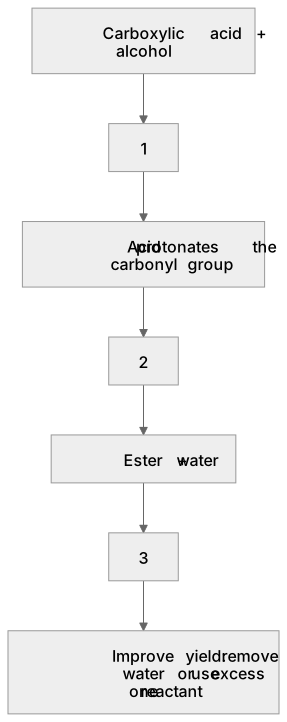
1Box 1
2Box 2
3Box 3
There is more to this lesson
The full lesson goes on to check your understanding and help you earn the marks. Create a free account to carry on, with your progress saved.
A week of Premium from your first lesson · Then the free plan continues · No card, no charge
Test your understanding of Carboxylic acids and esters: (c) esterification of:
Active recall beats re-reading. Take an instant quiz now to test what you’ve learned and lock it into long-term memory.
A week of Premium from your first lesson · Then the free plan continues · No card, no charge