OCR · A-Level · Chemistry
Course version: H432 · Version from Sept 2017
(i) carboxylic acids with alcohols in the presence of an acid catalyst…
Full specification wording
Carboxylic acids and esters: (i) carboxylic acids with alcohols in the presence of an acid catalyst (e.g. concentrated H₂SO₄)
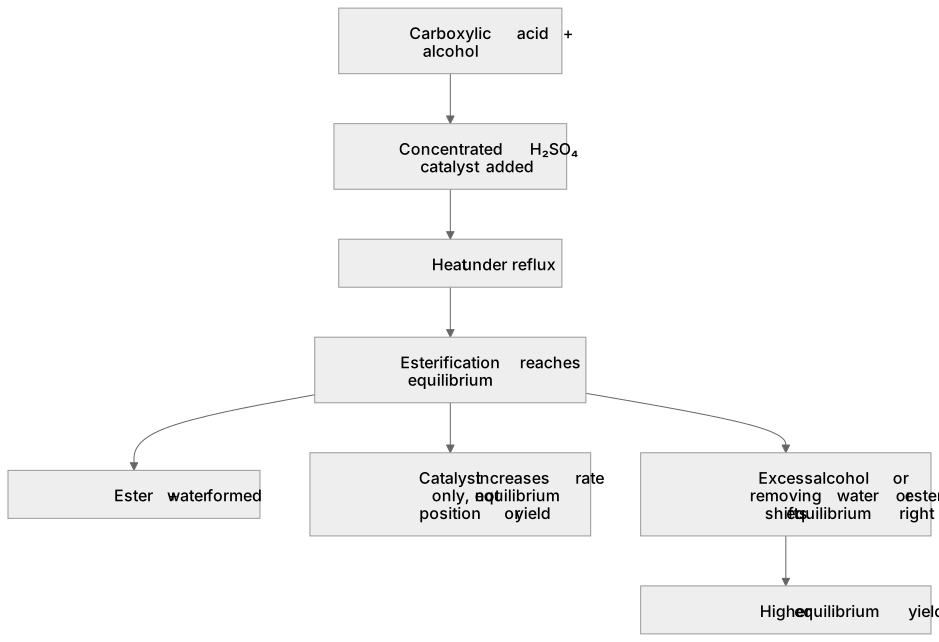
A carboxylic acid reacts with an alcohol to form an ester and water; this is esterification, a reversible condensation.
- Point 6 of 13
- 4 key terms
Study notes
From the teaching notes for this specification point.
The idea
A carboxylic acid reacts with an alcohol to form an ester and water; this is esterification, a reversible condensation. A few drops of concentrated sulfuric acid are added as a catalyst, and the mixture is heated under reflux so the reaction can reach equilibrium without losing volatile components. The acid catalyst protonates the carboxylic acid, making the carbonyl carbon more electrophilic so the alcohol can attack; the catalyst is regenerated at the end. Because the reaction is reversible, a catalyst speeds up the approach to equilibrium but does not change the position of equilibrium or the equilibrium yield. Yield is improved instead by using an excess of one reactant (often the alcohol) or by removing water or the ester as it forms, which shifts the equilibrium to the right by Le Chatelier's principle. The ester is often recognised by its characteristic sweet smell.
What earns the marks
- Identifies the reaction of a carboxylic acid with an alcohol as esterification, producing an ester and water.
- States that concentrated sulfuric acid acts as a catalyst and is not consumed in the reaction.
- Explains that heating under reflux allows the reaction to proceed to equilibrium without loss of volatile reactants.
- States that a catalyst increases the rate of reaching equilibrium but does not change the equilibrium position or yield.
- Identifies using excess alcohol or removing water or ester as ways to increase the equilibrium yield.
Common mistakes and how to put them right
Claims the acid catalyst or reflux increases the equilibrium yield.
Put it right: State that they increase the rate only, and yield is raised by excess reagent or removing a product.
Describes the sulfuric acid as a reactant that is used up.
Put it right: State that it is a catalyst and is regenerated.
Omits water as a product.
Put it right: Name both the ester and water as the products of esterification.
Treats esterification as irreversible.
Put it right: State that it is reversible and reaches equilibrium.
Exam tips
- Separate the roles of catalyst and reflux (rate) from the factors that change yield (equilibrium position).
- Name the catalyst and the reflux condition explicitly in your answer.
- Use Le Chatelier's principle to justify why removing water or adding excess alcohol raises the yield.
Try the lesson
The start of the Carboxylic acids and esters: (i) carboxylic acids with alcohols in the presence of an acid catalyst (e.g. concentrated H₂SO₄) lesson, made from teaching notes for this specification point.
Listen
A carboxylic acid reacts with an alcohol to form an ester and water; this is esterification, a reversible condensation. A few drops of concentrated sulfuric acid are added as a catalyst, and the mixture is heated under reflux so the reaction can reach equilibrium without losing volatile components. The acid catalyst protonates the carboxylic acid, making the carbonyl carbon more electrophilic so the alcohol can attack; the catalyst is regenerated at the end. Because the reaction is reversible, a catalyst speeds up the approach to equilibrium but does not change the position of equilibrium or the equilibrium yield. Yield is improved instead by using an excess of one reactant (often the alcohol) or by removing water or the ester as it forms, which shifts the equilibrium to the right by Le Chatelier's principle. The ester is often recognised by its characteristic sweet smell. A strong answer earns marks for these points. Identifies the reaction of a carboxylic acid with an alcohol as esterification, producing an ester and water. States that concentrated sulfuric acid acts as a catalyst and is not consumed in the reaction. Explains that heating under reflux allows the reaction to proceed to equilibrium without loss of volatile reactants. States that a catalyst increases the rate of reaching equilibrium but does not change the equilibrium position or yield. Exam tip: Separate the roles of catalyst and reflux (rate) from the factors that change yield (equilibrium position).
See it
Key words
Say what each word means before you turn the card.
Esterification
Try answering aloud or in your head before turning the card.
Role of an acid catalyst
Try answering aloud or in your head before turning the card.
Heating under reflux
Try answering aloud or in your head before turning the card.
Equilibrium position and yield versus rate
Try answering aloud or in your head before turning the card.
See every definition
- Esterification
- A carboxylic acid reacts with an alcohol to form an ester and water; it is a reversible condensation.
- Role of an acid catalyst
- A few drops of concentrated sulfuric acid are added as a catalyst, protonating the carboxylic acid so the alcohol can attack, and the catalyst is regenerated at the end.
- Heating under reflux
- The mixture is heated under reflux so the reaction can reach equilibrium without losing volatile components.
- Equilibrium position and yield versus rate
- A catalyst speeds up the approach to equilibrium but does not change the position of equilibrium or the equilibrium yield.
Label the diagram
Some boxes have lost their names. Pick the right name for each number.
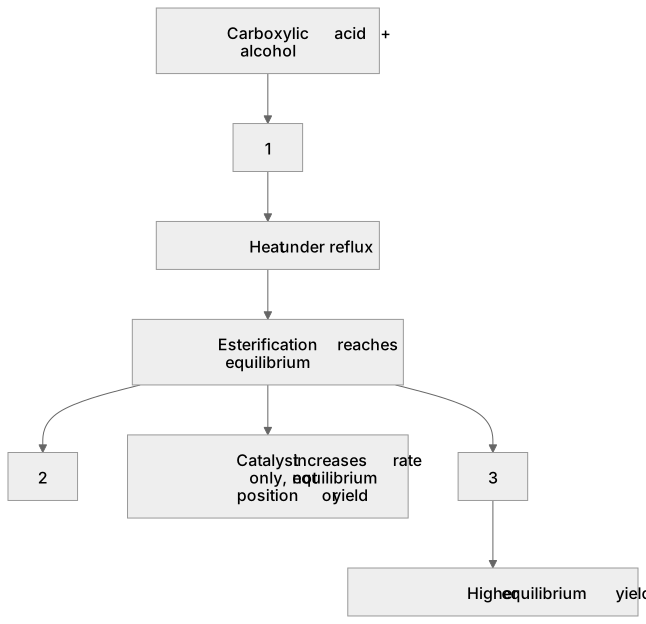
1Box 1
2Box 2
3Box 3
There is more to this lesson
The full lesson goes on to check your understanding and help you earn the marks. Create a free account to carry on, with your progress saved.
A week of Premium from your first lesson · Then the free plan continues · No card, no charge
Test your understanding of Carboxylic acids and esters: (i) carboxylic acids with alcohols in the presence of an acid catalyst (e.g. concentrated H₂SO₄)
Active recall beats re-reading. Take an instant quiz now to test what you’ve learned and lock it into long-term memory.
A week of Premium from your first lesson · Then the free plan continues · No card, no charge