OCR · A-Level · Chemistry
Course version: H432 · Version from Sept 2017
(a) explanation that a dynamic equilibrium exists in a closed system when…
Full specification wording
Chemical equilibrium: (a) explanation that a dynamic equilibrium exists in a closed system when the rate of the forward reaction is equal to the rate of the reverse reaction and the concentrations of reactants and products do not change
A dynamic equilibrium is reached only in a closed system, meaning no reactant or product can enter or leave.
- Point 2 of 8
- 4 key terms
Study notes
From the teaching notes for this specification point.
The idea
A dynamic equilibrium is reached only in a closed system, meaning no reactant or product can enter or leave. At this point the forward and reverse reactions continue at the same time, but the rate of the forward reaction equals the rate of the reverse reaction. Because the two rates match, the concentrations of reactants and products stay constant, even though particles are still reacting in both directions. The word dynamic signals that both reactions keep occurring; the word equilibrium signals the balance of rates.
For example: In a sealed vessel where hydrogen and iodine form hydrogen iodide, the forward and reverse rates become equal and the amounts of each substance stop changing, though the reactions have not stopped.
What earns the marks
- States that equilibrium requires a closed system so no substances enter or leave.
- Explains that the forward and reverse reactions both continue at equilibrium.
- Identifies that the rate of the forward reaction equals the rate of the reverse reaction.
- States that the concentrations of reactants and products remain constant.
- Distinguishes dynamic equilibrium from a reaction that has simply stopped.
Common mistakes and how to put them right
Claims that the reaction stops at equilibrium.
Put it right by stating that both reactions continue at equal rates.
States that concentrations of reactants and products become equal.
Put it right by saying the concentrations stay constant, not necessarily equal.
Describes equilibrium as possible in an open system.
Put it right by requiring a closed system.
Says only the forward reaction occurs.
Put it right by naming both forward and reverse reactions running together.
Exam tips
- Check that the option you choose mentions both equal rates and constant concentrations, since either alone is incomplete.
- Reject any option that says the reaction has stopped or that amounts are equal.
- Look for the phrase closed system, because equilibrium cannot be maintained if substances escape.
Try the lesson
The start of the Chemical equilibrium: (a) explanation that a dynamic equilibrium exists in a closed system when the rate of the forward reaction is equal to the rate of the reverse reaction and the concentrations of reactants and products do not change lesson, made from teaching notes for this specification point.
Listen
A dynamic equilibrium is reached only in a closed system, meaning no reactant or product can enter or leave. At this point the forward and reverse reactions continue at the same time, but the rate of the forward reaction equals the rate of the reverse reaction. Because the two rates match, the concentrations of reactants and products stay constant, even though particles are still reacting in both directions. The word dynamic signals that both reactions keep occurring; the word equilibrium signals the balance of rates. For example, in a sealed vessel where hydrogen and iodine form hydrogen iodide, the forward and reverse rates become equal and the amounts of each substance stop changing, though the reactions have not stopped. A strong answer earns marks for these points. States that equilibrium requires a closed system so no substances enter or leave. Explains that the forward and reverse reactions both continue at equilibrium. Identifies that the rate of the forward reaction equals the rate of the reverse reaction. States that the concentrations of reactants and products remain constant. A common slip: Claims that the reaction stops at equilibrium. Instead, stating that both reactions continue at equal rates. Exam tip: Check that the option you choose mentions both equal rates and constant concentrations, since either alone is incomplete.
See it
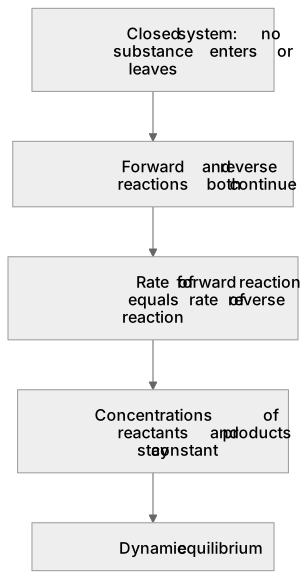
Put it in order
Put these steps in the order they happen.
- 1. Forward and reverse reactions both continue
- 2. Rate of forward reaction equals rate of reverse reaction
- 3. Closed system: no substance enters or leaves
- 4. Dynamic equilibrium
- 5. Concentrations of reactants and products stay constant
Key words
Say what each word means before you turn the card.
Closed system
Try answering aloud or in your head before turning the card.
Dynamic equilibrium
Try answering aloud or in your head before turning the card.
Equal forward and reverse rates
Try answering aloud or in your head before turning the card.
Constant concentrations
Try answering aloud or in your head before turning the card.
See every definition
- Closed system
- A system in which no reactant or product can enter or leave.
- Dynamic equilibrium
- A state in a closed system where the forward and reverse reactions continue at the same time with equal rates and constant concentrations.
- Equal forward and reverse rates
- The rate of the forward reaction equals the rate of the reverse reaction.
- Constant concentrations
- The concentrations of reactants and products do not change, even though particles are still reacting in both directions.
Label the diagram
Some boxes have lost their names. Pick the right name for each number.
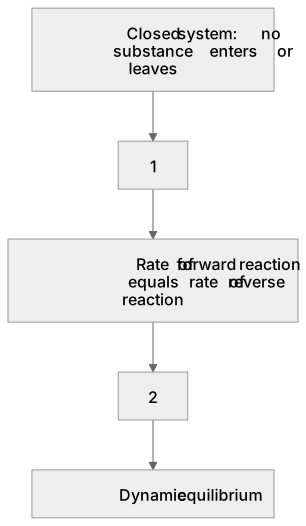
1Box 1
2Box 2
There is more to this lesson
The full lesson goes on to check your understanding and help you earn the marks. Create a free account to carry on, with your progress saved.
A week of Premium from your first lesson · Then the free plan continues · No card, no charge
Test your understanding of Chemical equilibrium: (a) explanation that a dynamic equilibrium exists in a closed system when the rate of the forward reaction is equal to the rate of the reverse reaction and the concentrations of reactants and products do not change
Active recall beats re-reading. Take an instant quiz now to test what you’ve learned and lock it into long-term memory.
A week of Premium from your first lesson · Then the free plan continues · No card, no charge