OCR · A-Level · Chemistry
Course version: H432 · Version from Sept 2017
(b) le Chatelier’s principle and its application for homogeneous…
Full specification wording
Chemical equilibrium: (b) le Chatelier’s principle and its application for homogeneous equilibria to deduce qualitatively the effect of a change in temperature, pressure or concentration on the position of equilibrium
Le Chatelier's principle states that when a system at equilibrium is disturbed, the position of equilibrium shifts to oppose the change.
- Point 3 of 8
- 4 key terms
Study notes
From the teaching notes for this specification point.
The idea
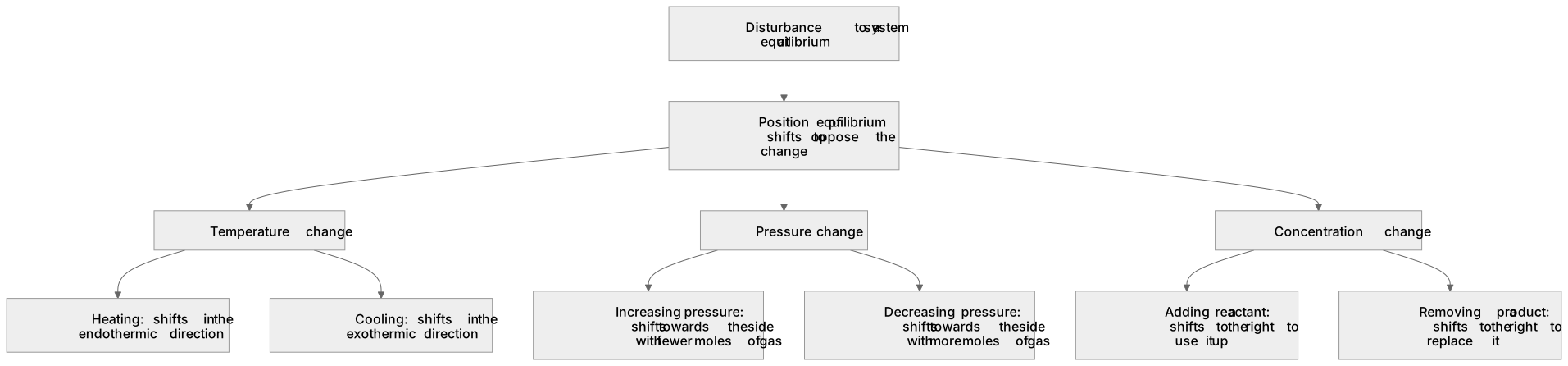
Le Chatelier's principle states that when a system at equilibrium is disturbed, the position of equilibrium shifts to oppose the change. Apply it only to homogeneous equilibria, where all species are in the same phase. For a temperature change, heating shifts equilibrium in the endothermic direction and cooling shifts it in the exothermic direction. For a pressure change, increasing pressure shifts equilibrium towards the side with fewer moles of gas, and decreasing pressure shifts it towards the side with more moles of gas. For a concentration change, adding a reactant shifts equilibrium to the right to use it up, while removing a product shifts it to the right to replace it. Deduce the direction qualitatively rather than calculating values.
What earns the marks
- States that the position of equilibrium shifts to oppose the change applied.
- Deduces that raising temperature shifts equilibrium in the endothermic direction.
- Deduces that increasing pressure shifts equilibrium towards the side with fewer moles of gas.
- Deduces that adding a reactant or removing a product shifts equilibrium to the right.
- Applies the principle only to homogeneous equilibria where all species share one phase.
Common mistakes and how to put them right
Assumes a catalyst shifts the position of equilibrium.
Put it right by stating a catalyst only speeds up attainment of equilibrium.
Applies pressure reasoning to equilibria with equal moles of gas on both sides.
Put it right by noting no shift occurs in that case.
Reverses the temperature rule.
Put it right by linking heating to the endothermic direction.
Applies the principle to a heterogeneous mixture as if all species were in one phase.
Put it right by restricting it to homogeneous equilibria.
Exam tips
- Count moles of gas on each side before deciding the direction of a pressure shift.
- Match the temperature change to the endothermic or exothermic direction using the enthalpy change sign.
- Check that the option names the correct direction of shift rather than only describing the disturbance.
Try the lesson
The start of the Chemical equilibrium: (b) le Chatelier’s principle and its application for homogeneous equilibria to deduce qualitatively the effect of a change in temperature, pressure or concentration on the position of equilibrium lesson, made from teaching notes for this specification point.
Listen
Le Chatelier's principle states that when a system at equilibrium is disturbed, the position of equilibrium shifts to oppose the change. Apply it only to homogeneous equilibria, where all species are in the same phase. For a temperature change, heating shifts equilibrium in the endothermic direction and cooling shifts it in the exothermic direction. For a pressure change, increasing pressure shifts equilibrium towards the side with fewer moles of gas, and decreasing pressure shifts it towards the side with more moles of gas. For a concentration change, adding a reactant shifts equilibrium to the right to use it up, while removing a product shifts it to the right to replace it. Deduce the direction qualitatively rather than calculating values. A strong answer earns marks for these points. States that the position of equilibrium shifts to oppose the change applied. Deduces that raising temperature shifts equilibrium in the endothermic direction. Deduces that increasing pressure shifts equilibrium towards the side with fewer moles of gas. Deduces that adding a reactant or removing a product shifts equilibrium to the right. A common slip: Assumes a catalyst shifts the position of equilibrium. Instead, stating a catalyst only speeds up attainment of equilibrium. Exam tip: Count moles of gas on each side before deciding the direction of a pressure shift.
See it
Key words
Say what each word means before you turn the card.
Le Chatelier's principle
Try answering aloud or in your head before turning the card.
Homogeneous equilibria
Try answering aloud or in your head before turning the card.
Temperature effects
Try answering aloud or in your head before turning the card.
Pressure and concentration effects
Try answering aloud or in your head before turning the card.
See every definition
- Le Chatelier's principle
- When a system at equilibrium is disturbed, the position of equilibrium shifts to oppose the change.
- Homogeneous equilibria
- Equilibria where all species are in the same phase, and the principle is applied only to these.
- Temperature effects
- Heating shifts equilibrium in the endothermic direction and cooling shifts it in the exothermic direction.
- Pressure and concentration effects
- Increasing pressure shifts equilibrium towards the side with fewer moles of gas, while adding a reactant or removing a product shifts it to the right.
Label the diagram
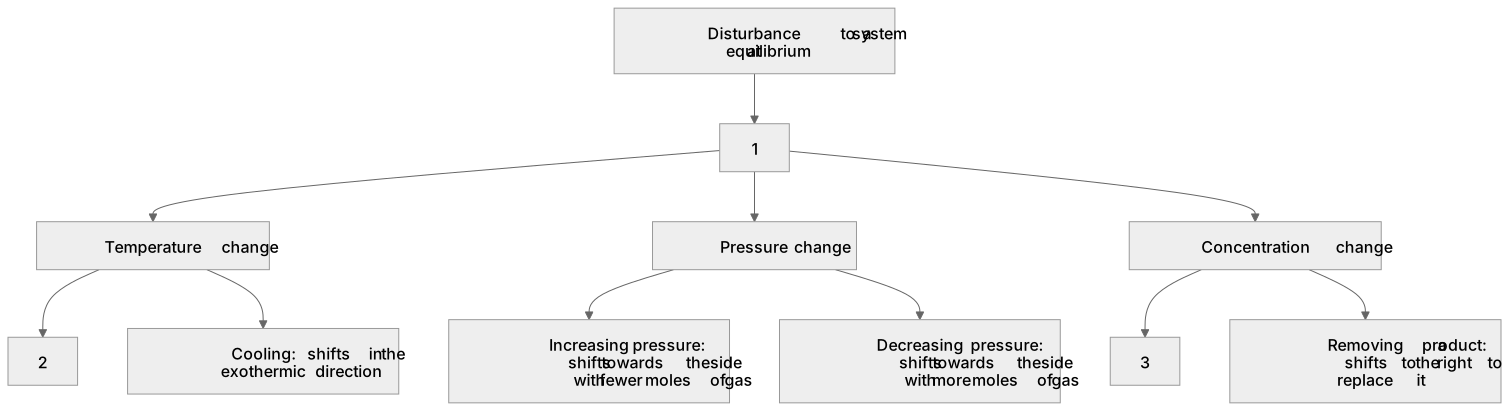
Some boxes have lost their names. Pick the right name for each number.
1Box 1
2Box 2
3Box 3
There is more to this lesson
The full lesson goes on to check your understanding and help you earn the marks. Create a free account to carry on, with your progress saved.
A week of Premium from your first lesson · Then the free plan continues · No card, no charge
Test your understanding of Chemical equilibrium: (b) le Chatelier’s principle and its application for homogeneous equilibria to deduce qualitatively the effect of a change in temperature, pressure or concentration on the position of equilibrium
Active recall beats re-reading. Take an instant quiz now to test what you’ve learned and lock it into long-term memory.
A week of Premium from your first lesson · Then the free plan continues · No card, no charge