OCR · A-Level · Chemistry
Course version: H432 · Version from Sept 2017
(i) alkenes by reaction with bromine (see also 4.1.3 f)
Full specification wording
Chromatography and qualitative analysis: (i) alkenes by reaction with bromine (see also 4.1.3 f)
This outcome covers using bromine to test for an alkene on a test-tube scale.
- Point 8 of 14
- 4 key terms
Study notes
From the teaching notes for this specification point.
The idea
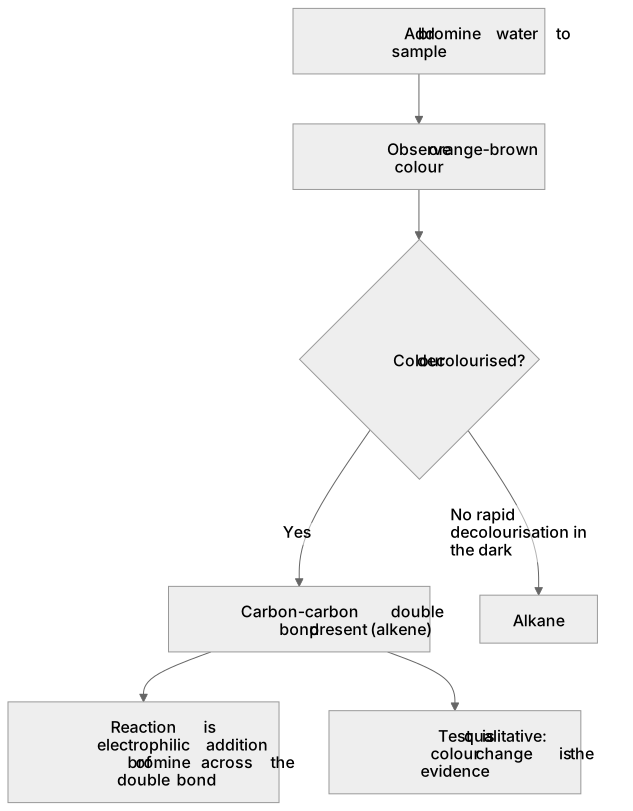
This outcome covers using bromine to test for an alkene on a test-tube scale. The learner adds bromine water to a small sample and observes the orange-brown colour being decolourised, which indicates a carbon-carbon double bond. The reaction is an electrophilic addition in which bromine adds across the double bond. The learner should distinguish this from an alkane, which gives no rapid decolourisation in the dark. The test is qualitative: the evidence is the loss of colour, not a measurement. The learner also notes that the test is carried out at room temperature and that excess bromine or light can complicate the observation.
What earns the marks
- Adds bromine water to the sample and observes whether the orange-brown colour is decolourised.
- Links decolourisation of bromine water to the presence of a carbon-carbon double bond in an alkene.
- Identifies the reaction as electrophilic addition of bromine across the double bond.
- Distinguishes an alkene from an alkane, which does not rapidly decolourise bromine water in the dark.
- States that the test is qualitative and uses the colour change as the evidence.
Common mistakes and how to put them right
States that bromine water turns clear without naming the starting colour.
Put it right: Describe the orange-brown colour being lost.
Confuses the alkene test with the test for an alkane.
Put it right: An alkane gives no rapid decolourisation in the dark.
Describes the reaction as substitution.
Put it right: Identify it as electrophilic addition across the double bond.
Exam tips
- Learn the colour change as orange-brown to colourless as the key observation.
- Name the reaction type as electrophilic addition when explaining the result.
- State the condition, room temperature in the dark, to show the test is controlled.
Try the lesson
The start of the Chromatography and qualitative analysis: (i) alkenes by reaction with bromine (see also 4.1.3 f) lesson, made from teaching notes for this specification point.
Listen
This outcome covers using bromine to test for an alkene on a test-tube scale. The learner adds bromine water to a small sample and observes the orange-brown colour being decolourised, which indicates a carbon-carbon double bond. The reaction is an electrophilic addition in which bromine adds across the double bond. The learner should distinguish this from an alkane, which gives no rapid decolourisation in the dark. The test is qualitative: the evidence is the loss of colour, not a measurement. The learner also notes that the test is carried out at room temperature and that excess bromine or light can complicate the observation. A strong answer earns marks for these points. Adds bromine water to the sample and observes whether the orange-brown colour is decolourised. Links decolourisation of bromine water to the presence of a carbon-carbon double bond in an alkene. Identifies the reaction as electrophilic addition of bromine across the double bond. Distinguishes an alkene from an alkane, which does not rapidly decolourise bromine water in the dark. Exam tip: Learn the colour change as orange-brown to colourless as the key observation.
See it
Key words
Say what each word means before you turn the card.
Bromine water test for alkenes
Try answering aloud or in your head before turning the card.
Electrophilic addition
Try answering aloud or in your head before turning the card.
Distinguishing alkenes from alkanes
Try answering aloud or in your head before turning the card.
Qualitative observation
Try answering aloud or in your head before turning the card.
See every definition
- Bromine water test for alkenes
- Adding bromine water to a small sample and observing whether the orange-brown colour is decolourised, which indicates a carbon-carbon double bond.
- Electrophilic addition
- The reaction in which bromine adds across the double bond.
- Distinguishing alkenes from alkanes
- An alkane gives no rapid decolourisation in the dark, unlike an alkene.
- Qualitative observation
- The evidence is the loss of colour, not a measurement.
Label the diagram
Some boxes have lost their names. Pick the right name for each number.
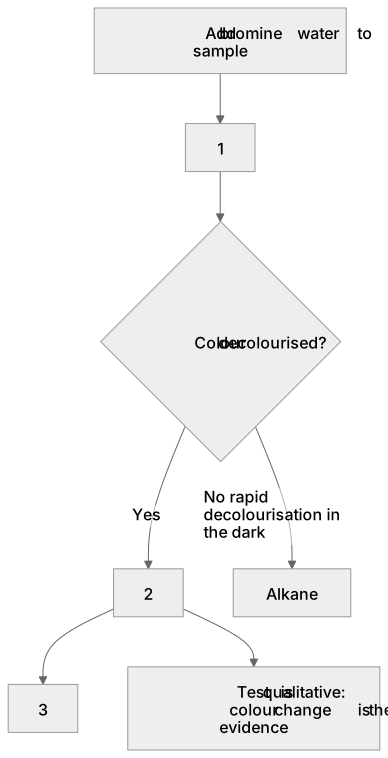
1Box 1
2Box 2
3Box 3
There is more to this lesson
The full lesson goes on to check your understanding and help you earn the marks. Create a free account to carry on, with your progress saved.
A week of Premium from your first lesson · Then the free plan continues · No card, no charge
Test your understanding of Chromatography and qualitative analysis: (i) alkenes by reaction with bromine (see also 4.1.3 f)
Active recall beats re-reading. Take an instant quiz now to test what you’ve learned and lock it into long-term memory.
A week of Premium from your first lesson · Then the free plan continues · No card, no charge