OCR · A-Level · Chemistry
Course version: H432 · Version from Sept 2017
(ii) haloalkanes by reaction with aqueous silver nitrate in ethanol (see…
Full specification wording
Chromatography and qualitative analysis: (ii) haloalkanes by reaction with aqueous silver nitrate in ethanol (see also 4.2.2 a)
This test identifies a haloalkane by warming it with aqueous silver nitrate in ethanol.
- Point 9 of 14
- 4 key terms
Study notes
From the teaching notes for this specification point.
The idea
This test identifies a haloalkane by warming it with aqueous silver nitrate in ethanol. The haloalkane undergoes nucleophilic substitution: the silver ion assists departure of the halide, and the halide ion that leaves immediately forms a silver halide precipitate. The colour of that precipitate identifies which halogen is present: silver chloride is white, silver bromide is cream and silver iodide is pale yellow. Ethanol is the solvent because the haloalkane and the aqueous silver nitrate do not mix well; ethanol brings them into one phase so the substitution can occur at a useful rate. The rate of precipitate formation also reflects the carbon–halogen bond strength, so iodoalkanes react fastest and chloroalkanes slowest. The test therefore gives both identity (from precipitate colour) and a rough reactivity order.
What earns the marks
- States that the haloalkane is warmed with aqueous silver nitrate dissolved in ethanol.
- Explains that the reaction is nucleophilic substitution in which the halide ion is released and captured by silver ions.
- Identifies the silver halide precipitate colour: white for chloride, cream for bromide and pale yellow for iodide.
- Explains that ethanol is added as a co-solvent so the haloalkane and aqueous silver nitrate mix and react.
- Links the rate of precipitate formation to carbon–halogen bond strength, with iodoalkanes reacting fastest.
Common mistakes and how to put them right
States that the silver nitrate itself replaces the halogen.
Put it right by saying the silver ion removes the released halide ion as a precipitate.
Omits the ethanol and expects the haloalkane to react with aqueous silver nitrate alone.
Put it right by naming ethanol as the co-solvent that allows mixing.
Reverses the precipitate colours.
Put it right by fixing white for silver chloride, cream for silver bromide and pale yellow for silver iodide.
Exam tips
- Name the reagent precisely as aqueous silver nitrate in ethanol, not just silver nitrate.
- Give the precipitate colour for each halide rather than only saying a precipitate forms.
- Explain the role of ethanol in one sentence so the method is fully justified.
Try the lesson
The start of the Chromatography and qualitative analysis: (ii) haloalkanes by reaction with aqueous silver nitrate in ethanol (see also 4.2.2 a) lesson, made from teaching notes for this specification point.
Listen
This test identifies a haloalkane by warming it with aqueous silver nitrate in ethanol. The haloalkane undergoes nucleophilic substitution: the silver ion assists departure of the halide, and the halide ion that leaves immediately forms a silver halide precipitate. The colour of that precipitate identifies which halogen is present: silver chloride is white, silver bromide is cream and silver iodide is pale yellow. Ethanol is the solvent because the haloalkane and the aqueous silver nitrate do not mix well; ethanol brings them into one phase so the substitution can occur at a useful rate. The rate of precipitate formation also reflects the carbon–halogen bond strength, so iodoalkanes react fastest and chloroalkanes slowest. The test therefore gives both identity (from precipitate colour) and a rough reactivity order. A strong answer earns marks for these points. States that the haloalkane is warmed with aqueous silver nitrate dissolved in ethanol. Explains that the reaction is nucleophilic substitution in which the halide ion is released and captured by silver ions. Identifies the silver halide precipitate colour: white for chloride, cream for bromide and pale yellow for iodide. Explains that ethanol is added as a co-solvent so the haloalkane and aqueous silver nitrate mix and react. A common slip: States that the silver nitrate itself replaces the halogen. Instead, saying the silver ion removes the released halide ion as a precipitate. Exam tip: Name the reagent precisely as aqueous silver nitrate in ethanol, not just silver nitrate.
See it
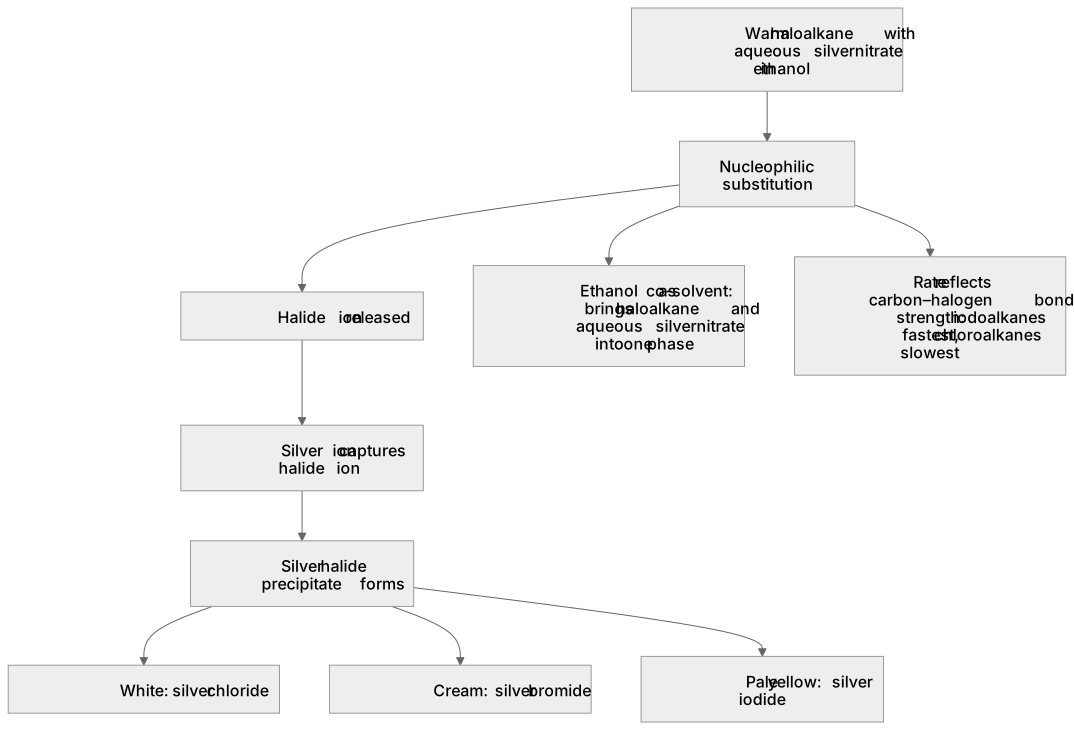
Key words
Say what each word means before you turn the card.
Nucleophilic substitution of haloalkanes
Try answering aloud or in your head before turning the card.
Silver halide precipitate colours
Try answering aloud or in your head before turning the card.
Role of ethanol as co-solvent
Try answering aloud or in your head before turning the card.
Carbon–halogen bond strength and reactivity
Try answering aloud or in your head before turning the card.
See every definition
- Nucleophilic substitution of haloalkanes
- The haloalkane undergoes nucleophilic substitution in which the silver ion assists departure of the halide and the released halide ion is captured by silver ions.
- Silver halide precipitate colours
- The colour of the precipitate identifies the halogen: silver chloride is white, silver bromide is cream and silver iodide is pale yellow.
- Role of ethanol as co-solvent
- Ethanol is added as a co-solvent because the haloalkane and the aqueous silver nitrate do not mix well, so it brings them into one phase so the substitution can occur at a useful rate.
- Carbon–halogen bond strength and reactivity
- The rate of precipitate formation reflects the carbon–halogen bond strength, so iodoalkanes react fastest and chloroalkanes slowest.
Label the diagram
Some boxes have lost their names. Pick the right name for each number.
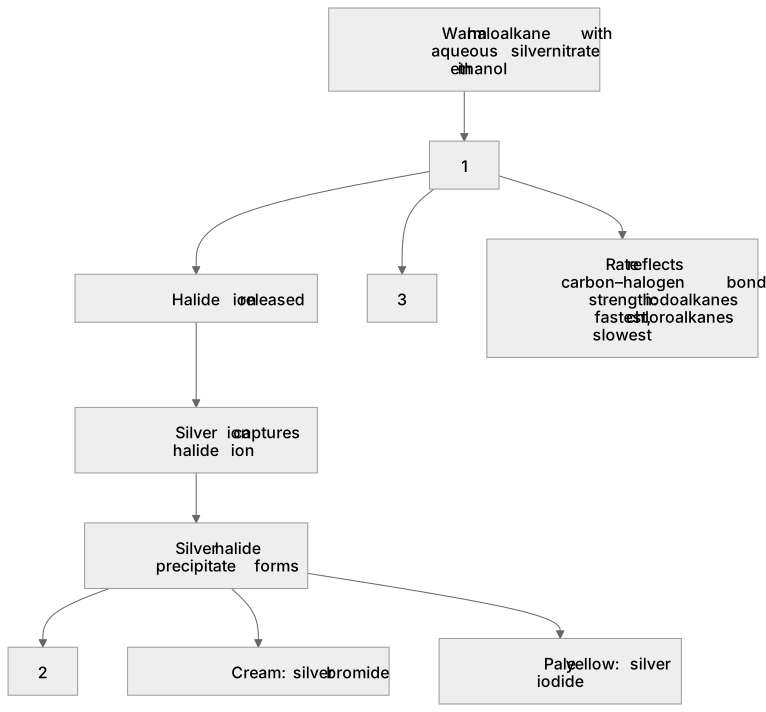
1Box 1
2Box 2
3Box 3
There is more to this lesson
The full lesson goes on to check your understanding and help you earn the marks. Create a free account to carry on, with your progress saved.
A week of Premium from your first lesson · Then the free plan continues · No card, no charge
Test your understanding of Chromatography and qualitative analysis: (ii) haloalkanes by reaction with aqueous silver nitrate in ethanol (see also 4.2.2 a)
Active recall beats re-reading. Take an instant quiz now to test what you’ve learned and lock it into long-term memory.
A week of Premium from your first lesson · Then the free plan continues · No card, no charge