OCR · A-Level · Chemistry
Course version: H432 · Version from Sept 2017
(iii) phenols by weak acidity but no reaction with CO₃²⁻ (see also 6.1.1 h)
Full specification wording
Chromatography and qualitative analysis: (iii) phenols by weak acidity but no reaction with CO₃²⁻ (see also 6.1.1 h)
This test distinguishes a phenol from a carboxylic acid by its acidity.
- Point 10 of 14
- 4 key terms
Study notes
From the teaching notes for this specification point.
The idea
This test distinguishes a phenol from a carboxylic acid by its acidity. A phenol is a weak acid: the phenoxide ion formed when it loses a proton is stabilised by delocalisation of the negative charge into the aromatic ring, but this stabilisation is less than that of a carboxylate ion, so phenol is only weakly acidic. A carboxylic acid is strong enough to react with carbonate ions, releasing carbon dioxide, whereas phenol is not. Adding sodium carbonate solution to a phenol therefore produces no effervescence, while a carboxylic acid gives visible bubbles of carbon dioxide. The test uses this difference: no reaction with CO₃²⁻ indicates a phenol rather than a carboxylic acid. Phenol does react with sodium metal and with sodium hydroxide, so those reagents do not distinguish it from a carboxylic acid.
What earns the marks
- States that phenol is a weak acid because the phenoxide ion is stabilised by delocalisation of charge into the ring.
- Explains that phenol is not acidic enough to react with carbonate ions, so no carbon dioxide is released.
- Contrasts this with a carboxylic acid, which reacts with CO₃²⁻ to give effervescence of carbon dioxide.
- Concludes that the absence of reaction with CO₃²⁻ identifies the compound as a phenol rather than a carboxylic acid.
Common mistakes and how to put them right
Claims that phenol reacts with carbonate to give carbon dioxide.
Put it right by stating that phenol is too weakly acidic to release CO₂ from CO₃²⁻.
Treats phenol as a strong acid comparable to a carboxylic acid.
Put it right by explaining that phenoxide stabilisation is weaker than carboxylate stabilisation.
Uses sodium hydroxide to distinguish phenol from a carboxylic acid.
Put it right by noting that both react with hydroxide, so carbonate is the discriminating reagent.
Exam tips
- State clearly that no effervescence is observed with carbonate, rather than saying no reaction occurs at all.
- Explain the weak acidity in terms of delocalisation of the phenoxide charge into the ring.
- Contrast the behaviour with a carboxylic acid to show why the test is useful.
Try the lesson
The start of the Chromatography and qualitative analysis: (iii) phenols by weak acidity but no reaction with CO₃²⁻ (see also 6.1.1 h) lesson, made from teaching notes for this specification point.
Listen
This test distinguishes a phenol from a carboxylic acid by its acidity. A phenol is a weak acid: the phenoxide ion formed when it loses a proton is stabilised by delocalisation of the negative charge into the aromatic ring, but this stabilisation is less than that of a carboxylate ion, so phenol is only weakly acidic. A carboxylic acid is strong enough to react with carbonate ions, releasing carbon dioxide, whereas phenol is not. Adding sodium carbonate solution to a phenol therefore produces no effervescence, while a carboxylic acid gives visible bubbles of carbon dioxide. The test uses this difference: no reaction with CO₃²⁻ indicates a phenol rather than a carboxylic acid. Phenol does react with sodium metal and with sodium hydroxide, so those reagents do not distinguish it from a carboxylic acid. A strong answer earns marks for these points. States that phenol is a weak acid because the phenoxide ion is stabilised by delocalisation of charge into the ring. Explains that phenol is not acidic enough to react with carbonate ions, so no carbon dioxide is released. Contrasts this with a carboxylic acid, which reacts with CO₃²⁻ to give effervescence of carbon dioxide. Concludes that the absence of reaction with CO₃²⁻ identifies the compound as a phenol rather than a carboxylic acid. A common slip: Claims that phenol reacts with carbonate to give carbon dioxide. Instead, stating that phenol is too weakly acidic to release CO₂ from CO₃²⁻. Exam tip: State clearly that no effervescence is observed with carbonate, rather than saying no reaction occurs at all.
See it
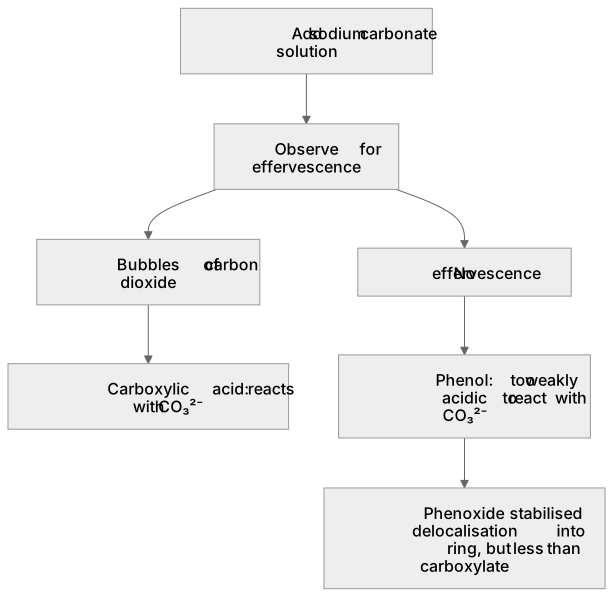
Key words
Say what each word means before you turn the card.
Weak acidity of phenols
Try answering aloud or in your head before turning the card.
Delocalisation stabilising the phenoxide ion
Try answering aloud or in your head before turning the card.
Reaction of carboxylic acids with carbonate
Try answering aloud or in your head before turning the card.
Qualitative distinction between phenol and carboxylic acid
Try answering aloud or in your head before turning the card.
See every definition
- Weak acidity of phenols
- Phenol is only weakly acidic because the phenoxide ion formed when it loses a proton is stabilised by delocalisation, but less than a carboxylate ion.
- Delocalisation stabilising the phenoxide ion
- The negative charge on the phenoxide ion is delocalised into the aromatic ring, which stabilises the ion.
- Reaction of carboxylic acids with carbonate
- A carboxylic acid is strong enough to react with carbonate ions, releasing carbon dioxide.
- Qualitative distinction between phenol and carboxylic acid
- No reaction with CO₃²⁻ indicates a phenol rather than a carboxylic acid, while a carboxylic acid gives visible bubbles of carbon dioxide.
Label the diagram
Some boxes have lost their names. Pick the right name for each number.
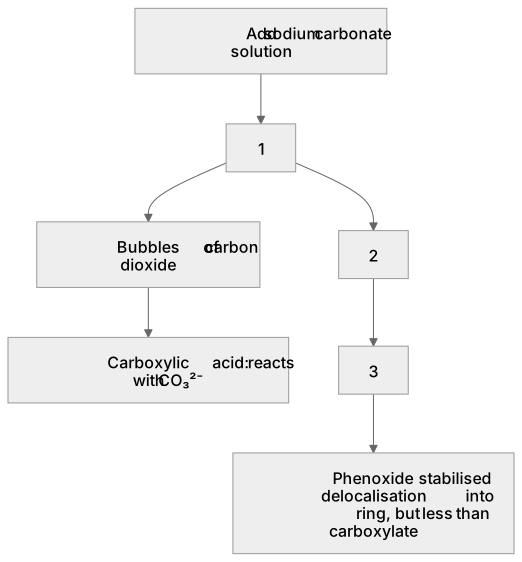
1Box 1
2Box 2
3Box 3
There is more to this lesson
The full lesson goes on to check your understanding and help you earn the marks. Create a free account to carry on, with your progress saved.
A week of Premium from your first lesson · Then the free plan continues · No card, no charge
Test your understanding of Chromatography and qualitative analysis: (iii) phenols by weak acidity but no reaction with CO₃²⁻ (see also 6.1.1 h)
Active recall beats re-reading. Take an instant quiz now to test what you’ve learned and lock it into long-term memory.
A week of Premium from your first lesson · Then the free plan continues · No card, no charge