OCR · A-Level · Chemistry
Course version: H432 · Version from Sept 2017
(v) aldehydes by reaction with Tollens’ reagent (see also 6.1.2 e)
Full specification wording
Chromatography and qualitative analysis: (v) aldehydes by reaction with Tollens’ reagent (see also 6.1.2 e)
Tollens' reagent is ammoniacal silver nitrate, [Ag(NH₃)₂]⁺, made by adding aqueous ammonia to silver nitrate until the precipitate just dissolves.
- Point 12 of 14
- 4 key terms
Study notes
From the teaching notes for this specification point.
The idea
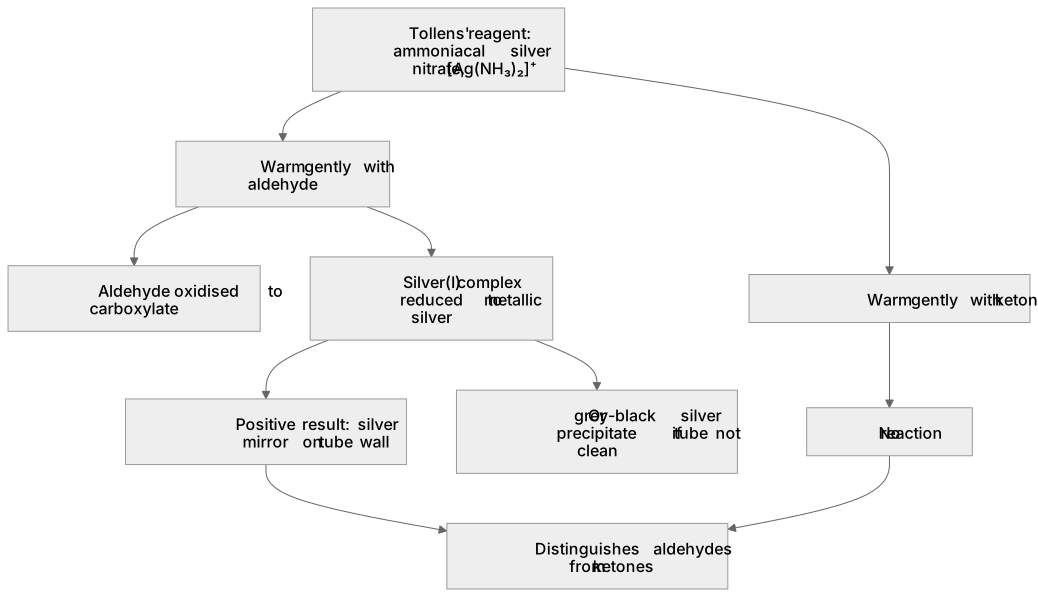
Tollens' reagent is ammoniacal silver nitrate, [Ag(NH₃)₂]⁺, made by adding aqueous ammonia to silver nitrate until the precipitate just dissolves. It is warmed gently with the aldehyde, and the aldehyde is oxidised to the corresponding carboxylate while the silver(I) complex is reduced to metallic silver. A positive result is a silver mirror on the inside of the test tube, or a grey-black precipitate of silver if the tube is not clean. Ketones do not react, so Tollens' reagent distinguishes aldehydes from ketones. In a multiple-choice question, choose the option that names the silver mirror and identifies the aldehyde as the species oxidised, and reject options describing a coloured 2,4-DNP precipitate or claiming the aldehyde is reduced.
What earns the marks
- Names Tollens' reagent as ammoniacal silver nitrate, [Ag(NH₃)₂]⁺.
- States that a positive result is a silver mirror on the tube wall or a grey-black silver precipitate.
- Explains that the aldehyde is oxidised to a carboxylate while silver(I) is reduced to silver metal.
- Recognises that ketones give no reaction, so the test distinguishes aldehydes from ketones.
- Specifies warming the aldehyde gently with the reagent to obtain the silver mirror.
Common mistakes and how to put them right
Claims that Tollens' reagent detects all carbonyl compounds.
Put it right: State that it reacts with aldehydes but not ketones.
Says the aldehyde is reduced.
Put it right: Explain that the aldehyde is oxidised and silver(I) is reduced.
Describes a yellow or orange precipitate as the positive result.
Put it right: Reserve that observation for 2,4-DNP and specify a silver mirror for Tollens'.
Omits warming the mixture.
Put it right: Include gentle warming as part of the procedure.
Exam tips
- Match the observation to the reagent: silver mirror means Tollens', coloured precipitate means 2,4-DNP.
- Check which species is oxidised and which is reduced before selecting an option.
- Reject options that claim ketones give a silver mirror with Tollens' reagent.
Try the lesson
The start of the Chromatography and qualitative analysis: (v) aldehydes by reaction with Tollens’ reagent (see also 6.1.2 e) lesson, made from teaching notes for this specification point.
Listen
Tollens' reagent is ammoniacal silver nitrate, [Ag(NH₃)₂]⁺, made by adding aqueous ammonia to silver nitrate until the precipitate just dissolves. It is warmed gently with the aldehyde, and the aldehyde is oxidised to the corresponding carboxylate while the silver(I) complex is reduced to metallic silver. A positive result is a silver mirror on the inside of the test tube, or a grey-black precipitate of silver if the tube is not clean. Ketones do not react, so Tollens' reagent distinguishes aldehydes from ketones. In a multiple-choice question, choose the option that names the silver mirror and identifies the aldehyde as the species oxidised, and reject options describing a coloured 2,4-DNP precipitate or claiming the aldehyde is reduced. A strong answer earns marks for these points. Names Tollens' reagent as ammoniacal silver nitrate, [Ag(NH₃)₂]⁺. States that a positive result is a silver mirror on the tube wall or a grey-black silver precipitate. Explains that the aldehyde is oxidised to a carboxylate while silver(I) is reduced to silver metal. Recognises that ketones give no reaction, so the test distinguishes aldehydes from ketones. Exam tip: Match the observation to the reagent: silver mirror means Tollens', coloured precipitate means 2,4-DNP.
See it
Key words
Say what each word means before you turn the card.
Tollens' reagent
Try answering aloud or in your head before turning the card.
Oxidation of aldehydes
Try answering aloud or in your head before turning the card.
Reduction of silver(I) to silver metal
Try answering aloud or in your head before turning the card.
Distinguishing aldehydes from ketones
Try answering aloud or in your head before turning the card.
See every definition
- Tollens' reagent
- Ammoniacal silver nitrate, [Ag(NH₃)₂]⁺, made by adding aqueous ammonia to silver nitrate until the precipitate just dissolves.
- Oxidation of aldehydes
- The aldehyde is oxidised to the corresponding carboxylate when warmed gently with Tollens' reagent.
- Reduction of silver(I) to silver metal
- The silver(I) complex is reduced to metallic silver, giving a silver mirror on the inside of the test tube or a grey-black precipitate if the tube is not clean.
- Distinguishing aldehydes from ketones
- Ketones do not react with Tollens' reagent, so the reagent distinguishes aldehydes from ketones.
Label the diagram
Some boxes have lost their names. Pick the right name for each number.
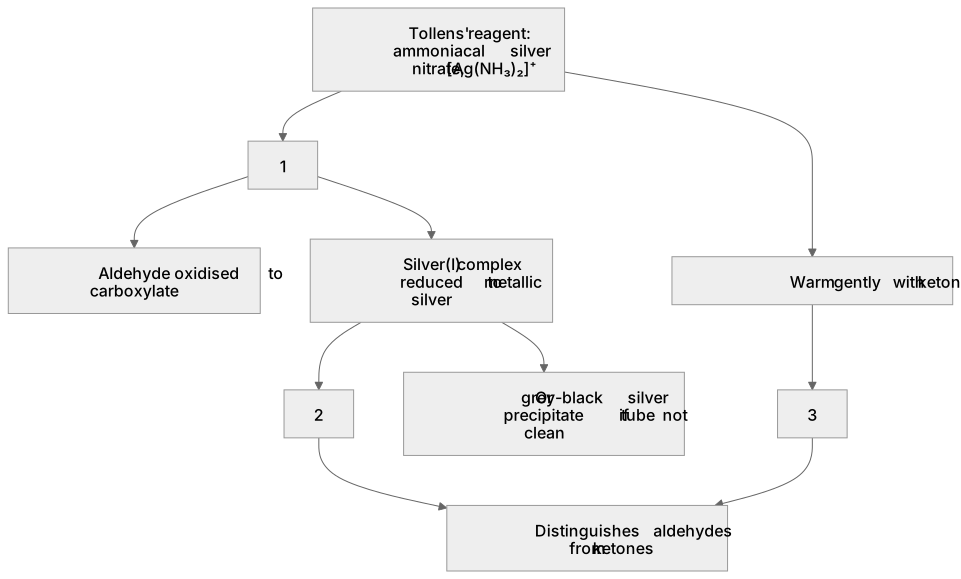
1Box 1
2Box 2
3Box 3
There is more to this lesson
The full lesson goes on to check your understanding and help you earn the marks. Create a free account to carry on, with your progress saved.
A week of Premium from your first lesson · Then the free plan continues · No card, no charge
Test your understanding of Chromatography and qualitative analysis: (v) aldehydes by reaction with Tollens’ reagent (see also 6.1.2 e)
Active recall beats re-reading. Take an instant quiz now to test what you’ve learned and lock it into long-term memory.
A week of Premium from your first lesson · Then the free plan continues · No card, no charge