OCR · A-Level · Chemistry
Course version: H432 · Version from Sept 2017
(vi) primary and secondary alcohols and aldehydes by reaction with…
Full specification wording
Chromatography and qualitative analysis: (vi) primary and secondary alcohols and aldehydes by reaction with acidified dichromate (see also 4.2.1 c, 6.1.2a)
Acidified dichromate(VI), usually written as K₂Cr₂O₇/H₂SO₄ or as Cr₂O₇²⁻ with H⁺, is an orange oxidising agent that turns green when it is reduced to Cr³⁺.
- Point 13 of 14
- 4 key terms
Study notes
From the teaching notes for this specification point.
The idea
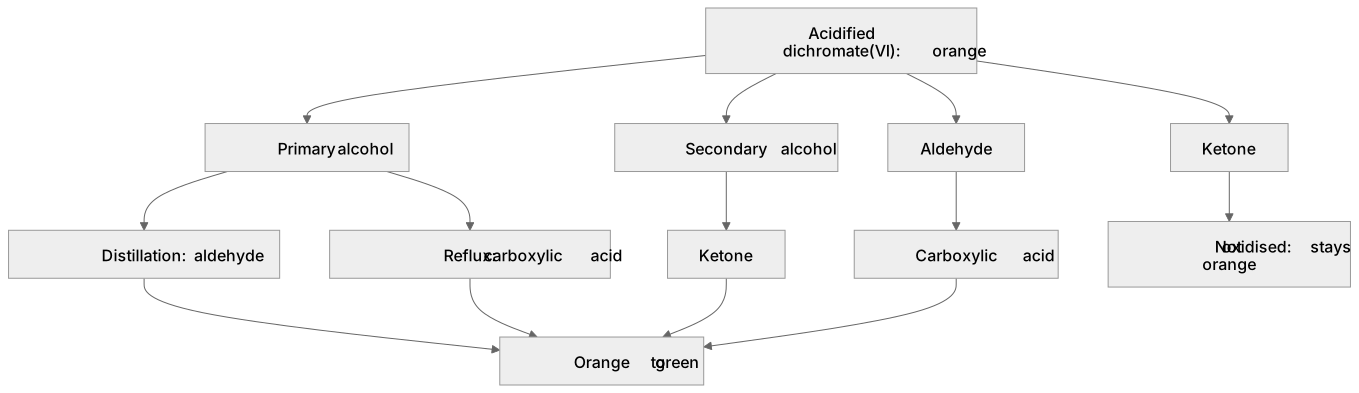
Acidified dichromate(VI), usually written as K₂Cr₂O₇/H₂SO₄ or as Cr₂O₇²⁻ with H⁺, is an orange oxidising agent that turns green when it is reduced to Cr³⁺. You use this colour change to identify which functional group is present. Warm a primary alcohol with acidified dichromate and distillation collects an aldehyde, while refluxing gives a carboxylic acid; the orange solution turns green in both cases. A secondary alcohol is oxidised to a ketone and again turns the solution green. An aldehyde is oxidised to a carboxylic acid, so it also turns the reagent from orange to green. A ketone is not oxidised, so the reagent stays orange. The test therefore distinguishes aldehydes from ketones and confirms that a primary or secondary alcohol is present.
What earns the marks
- States that acidified dichromate(VI) is an orange oxidising agent that is reduced to green chromium(III) ions.
- Identifies that a primary alcohol is oxidised to an aldehyde on distillation or to a carboxylic acid on reflux, turning the solution from orange to green.
- Identifies that a secondary alcohol is oxidised to a ketone, turning the solution from orange to green.
- Identifies that an aldehyde is oxidised to a carboxylic acid, turning the solution from orange to green.
- Distinguishes an aldehyde from a ketone because a ketone leaves the acidified dichromate(VI) orange.
Common mistakes and how to put them right
Claims that acidified dichromate(VI) decolourises when it oxidises an alcohol or aldehyde.
Put it right: State that the solution turns from orange to green as Cr³⁺ forms.
Treats a ketone as oxidised by acidified dichromate(VI).
Put it right: State that a ketone resists oxidation and the reagent stays orange.
Confuses the reagent with Fehling's or Tollens' solution.
Put it right: Keep acidified dichromate(VI) as the orange-to-green oxidising agent for alcohols and aldehydes.
Assumes a secondary alcohol gives a carboxylic acid.
Put it right: State that a secondary alcohol gives a ketone.
Exam tips
- Link each colour change to the specific functional group being oxidised, not just to 'a reaction'.
- State the initial orange colour and the final green colour explicitly rather than saying the reagent 'changes'.
- Use the ketone result as the contrast that proves the test distinguishes aldehydes from ketones.
Try the lesson
The start of the Chromatography and qualitative analysis: (vi) primary and secondary alcohols and aldehydes by reaction with acidified dichromate (see also 4.2.1 c, 6.1.2a) lesson, made from teaching notes for this specification point.
Listen
Acidified dichromate(VI), usually written as K₂Cr₂O₇/H₂SO₄ or as Cr₂O₇²⁻ with H⁺, is an orange oxidising agent that turns green when it is reduced to Cr³⁺. You use this colour change to identify which functional group is present. Warm a primary alcohol with acidified dichromate and distillation collects an aldehyde, while refluxing gives a carboxylic acid; the orange solution turns green in both cases. A secondary alcohol is oxidised to a ketone and again turns the solution green. An aldehyde is oxidised to a carboxylic acid, so it also turns the reagent from orange to green. A ketone is not oxidised, so the reagent stays orange. The test therefore distinguishes aldehydes from ketones and confirms that a primary or secondary alcohol is present. A strong answer earns marks for these points. States that acidified dichromate(VI) is an orange oxidising agent that is reduced to green chromium(III) ions. Identifies that a primary alcohol is oxidised to an aldehyde on distillation or to a carboxylic acid on reflux, turning the solution from orange to green. Identifies that a secondary alcohol is oxidised to a ketone, turning the solution from orange to green. Identifies that an aldehyde is oxidised to a carboxylic acid, turning the solution from orange to green. Exam tip: Link each colour change to the specific functional group being oxidised, not just to 'a reaction'.
See it
Key words
Say what each word means before you turn the card.
Oxidation of alcohols
Try answering aloud or in your head before turning the card.
Oxidation of aldehydes
Try answering aloud or in your head before turning the card.
Colour change of acidified dichromate(VI)
Try answering aloud or in your head before turning the card.
Distinguishing aldehydes from ketones
Try answering aloud or in your head before turning the card.
See every definition
- Oxidation of alcohols
- A primary alcohol is oxidised to an aldehyde on distillation or to a carboxylic acid on reflux, while a secondary alcohol is oxidised to a ketone.
- Oxidation of aldehydes
- An aldehyde is oxidised to a carboxylic acid, turning the solution from orange to green.
- Colour change of acidified dichromate(VI)
- Acidified dichromate(VI) is an orange oxidising agent that is reduced to green chromium(III) ions when it oxidises a primary or secondary alcohol or an aldehyde.
- Distinguishing aldehydes from ketones
- An aldehyde turns the reagent from orange to green, whereas a ketone is not oxidised so the reagent stays orange.
There is more to this lesson
The full lesson goes on to check your understanding and help you earn the marks. Create a free account to carry on, with your progress saved.
A week of Premium from your first lesson · Then the free plan continues · No card, no charge
Test your understanding of Chromatography and qualitative analysis: (vi) primary and secondary alcohols and aldehydes by reaction with acidified dichromate (see also 4.2.1 c, 6.1.2a)
Active recall beats re-reading. Take an instant quiz now to test what you’ve learned and lock it into long-term memory.
A week of Premium from your first lesson · Then the free plan continues · No card, no charge