OCR · A-Level · Chemistry
Course version: H432 · Version from Sept 2017
(vii) carboxylic acids by reaction with CO₃²⁻ (see also 6.1.3 b).
Full specification wording
Chromatography and qualitative analysis: (vii) carboxylic acids by reaction with CO₃²⁻ (see also 6.1.3 b).
Carboxylic acids can be identified by adding a carbonate, such as sodium carbonate solution or solid calcium carbonate.
- Point 14 of 14
- 4 key terms
Study notes
From the teaching notes for this specification point.
The idea
Carboxylic acids can be identified by adding a carbonate, such as sodium carbonate solution or solid calcium carbonate. A carboxylic acid is a weak acid but is strong enough to react with the carbonate ion CO₃²⁻, donating a proton to it. The reaction produces a carboxylate salt, carbon dioxide gas and water. For example, ethanoic acid reacts with sodium carbonate to give sodium ethanoate, carbon dioxide and water. The observable sign is effervescence as carbon dioxide is released; the gas turns limewater milky, confirming CO₂. This test distinguishes a carboxylic acid from most other organic compounds, though it is not unique to carboxylic acids because any acid strong enough to protonate CO₃²⁻ gives the same effervescence. In qualitative analysis the effervescence with carbonate is therefore used alongside other tests to confirm a carboxylic acid.
What earns the marks
- States that a carboxylic acid reacts with the carbonate ion CO₃²⁻ to release carbon dioxide gas.
- Identifies effervescence as the observable sign of carbon dioxide production.
- States that the carbon dioxide produced turns limewater milky, confirming the gas.
- Names the other products as a carboxylate salt and water.
- Recognises that the test is not unique to carboxylic acids because other acids also release carbon dioxide from carbonate.
Common mistakes and how to put them right
Claims that the gas released is hydrogen.
Put it right by stating that reaction with CO₃²⁻ releases carbon dioxide.
States that the test is specific to carboxylic acids.
Put it right by noting that any acid able to protonate CO₃²⁻ gives effervescence.
Omits the salt and water products.
Put it right by naming the carboxylate salt and water alongside carbon dioxide.
Describes the gas as turning limewater cloudy only if it is oxygen.
Put it right by stating that carbon dioxide turns limewater milky.
Exam tips
- Write the ionic equation showing CO₃²⁻ accepting protons and releasing CO₂ to check the products.
- Use the limewater test to confirm that the gas is carbon dioxide rather than another gas.
- Remember that the test shows acidity, not specifically a carboxylic acid, so combine it with other evidence.
Try the lesson
The start of the Chromatography and qualitative analysis: (vii) carboxylic acids by reaction with CO₃²⁻ (see also 6.1.3 b). lesson, made from teaching notes for this specification point.
Listen
Carboxylic acids can be identified by adding a carbonate, such as sodium carbonate solution or solid calcium carbonate. A carboxylic acid is a weak acid but is strong enough to react with the carbonate ion CO₃²⁻, donating a proton to it. The reaction produces a carboxylate salt, carbon dioxide gas and water. For example, ethanoic acid reacts with sodium carbonate to give sodium ethanoate, carbon dioxide and water. The observable sign is effervescence as carbon dioxide is released; the gas turns limewater milky, confirming CO₂. This test distinguishes a carboxylic acid from most other organic compounds, though it is not unique to carboxylic acids because any acid strong enough to protonate CO₃²⁻ gives the same effervescence. In qualitative analysis the effervescence with carbonate is therefore used alongside other tests to confirm a carboxylic acid. A strong answer earns marks for these points. States that a carboxylic acid reacts with the carbonate ion CO₃²⁻ to release carbon dioxide gas. Identifies effervescence as the observable sign of carbon dioxide production. States that the carbon dioxide produced turns limewater milky, confirming the gas. Names the other products as a carboxylate salt and water. A common slip: Claims that the gas released is hydrogen. Instead, stating that reaction with CO₃²⁻ releases carbon dioxide. Exam tip: Write the ionic equation showing CO₃²⁻ accepting protons and releasing CO₂ to check the products.
See it
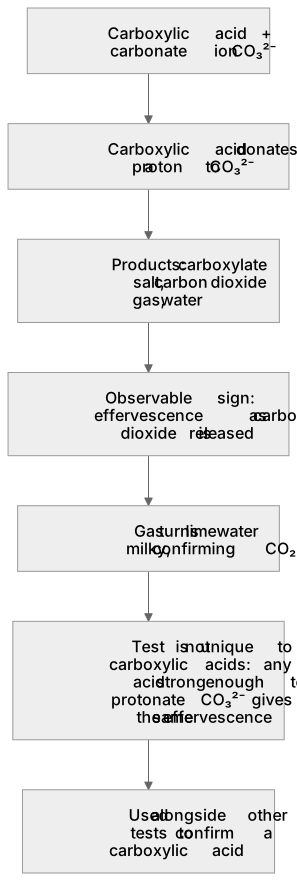
Put it in order
Put these steps in the order they happen.
- 1. Used alongside other tests to confirm a carboxylic acid
- 2. Test is not unique to carboxylic acids: any acid strong enough to protonate CO₃²⁻ gives the same effervescence
- 3. Products: carboxylate salt, carbon dioxide gas, water
- 4. Gas turns limewater milky, confirming CO₂
- 5. Carboxylic acid + carbonate ion CO₃²⁻
- 6. Carboxylic acid donates a proton to CO₃²⁻
- 7. Observable sign: effervescence as carbon dioxide is released
Key words
Say what each word means before you turn the card.
Acid–carbonate reactions
Try answering aloud or in your head before turning the card.
Carboxylic acid identification
Try answering aloud or in your head before turning the card.
Carbon dioxide test
Try answering aloud or in your head before turning the card.
Qualitative analysis
Try answering aloud or in your head before turning the card.
See every definition
- Acid–carbonate reactions
- A carboxylic acid is a weak acid but is strong enough to react with the carbonate ion CO₃²⁻, donating a proton to it.
- Carboxylic acid identification
- Carboxylic acids can be identified by adding a carbonate, such as sodium carbonate solution or solid calcium carbonate.
- Carbon dioxide test
- The observable sign is effervescence as carbon dioxide is released; the gas turns limewater milky, confirming CO₂.
- Qualitative analysis
- In qualitative analysis the effervescence with carbonate is used alongside other tests to confirm a carboxylic acid.
Label the diagram
Some boxes have lost their names. Pick the right name for each number.
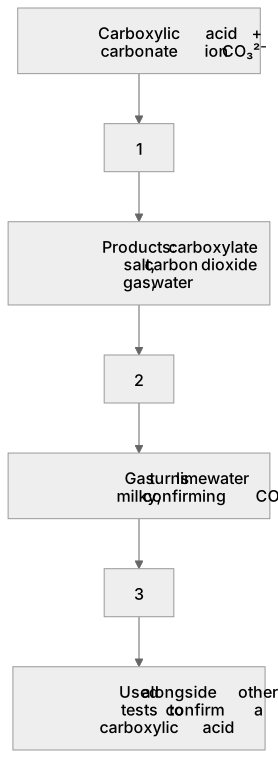
1Box 1
2Box 2
3Box 3
There is more to this lesson
The full lesson goes on to check your understanding and help you earn the marks. Create a free account to carry on, with your progress saved.
A week of Premium from your first lesson · Then the free plan continues · No card, no charge
Test your understanding of Chromatography and qualitative analysis: (vii) carboxylic acids by reaction with CO₃²⁻ (see also 6.1.3 b).
Active recall beats re-reading. Take an instant quiz now to test what you’ve learned and lock it into long-term memory.
A week of Premium from your first lesson · Then the free plan continues · No card, no charge