OCR · A-Level · Chemistry
Course version: H432 · Version from Sept 2017
(a) the number of electrons that can fill the first four shells
Full specification wording
Electron structure: (a) the number of electrons that can fill the first four shells
This criterion asks you to work out how many electrons each of the first four shells can hold.
- Point 2 of 12
- 4 key terms
Study notes
From the teaching notes for this specification point.
The idea
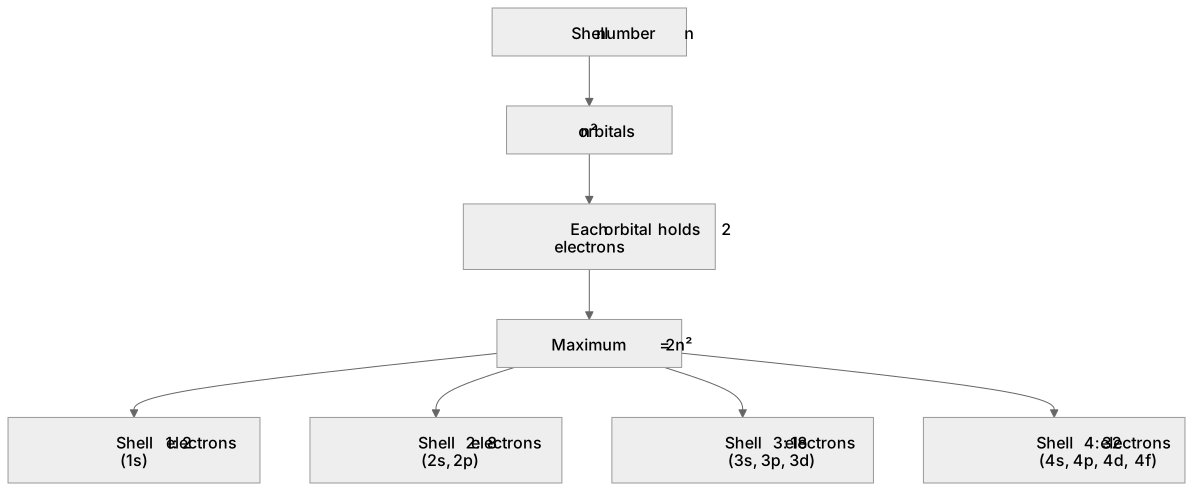
This criterion asks you to work out how many electrons each of the first four shells can hold. The nth shell contains n² orbitals, and each orbital holds two electrons, so the maximum is 2n². Shell 1 holds 2 electrons, shell 2 holds 8, shell 3 holds 18 and shell 4 holds 32. In practice the third and fourth shells are not always filled to their maximum before the next shell begins, because the 4s sub-shell fills before 3d, but the capacity of each shell is still given by 2n². Learn to calculate 2n² for n = 1 to 4 and to explain the result in terms of sub-shells: shell 1 has 1s; shell 2 has 2s and 2p; shell 3 has 3s, 3p and 3d; shell 4 has 4s, 4p, 4d and 4f.
What earns the marks
- Calculates the capacity of a shell using the expression 2n².
- States that the first shell holds a maximum of 2 electrons.
- States that the second shell holds a maximum of 8 electrons.
- States that the third shell holds a maximum of 18 electrons and the fourth holds 32.
- Explains the capacity in terms of the number of orbitals (n²) each holding two electrons.
Common mistakes and how to put them right
Assumes every shell holds eight electrons.
Put it right: Use 2n² so shell 3 holds 18 and shell 4 holds 32.
Confuses the capacity of a shell with the order in which sub-shells fill.
Put it right: Keep the two ideas separate.
Forgets to square n before doubling.
Put it right: Calculate n² first, then multiply by two.
Writes powers as baseline digits.
Put it right: Use raised superscripts such as n² and 2n².
Exam tips
- Write out n² for n = 1 to 4 before doubling to avoid arithmetic slips.
- Link each shell total to its sub-shells so your answer shows understanding, not just a number.
- Check a total by adding the maximum electrons of the sub-shells in that shell.
Try the lesson
The start of the Electron structure: (a) the number of electrons that can fill the first four shells lesson, made from teaching notes for this specification point.
Listen
This criterion asks you to work out how many electrons each of the first four shells can hold. The nth shell contains n² orbitals, and each orbital holds two electrons, so the maximum is 2n². Shell 1 holds 2 electrons, shell 2 holds 8, shell 3 holds 18 and shell 4 holds 32. In practice the third and fourth shells are not always filled to their maximum before the next shell begins, because the 4s sub-shell fills before 3d, but the capacity of each shell is still given by 2n². Learn to calculate 2n² for n = 1 to 4 and to explain the result in terms of sub-shells: shell 1 has 1s; shell 2 has 2s and 2p; shell 3 has 3s, 3p and 3d; shell 4 has 4s, 4p, 4d and 4f. A strong answer earns marks for these points. Calculates the capacity of a shell using the expression 2n². States that the first shell holds a maximum of 2 electrons. States that the second shell holds a maximum of 8 electrons. States that the third shell holds a maximum of 18 electrons and the fourth holds 32. Exam tip: Write out n² for n = 1 to 4 before doubling to avoid arithmetic slips.
See it
Key words
Say what each word means before you turn the card.
Shell capacity and the 2n² relationship
Try answering aloud or in your head before turning the card.
Number of orbitals per shell
Try answering aloud or in your head before turning the card.
Sub-shell composition of each shell
Try answering aloud or in your head before turning the card.
Distinguishing capacity from filling order
Try answering aloud or in your head before turning the card.
See every definition
- Shell capacity and the 2n² relationship
- The nth shell contains n² orbitals and each orbital holds two electrons, so the maximum number of electrons is 2n².
- Number of orbitals per shell
- The nth shell contains n² orbitals, each of which holds two electrons.
- Sub-shell composition of each shell
- Shell 1 has 1s; shell 2 has 2s and 2p; shell 3 has 3s, 3p and 3d; shell 4 has 4s, 4p, 4d and 4f.
- Distinguishing capacity from filling order
- The third and fourth shells are not always filled to their maximum before the next shell begins, because the 4s sub-shell fills before 3d, but the capacity of each shell is still given by 2n².
Label the diagram
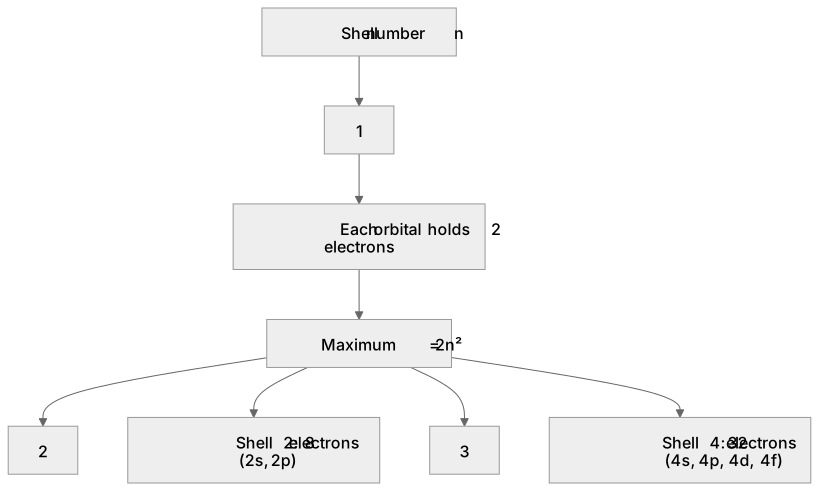
Some boxes have lost their names. Pick the right name for each number.
1Box 1
2Box 2
3Box 3
There is more to this lesson
The full lesson goes on to check your understanding and help you earn the marks. Create a free account to carry on, with your progress saved.
A week of Premium from your first lesson · Then the free plan continues · No card, no charge
Test your understanding of Electron structure: (a) the number of electrons that can fill the first four shells
Active recall beats re-reading. Take an instant quiz now to test what you’ve learned and lock it into long-term memory.
A week of Premium from your first lesson · Then the free plan continues · No card, no charge