OCR · A-Level · Chemistry
Course version: H432 · Version from Sept 2017
Electron structure: (b) atomic orbitals, including:
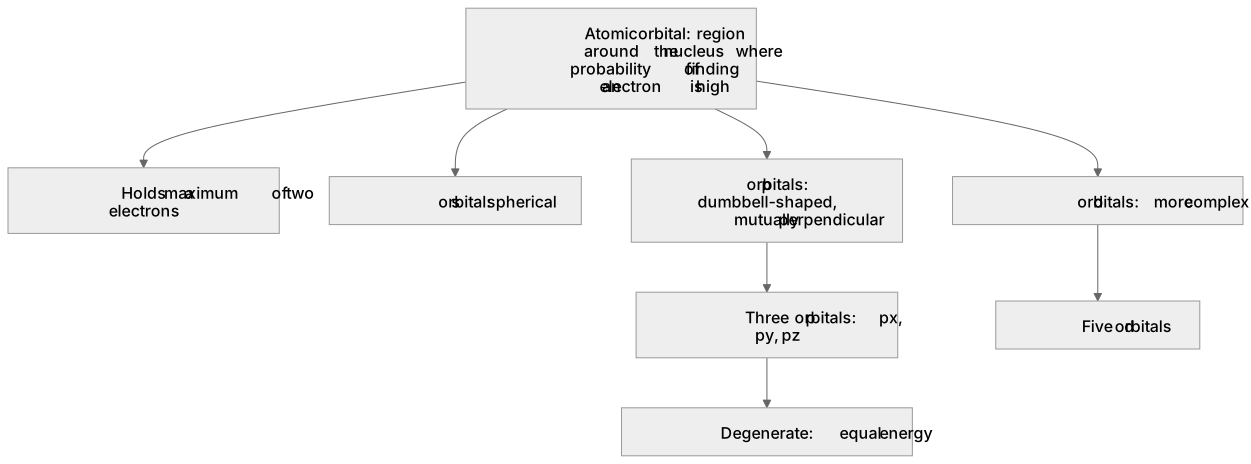
An atomic orbital is a region around the nucleus where there is a high probability of finding an electron, and it can hold a maximum of two electrons.
- Point 3 of 12
- 4 key terms
Study notes
From the teaching notes for this specification point.
The idea
An atomic orbital is a region around the nucleus where there is a high probability of finding an electron, and it can hold a maximum of two electrons. The statement introduces orbitals as a heading, so the assessed knowledge is the definition itself plus the shapes and labels of the s, p and d orbitals. An s orbital is spherical; the three p orbitals are dumbbell-shaped and mutually perpendicular, labelled px, py and pz; the five d orbitals are more complex. Each orbital holds at most two electrons, and orbitals of equal energy within a subshell are degenerate. A question may ask you to identify a shape, count orbitals in a subshell, or state the maximum electron capacity of a given type of orbital.
What earns the marks
- Defines an atomic orbital as a region around the nucleus where the probability of finding an electron is high.
- States that a single orbital holds a maximum of two electrons.
- Identifies an s orbital as spherical and a p orbital as dumbbell-shaped.
- Recognises that a p subshell contains three orbitals and a d subshell contains five orbitals.
- Applies the rule that n electrons occupy n/2 orbitals when pairing is complete.
Common mistakes and how to put them right
Confuses an orbital with a shell or subshell.
Put it right: Keep the orbital as the single region holding up to two electrons.
Claims an orbital can hold more than two electrons.
Put it right: Cap the occupancy at two.
Describes the p orbitals as spherical.
Put it right: Describe them as dumbbell-shaped and perpendicular.
Forgets that the three p orbitals are degenerate.
Put it right: State that they have equal energy.
Exam tips
- Learn the shape and label of each orbital type so a diagram question is quick.
- Count orbitals per subshell: one s, three p, five d.
- Check whether the question asks about an orbital, a subshell or a shell before answering.
- Use the phrase 'region of high probability' when defining an orbital.
Try the lesson
The start of the Electron structure: (b) atomic orbitals, including: lesson, made from teaching notes for this specification point.
Listen
An atomic orbital is a region around the nucleus where there is a high probability of finding an electron, and it can hold a maximum of two electrons. The statement introduces orbitals as a heading, so the assessed knowledge is the definition itself plus the shapes and labels of the s, p and d orbitals. An s orbital is spherical; the three p orbitals are dumbbell-shaped and mutually perpendicular, labelled px, py and pz; the five d orbitals are more complex. Each orbital holds at most two electrons, and orbitals of equal energy within a subshell are degenerate. A question may ask you to identify a shape, count orbitals in a subshell, or state the maximum electron capacity of a given type of orbital. A strong answer earns marks for these points. Defines an atomic orbital as a region around the nucleus where the probability of finding an electron is high. States that a single orbital holds a maximum of two electrons. Identifies an s orbital as spherical and a p orbital as dumbbell-shaped. Recognises that a p subshell contains three orbitals and a d subshell contains five orbitals. Exam tip: Learn the shape and label of each orbital type so a diagram question is quick.
See it
Key words
Say what each word means before you turn the card.
Atomic orbital
Try answering aloud or in your head before turning the card.
Maximum occupancy of two electrons
Try answering aloud or in your head before turning the card.
Shapes of s, p and d orbitals
Try answering aloud or in your head before turning the card.
Number of orbitals in each subshell
Try answering aloud or in your head before turning the card.
See every definition
- Atomic orbital
- A region around the nucleus where there is a high probability of finding an electron.
- Maximum occupancy of two electrons
- A single orbital holds a maximum of two electrons.
- Shapes of s, p and d orbitals
- An s orbital is spherical, the three p orbitals are dumbbell-shaped and mutually perpendicular, and the five d orbitals are more complex.
- Number of orbitals in each subshell
- A p subshell contains three orbitals and a d subshell contains five orbitals.
Label the diagram
Some boxes have lost their names. Pick the right name for each number.
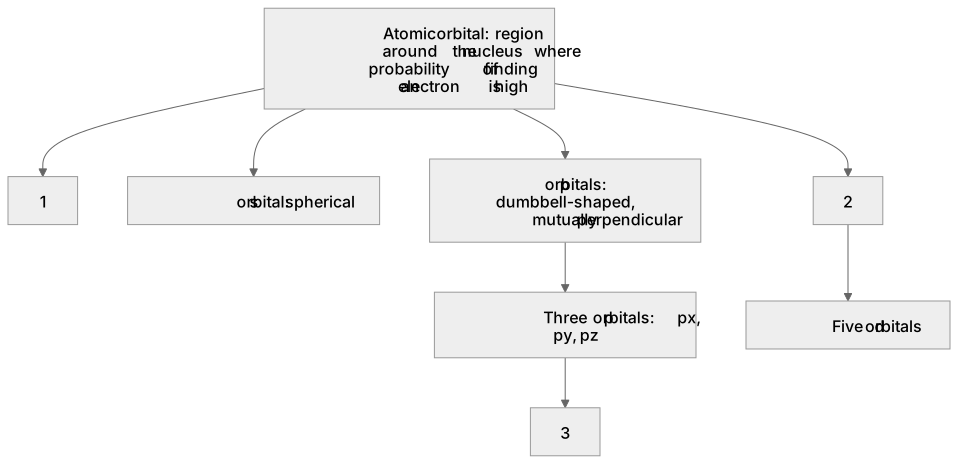
1Box 1
2Box 2
3Box 3
There is more to this lesson
The full lesson goes on to check your understanding and help you earn the marks. Create a free account to carry on, with your progress saved.
A week of Premium from your first lesson · Then the free plan continues · No card, no charge
Test your understanding of Electron structure: (b) atomic orbitals, including:
Active recall beats re-reading. Take an instant quiz now to test what you’ve learned and lock it into long-term memory.
A week of Premium from your first lesson · Then the free plan continues · No card, no charge