OCR · A-Level · Chemistry
Course version: H432 · Version from Sept 2017
(i) as a region around the nucleus that can hold up to two electrons, with…
Full specification wording
Electron structure: (i) as a region around the nucleus that can hold up to two electrons, with opposite spins
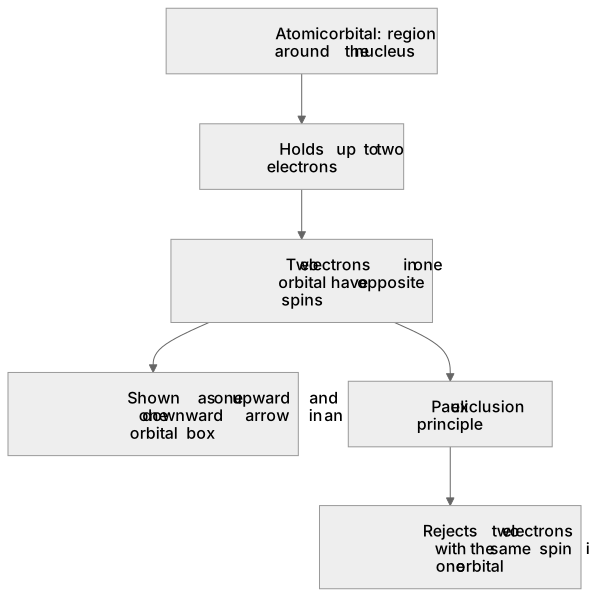
This statement defines an atomic orbital precisely: a region around the nucleus where an electron is likely to be found, holding a maximum of two electrons.
- Point 4 of 12
- 3 key terms
Study notes
From the teaching notes for this specification point.
The idea
This statement defines an atomic orbital precisely: a region around the nucleus where an electron is likely to be found, holding a maximum of two electrons. When two electrons occupy the same orbital they must have opposite spins, shown as one arrow pointing up and one pointing down. This follows the Pauli exclusion principle. In an orbital diagram, a single electron is drawn as an upward arrow; a paired orbital shows an upward and a downward arrow. A question may ask you to complete an orbital diagram, identify a valid spin pairing, or explain why two electrons in one orbital cannot have the same spin.
What earns the marks
- Defines an orbital as a region around the nucleus holding up to two electrons.
- States that the two electrons in one orbital have opposite spins.
- Represents opposite spins with one upward and one downward arrow in an orbital box.
- Applies the Pauli exclusion principle to reject two electrons with the same spin in one orbital.
Common mistakes and how to put them right
Draws two electrons in one orbital with the same spin direction.
Put it right: Show one up and one down arrow.
Places three electrons in a single orbital.
Put it right: Limit each orbital to two electrons.
Treats spin as a property of the subshell rather than of individual electrons.
Put it right: Assign spin to each electron.
Omits the spin arrows entirely in an orbital diagram.
Put it right: Include them to show pairing.
Exam tips
- Always draw spin arrows when filling orbital boxes.
- Pair electrons only after each degenerate orbital has one electron.
- Link opposite spins to the Pauli exclusion principle when explaining.
- Check the total electron count matches the atom or ion before finalising the diagram.
Try the lesson
The start of the Electron structure: (i) as a region around the nucleus that can hold up to two electrons, with opposite spins lesson, made from teaching notes for this specification point.
Listen
This statement defines an atomic orbital precisely: a region around the nucleus where an electron is likely to be found, holding a maximum of two electrons. When two electrons occupy the same orbital they must have opposite spins, shown as one arrow pointing up and one pointing down. This follows the Pauli exclusion principle. In an orbital diagram, a single electron is drawn as an upward arrow; a paired orbital shows an upward and a downward arrow. A question may ask you to complete an orbital diagram, identify a valid spin pairing, or explain why two electrons in one orbital cannot have the same spin. A strong answer earns marks for these points. Defines an orbital as a region around the nucleus holding up to two electrons. States that the two electrons in one orbital have opposite spins. Represents opposite spins with one upward and one downward arrow in an orbital box. Applies the Pauli exclusion principle to reject two electrons with the same spin in one orbital. Exam tip: Always draw spin arrows when filling orbital boxes.
See it
Key words
Say what each word means before you turn the card.
Atomic orbital
Try answering aloud or in your head before turning the card.
Opposite spins
Try answering aloud or in your head before turning the card.
Pauli exclusion principle
Try answering aloud or in your head before turning the card.
See every definition
- Atomic orbital
- A region around the nucleus that can hold up to two electrons, with opposite spins.
- Opposite spins
- The two electrons in one orbital have opposite spins, shown as one arrow pointing up and one arrow pointing down.
- Pauli exclusion principle
- Two electrons in one orbital cannot have the same spin, so opposite spins are required.
Label the diagram
Some boxes have lost their names. Pick the right name for each number.
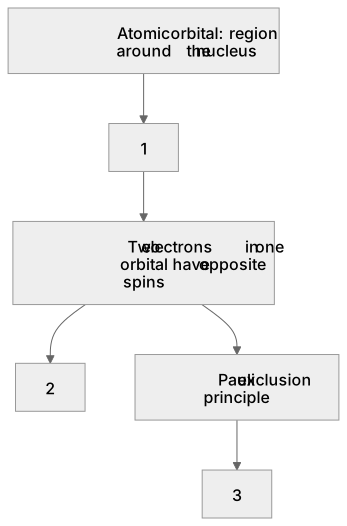
1Box 1
2Box 2
3Box 3
There is more to this lesson
The full lesson goes on to check your understanding and help you earn the marks. Create a free account to carry on, with your progress saved.
A week of Premium from your first lesson · Then the free plan continues · No card, no charge
Test your understanding of Electron structure: (i) as a region around the nucleus that can hold up to two electrons, with opposite spins
Active recall beats re-reading. Take an instant quiz now to test what you’ve learned and lock it into long-term memory.
A week of Premium from your first lesson · Then the free plan continues · No card, no charge