OCR · A-Level · Chemistry
Course version: H432 · Version from Sept 2017
(ii) for orbitals with the same energy, occupation singly before pairing
Full specification wording
Electron structure: (ii) for orbitals with the same energy, occupation singly before pairing
This rule governs how electrons fill orbitals that have the same energy, such as the three 2p orbitals or the five 3d orbitals.
- Point 9 of 12
Study notes
From the teaching notes for this specification point.
The idea
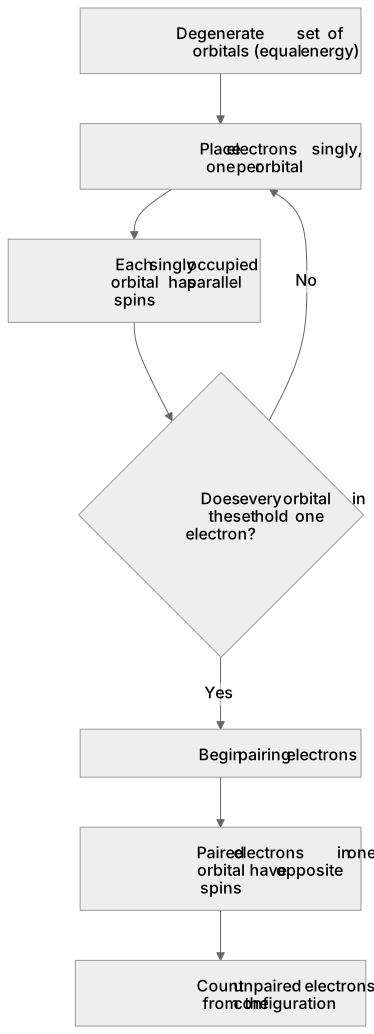
This rule governs how electrons fill orbitals that have the same energy, such as the three 2p orbitals or the five 3d orbitals. Electrons occupy these degenerate orbitals singly first, each with parallel spins, and only pair up once every orbital of that energy holds one electron. For example, nitrogen's 2p³ arrangement places one electron in each of the three 2p orbitals rather than pairing two in one orbital and leaving another empty. Oxygen adds a fourth 2p electron, which now pairs in one orbital, giving two singly occupied and one doubly occupied 2p orbital. Applying the rule correctly lets you predict unpaired electron counts, which link to magnetic behaviour and to the number of covalent bonds an atom can form.
What earns the marks
- Places electrons singly into degenerate orbitals before any pairing occurs.
- Assigns parallel spins to electrons occupying separate orbitals of equal energy.
- Pairs electrons only after each degenerate orbital holds one electron.
- Predicts the correct number of unpaired electrons for a given configuration.
Common mistakes and how to put them right
Pairs electrons in one orbital while leaving an equal-energy orbital empty.
Put it right: Fill each degenerate orbital singly first.
Gives paired electrons in separate orbitals the same spin.
Put it right: Paired electrons in one orbital must have opposite spins.
Counts unpaired electrons from the total electron number without applying the filling rule.
Put it right: Work through the degenerate set orbital by orbital.
Exam tips
- Identify the degenerate set (for example the three 2p orbitals) before placing any electrons.
- Check the unpaired-electron count at the end against the configuration you have drawn.
- Remember the rule applies to equal-energy orbitals, so do not apply it across different subshells.
Try the lesson
The start of the Electron structure: (ii) for orbitals with the same energy, occupation singly before pairing lesson, made from teaching notes for this specification point.
Listen
This rule governs how electrons fill orbitals that have the same energy, such as the three 2p orbitals or the five 3d orbitals. Electrons occupy these degenerate orbitals singly first, each with parallel spins, and only pair up once every orbital of that energy holds one electron. For example, nitrogen's 2p³ arrangement places one electron in each of the three 2p orbitals rather than pairing two in one orbital and leaving another empty. Oxygen adds a fourth 2p electron, which now pairs in one orbital, giving two singly occupied and one doubly occupied 2p orbital. Applying the rule correctly lets you predict unpaired electron counts, which link to magnetic behaviour and to the number of covalent bonds an atom can form. A strong answer earns marks for these points. Places electrons singly into degenerate orbitals before any pairing occurs. Assigns parallel spins to electrons occupying separate orbitals of equal energy. Pairs electrons only after each degenerate orbital holds one electron. Predicts the correct number of unpaired electrons for a given configuration. Exam tip: Identify the degenerate set (for example the three 2p orbitals) before placing any electrons.
See it
There is more to this lesson
The full lesson goes on to check your understanding and help you earn the marks. Create a free account to carry on, with your progress saved.
A week of Premium from your first lesson · Then the free plan continues · No card, no charge
Test your understanding of Electron structure: (ii) for orbitals with the same energy, occupation singly before pairing
Active recall beats re-reading. Take an instant quiz now to test what you’ve learned and lock it into long-term memory.
A week of Premium from your first lesson · Then the free plan continues · No card, no charge