OCR · A-Level · Chemistry
Course version: H432 · Version from Sept 2017
Electron structure: (d) deduction of the electron configurations of:
This outcome asks you to deduce electron configurations rather than simply recall them.
- Point 10 of 12
- 4 key terms
Study notes
From the teaching notes for this specification point.
The idea
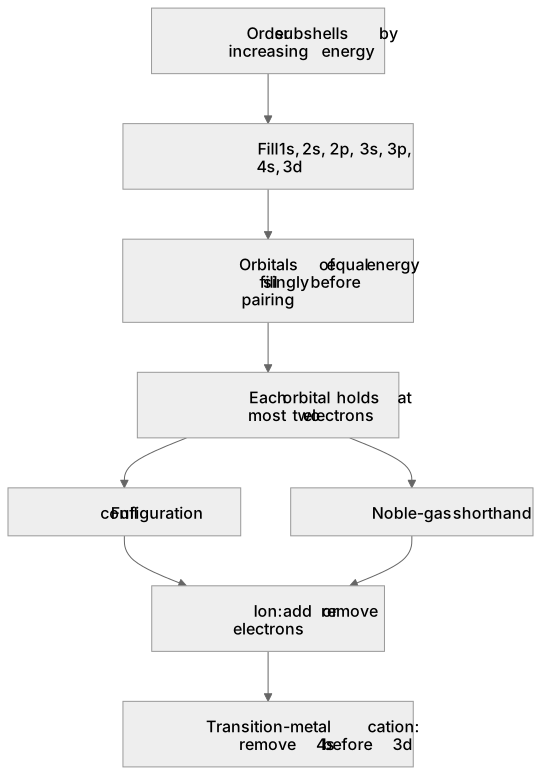
This outcome asks you to deduce electron configurations rather than simply recall them. You build a configuration by filling subshells in order of increasing energy, respecting the 1s, 2s, 2p, 3s, 3p, 4s, 3d sequence, and by applying the rules that orbitals of equal energy fill singly before pairing and that each orbital holds at most two electrons. You should be able to write configurations in full, such as 1s² 2s² 2p⁶ 3s² 3p⁶ 4s² 3d⁶ for iron, and in shorthand using a noble-gas core, such as [Ar] 4s² 3d⁶. You also deduce configurations of ions by adding or removing electrons, noting that 4s electrons are removed before 3d when transition-metal cations form.
What earns the marks
- Orders subshells by increasing energy when building a configuration.
- Writes full configurations with correct electron counts in each subshell.
- Uses noble-gas shorthand notation correctly for a given element.
- Deduces ion configurations by adding or removing the correct number of electrons.
Common mistakes and how to put them right
Fills 3d before 4s.
Put it right: Place the 4s electrons first in the filling order.
Writes shorthand notation with the wrong core.
Put it right: Match the noble gas to the electrons already accounted for.
Removes 3d electrons before 4s when forming a transition-metal cation.
Put it right: Remove 4s electrons first.
Exam tips
- Count total electrons against proton number before finalising a configuration.
- Check subshell capacities: s holds 2, p holds 6, d holds 10.
- For ions, adjust the electron total first, then refill or remove in the correct order.
Try the lesson
The start of the Electron structure: (d) deduction of the electron configurations of: lesson, made from teaching notes for this specification point.
Listen
This outcome asks you to deduce electron configurations rather than simply recall them. You build a configuration by filling subshells in order of increasing energy, respecting the 1s, 2s, 2p, 3s, 3p, 4s, 3d sequence, and by applying the rules that orbitals of equal energy fill singly before pairing and that each orbital holds at most two electrons. You should be able to write configurations in full, such as 1s² 2s² 2p⁶ 3s² 3p⁶ 4s² 3d⁶ for iron, and in shorthand using a noble-gas core, such as [Ar] 4s² 3d⁶. You also deduce configurations of ions by adding or removing electrons, noting that 4s electrons are removed before 3d when transition-metal cations form. A strong answer earns marks for these points. Orders subshells by increasing energy when building a configuration. Writes full configurations with correct electron counts in each subshell. Uses noble-gas shorthand notation correctly for a given element. Deduces ion configurations by adding or removing the correct number of electrons. Exam tip: Count total electrons against proton number before finalising a configuration.
See it
Key words
Say what each word means before you turn the card.
Electron configuration
Try answering aloud or in your head before turning the card.
Subshell filling order
Try answering aloud or in your head before turning the card.
Noble-gas shorthand
Try answering aloud or in your head before turning the card.
Ion electron configurations
Try answering aloud or in your head before turning the card.
See every definition
- Electron configuration
- Built by filling subshells in order of increasing energy, respecting the 1s, 2s, 2p, 3s, 3p, 4s, 3d sequence.
- Subshell filling order
- Subshells are filled in order of increasing energy, and orbitals of equal energy fill singly before pairing, each orbital holding at most two electrons.
- Noble-gas shorthand
- A configuration written using a noble-gas core, such as [Ar] 4s² 3d⁶, matching the noble gas to the electrons already accounted for.
- Ion electron configurations
- Deduced by adding or removing electrons, noting that 4s electrons are removed before 3d when transition-metal cations form.
Label the diagram
Some boxes have lost their names. Pick the right name for each number.
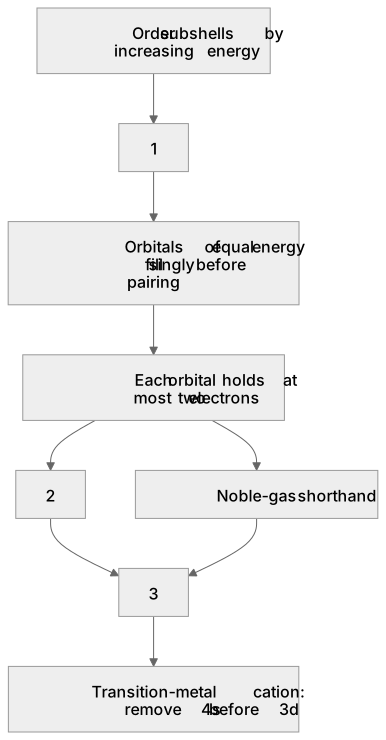
1Box 1
2Box 2
3Box 3
There is more to this lesson
The full lesson goes on to check your understanding and help you earn the marks. Create a free account to carry on, with your progress saved.
A week of Premium from your first lesson · Then the free plan continues · No card, no charge
Test your understanding of Electron structure: (d) deduction of the electron configurations of:
Active recall beats re-reading. Take an instant quiz now to test what you’ve learned and lock it into long-term memory.
A week of Premium from your first lesson · Then the free plan continues · No card, no charge